On this page
Every example below is printed in the Human Health and Disease chapter of NCERT's Class 12 Biology (Chapter 7, Reprint 2026-27), spelt as the book spells it. The NEET (UG) 2026 syllabus lists this chapter under Unit 8, Biology and Human Welfare. The questions are original, not past-paper items or predictions.
This is a study summary, not medical advice; all wording on diseases and drugs follows NCERT.
Which organisms does NCERT name in Human Health and Disease?
Bacteria (7.1): *Salmonella typhi* (typhoid); *Streptococcus pneumoniae* and *Haemophilus influenzae* (pneumonia).
Viruses (7.1, 7.3): Rhino viruses (common cold); HIV, a retrovirus (AIDS).
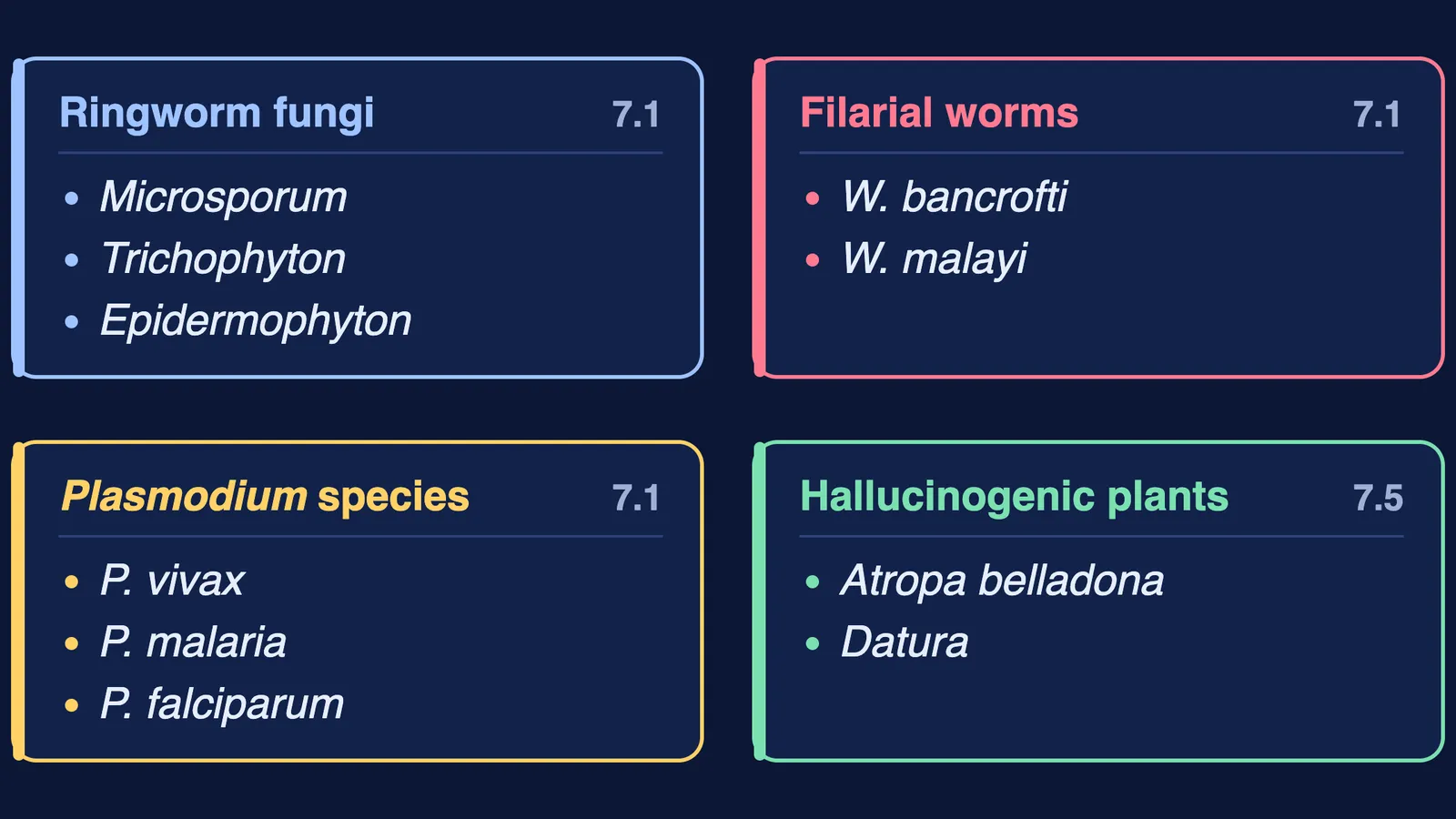
Protozoans (7.1): *Plasmodium*, with *P. vivax*, *P. malaria* and *P. falciparum* (malaria); *Entamoeba histolytica* (amoebiasis).
Helminths (7.1): *Ascaris*, the common round worm (ascariasis); *Wuchereria*, with *W. bancrofti* and *W. malayi* (filariasis or elephantiasis).
Fungi (7.1): *Microsporum*, *Trichophyton* and *Epidermophyton* (ringworm).
Vectors, carriers and a larva-eater (7.1): female *Anopheles* (vector of *Plasmodium*); female mosquito vectors (filariasis); *Aedes* mosquitoes (dengue, chikungunya); houseflies (mechanical carriers of *E. histolytica*); *Gambusia*, a fish that feeds on mosquito larvae.
Immunity and HIV sections (7.2, 7.3): mites in dust (an allergen); yeast (hepatitis B vaccine); *Mycobacterium* and *Toxoplasma* (infections as helper T-lymphocytes fall).
Drug and hallucinogen plants (7.5): *Papaver somniferum*, the poppy (morphine, heroin); *Cannabis sativa* (cannabinoids); *Erythroxylum coca* (cocaine); *Atropa belladona* and *Datura* (hallucinogenic); tobacco (nicotine).
How do you remember which example is which?
Try a route walk: picture one day and place each organism where NCERT says it reaches people. At breakfast: *Salmonella typhi*, *Entamoeba histolytica* and *Ascaris*, through contaminated food and water. On the school bus: Rhino viruses and the pneumonia bacteria, through droplets. By the pond at dusk: *Anopheles* and *Aedes* biting, with *Gambusia* eating larvae below. Then flag the misleading name: *Haemophilus influenzae* is a pneumonia bacterium.
Can you answer these NCERT example questions?
How to attack this format: name each option's group first. For "NOT" questions, mark every option T or F.
Q1. Which organism does NCERT suggest introducing into ponds to feed on mosquito larvae? (1) *Gambusia* (2) *Aedes* (3) *Anopheles* (4) *Ascaris*
Answer: (1). A vector-control measure in 7.1.
Q2. In which organism's infection does NCERT say intestinal perforation and death may occur in severe cases? (1) *Ascaris* (2) *Entamoeba histolytica* (3) *Salmonella typhi* (4) *Wuchereria bancrofti*
Answer: (3). NCERT gives this for typhoid; *Ascaris* blocks the intestinal passage instead (7.1).
Q3. Which is NOT an example of an allergen in NCERT? (1) Mites in dust (2) Pollens (3) Animal dander (4) Rhino viruses
Answer: (4). The other three are NCERT's allergen examples (7.2.5).
Q4. Which is NOT a symptom NCERT lists for the disease caused by *Streptococcus pneumoniae* and *Haemophilus influenzae*? (1) Fever and chills (2) Cough and headache (3) Lips and finger nails turning gray to bluish in severe cases (4) Nasal congestion and hoarseness
Answer: (4). Those are common cold symptoms from Rhino viruses (7.1).
Q5. Match each organism with the body site NCERT gives. List-I: A. *Salmonella typhi*; B. Rhino viruses; C. *Streptococcus pneumoniae*; D. *Entamoeba histolytica*. List-II: I. Alveoli of the lungs; II. Large intestine; III. Small intestine, then other organs through blood; IV. Nose and respiratory passage. (1) A-III, B-IV, C-I, D-II (2) A-II, B-IV, C-I, D-III (3) A-III, B-I, C-IV, D-II (4) A-IV, B-III, C-I, D-II
Answer: (1). Rhino viruses spare the lungs (7.1).
Q6. Match each organism with how NCERT says it spreads. List-I: A. Rhino viruses; B. HIV; C. *Salmonella typhi*; D. *Ascaris*. List-II: I. Passed from an infected mother to her baby across the placenta; II. Eggs in faeces contaminate soil, water and plants; III. Objects such as doorknobs and a computer keyboard; IV. Food prepared by a carrier, as with Typhoid Mary. (1) A-III, B-I, C-II, D-IV (2) A-III, B-I, C-IV, D-II (3) A-I, B-III, C-IV, D-II (4) A-IV, B-I, C-III, D-II
Answer: (2). Mary Mallon, a cook, carried typhoid (7.1).
Q7. Match each organism with its group. List-I: A. *Haemophilus influenzae*; B. Rhino viruses; C. *Entamoeba histolytica*; D. *Ascaris*. List-II: I. Helminth; II. Protozoan; III. Virus; IV. Bacterium. (1) A-III, B-IV, C-II, D-I (2) A-IV, B-III, C-I, D-II (3) A-IV, B-III, C-II, D-I (4) A-II, B-III, C-IV, D-I
Answer: (3). *H. influenzae* is a pneumonia bacterium (7.1).
Options for Q8 and Q9: (1) Both statements correct (2) Both incorrect (3) Only I correct (4) Only II correct.
Q8. Statement I: *Erythroxylum coca*, the source of cocaine, is native to South America. Statement II: Heroin, from the morphine of *Papaver somniferum*, is generally taken by oral ingestion.
Answer: (3). NCERT says heroin is generally snorted or injected (7.5).
Q9. Statement I: NCERT names *Salmonella typhi* as a protozoan. Statement II: HIV belongs to the retroviruses, which have an envelope around an RNA genome.
Answer: (4). *S. typhi* is a bacterium (7.1).
Q10. Which pair is correctly matched? (1) Rhino viruses: alveoli fill with fluid (2) *Entamoeba histolytica*: stools with excess mucous and blood clots (3) *Ascaris*: dry, scaly skin lesions with intense itching (4) *Salmonella typhi*: high fever and chill returning every three to four days
Answer: (2). The others describe pneumonia, ringworm and malaria (7.1).
Q11. Which pair is correctly matched? (1) *Papaver somniferum*: source of cocaine (2) *Cannabis sativa*: flower tops, leaves and resin give marijuana, hashish, charas and ganja (3) *Erythroxylum coca*: acts on cannabinoid receptors (4) Tobacco: nicotine lowers blood pressure
Answer: (2). Nicotine raises blood pressure; cocaine affects dopamine transport (7.5).
What should you practise next?
Redo the set with answers covered and rebuild the eight groups from memory. Then try the two-statement and match-the-list questions for this chapter, the NCERT exceptions and odd-one-out questions and the sequence and order questions.
Which group keeps slipping? Fermi's AI tutor works out what you already know and builds a plan for the session.