On this page
Mix acetone with free hydroxylamine at 0 °C and half has become acetoxime after about 27 minutes. Add about half an equivalent of hydrochloric acid and the half-way point comes in little more than a minute. Add more acid and it slows down again. Ernest Barrett and Arthur Lapworth, at Goldsmiths' College, New Cross, London, measured that rise and fall in 1908. Their paper is "The Influence of Acids and Alkalis on the Velocity of Formation of Acetoxime", J. Chem. Soc. Trans. 93, 85–93. We read it in the scanned 1908 volume and checked the figures below against the page images, since the scan's text layer misreads some. The paper gives nothing about Barrett beyond his name. Lapworth's earlier work is in Arthur Lapworth, 1903: the colour clock that showed CN⁻ attacks.
How did Barrett and Lapworth follow the reaction?
The reaction is the oxime formation you meet in Class 12:
(CH₃)₂C=O + NH₂OH → (CH₃)₂C=N–OH + H₂O
Check: C 3 and 3, H 9 and 9, N 1 and 1, O 2 and 2.
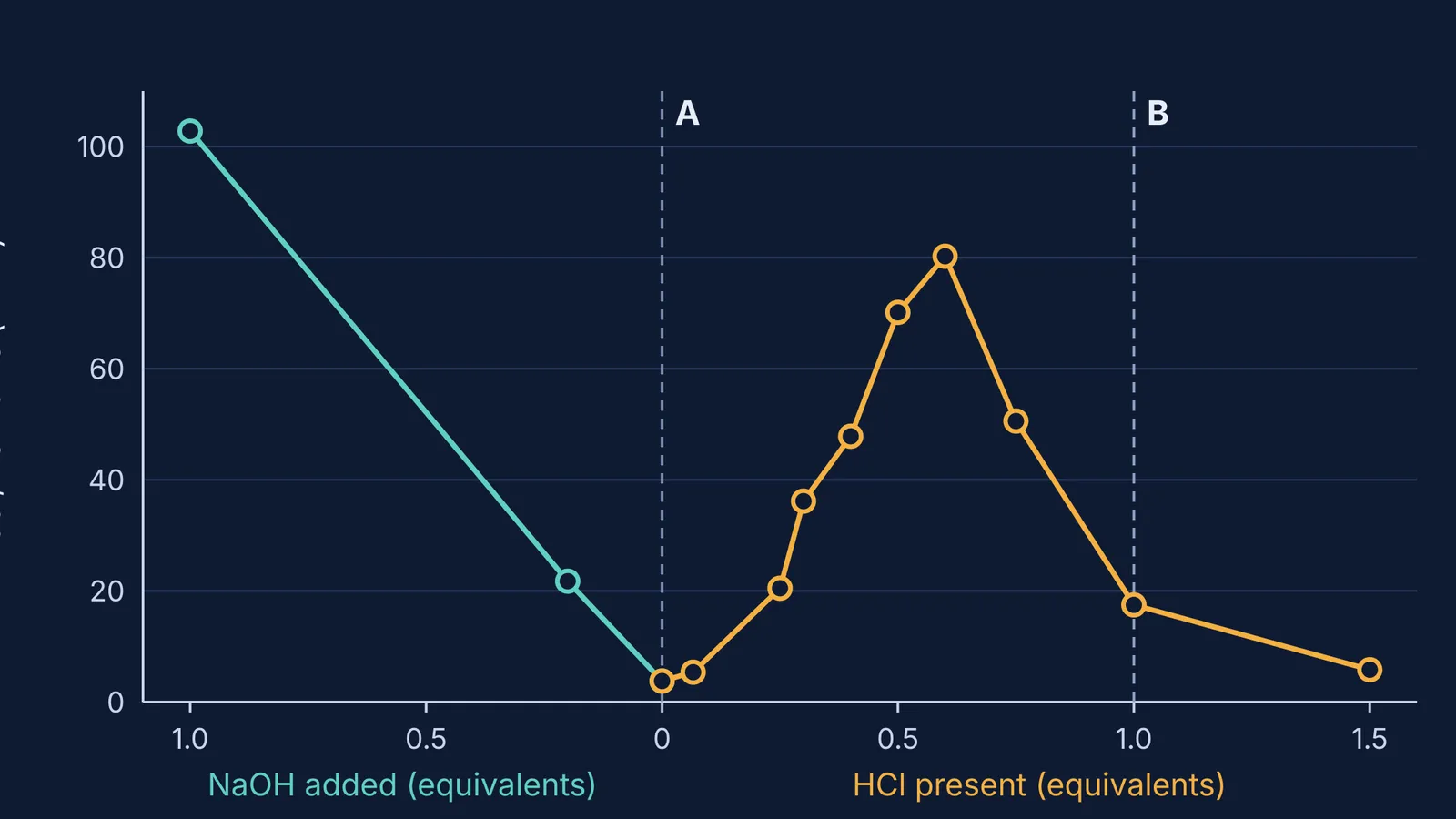
Acetone and total hydroxylamine were both N/40 (0.025 mol L⁻¹) after mixing. They started from the hydrochloride and added NaOH or extra HCl, so "0 equivalent of HCl" means free hydroxylamine (line A on their graph), and "1.00 equivalent" means the hydrochloride alone (line B). They titrated the hydroxylamine left with standard iodine at timed intervals. Oxime formed is 100 minus what was left, so 100 means complete. They judged the results "correct within 2—3 units".
What did the rate do as acid was added?
Oxime formed at 2 minutes, from their tables:
1.00 equivalent of NaOH: 64.3
free hydroxylamine (run I): 5.8
0.30 equivalent of HCl: 34.5
0.50 equivalent of HCl: 49.8
1.00 equivalent of HCl: 16.3
Their summary: the rate is lowest with free hydroxylamine. Alkali speeds it up, nearly in proportion to the amount. Acid speeds it up to a maximum "where there is present about 0·5 to 0·6 equivalent of acid", with "the velocity here being more than fifty times as great as with free hydroxylamine alone". Beyond that the rate falls fast, yet even with 40 proportions of HCl oxime still forms "with considerable velocity".
The end points fell too: 99.5 with free hydroxylamine, but 85.8 at 0.30 equivalent of acid, 71.0 at 0.50 and 60.5 at 1.00. Acid also hydrolyses the oxime back, so the reaction settles at an equilibrium. That is the "reversible" in NCERT's line on carbonyls with ammonia derivatives.
How fast is "more than fifty times"?
Because acidity changed during each run, they used no rate constants. They plotted 100 divided by the time to go half-way to the end point.
Free hydroxylamine. Half of 99.5 is 49.75, between 43.7 at 20 min and 52.9 at 30 min. t½ = 20 + 10 × (49.75 − 43.7)/(52.9 − 43.7) = 26.6 min. Their measure is 100/26.6 = 3.8.
0.30 equivalent HCl. Half of 85.8 is 42.9, between 34.5 at 2 min and 67.4 at 5 min. t½ = 2.8 min, so 100/t½ = 36.
0.60 equivalent HCl. Half of 69.4 is 34.7, between 31.6 at 1 min and 44.2 at 2 min. t½ ≈ 1.25 min, so 100/t½ ≈ 80.
The fastest runs were half done before the first sample, so these are rough. The highest points on the authors' own graph sit near 100, about 26 times run I. Their text says "more than fifty". They admitted it was "difficult to state precisely" the size of the maximum. The sharp peak between A and B is the solid result.
Is it second order? Worked example: k for free hydroxylamine
Changing one concentration at a time, they found the rate "nearly proportional to the concentration of each" reactant. So rate = k[acetone][NH₂OH]. With equal starting concentrations, the integrated law is 1/[A] − 1/[A]₀ = kt. Run I, with no acid, is the cleanest case.
At 10 min, the fraction reacted is x = 29.2/99.5 = 0.293.
[A] = 0.025 × (1 − 0.293) = 0.01766 mol L⁻¹.
1/[A] − 1/[A]₀ = 56.62 − 40.00 = 16.6 L mol⁻¹.
k = 16.6 ÷ 10 = 1.66 L mol⁻¹ min⁻¹.
The same working gives 1.65 at 5 min, 1.57 at 20 min and 1.51 at 30 min, about 1.6 on average. The 2-minute point (1.24) is the one most hurt by timing error. Check: for second order, t½ = 1/(k[A]₀) = 1/(1.6 × 0.025) = 25 min, close to the 26.6 min read from the table. See [how to recognise a second-order reaction from a 1/[A] plot](https://news.fermi.ai/academic-success/second-order-kinetics-1-over-a-plot) for the graph method.
Where is the maximum in pH terms?
pH was not measured in 1908, so this is a reconstruction. Take pKa of NH₃OH⁺ as 5.94 at 25 °C, as PubChem lists from the CRC Handbook. We have no value for 0 °C, so these are rough.
Free base, 0.025 M. pKb = 14 − 5.94 = 8.06. [OH⁻] = √(Kb × 0.025), so pH ≈ 9.2.
0.50 equivalent HCl. Half the base is NH₃OH⁺, so pH = pKa = 5.94.
0.60 equivalent. pH = 5.94 + log(0.40/0.60) = 5.76.
Hydrochloride alone. pH = ½(pKa − log c) = ½(5.94 + 1.60) = 3.77.
So the peak sits near half-neutralisation, around pH 6, between the free base and the salt. The often-quoted pH 4.5 for this reaction refers to different conditions, so do not set the two against each other.
Why does acid help and then hurt?
Acree and Johnson had proposed that NH₃OH⁺ itself adds to acetone. Barrett and Lapworth objected that "only negative groups become attached to the carbon atom of the carbonyl group". Their suggestion was that H⁺ adds to acetone, giving (CH₃)₂C⁺–OH, and this ion is attacked by free NH₂OH.
Test that with numbers. The rate would follow [H⁺] × (fraction of hydroxylamine free). The free fraction is Ka/(Ka + [H⁺]). Relative to its limit, the product is 0.0005 at pH 9.2, 0.47 at pH 6.0, 0.60 at pH 5.76 and 0.99 at pH 3.8. It climbs, then levels off, but never falls. Yet the hydrochloride alone (pH 3.8, 100/t½ ≈ 17.5) ran about four times slower than the half-neutralised mixture. They saw the gap themselves: neither view "explains the curious variation of the velocity between the points A and B".
Today's textbook picture: acid helps remove water from the addition product, but the attacking nitrogen must be unprotonated, and at pH 3.8 only about 0.7% of the hydroxylamine is free.
They never finished: when Acree asked them to leave the field to him, they "agreed to abandon the further study" of oxime rates.
Where does this show up in JEE and NEET?
Class 12 Aldehydes and Ketones: ammonia derivatives and the pH condition.
Class 11 Equilibrium: pH = pKa at half-neutralisation.
Class 12 Kinetics: second-order law and half-life.
To practise half-life and buffer numericals like these, the Fermi Problem Library has a step-by-step solver that explains the reasoning.
Quick checklist
Acetoxime at 0 °C, N/40: slowest with free NH₂OH, t½ ≈ 26.6 min.
Peak at about 0.5–0.6 equivalent of HCl, near pH = pKa ≈ 6 by our estimate.
Free-base run is second order, k ≈ 1.6 L mol⁻¹ min⁻¹.
More acid, lower end point: the oxime hydrolyses back.
Acid activates C=O, but the attacking nitrogen must be free.