On this page
In 1900 James Walker of University College, Dundee, printed a worked example in which a bottle of air held 3.31 volumes of carbon dioxide in 10,000 volumes of air, or 331 parts per million. The number came from a small change to an old method: he sent his alkali straight into acid before it could absorb the CO₂ in his own breath. The arithmetic is a Class 11 back titration you can do yourself.
What did Walker measure, and what does 3.31 in 10,000 mean?
The paper is J. Walker, "Estimation of Atmospheric Carbon Dioxide", J. Chem. Soc. Trans. 77 (1900) 1110–1114. We read it in the scanned 1900 volume and checked the numbers against the page images. Walker's earlier kinetics work is in Walker and Hambly's 1895 study of why cyanate to urea is second order.
One part in 10,000 is 100 parts per million, so 3.31 parts in 10,000 is 331 ppm by volume.
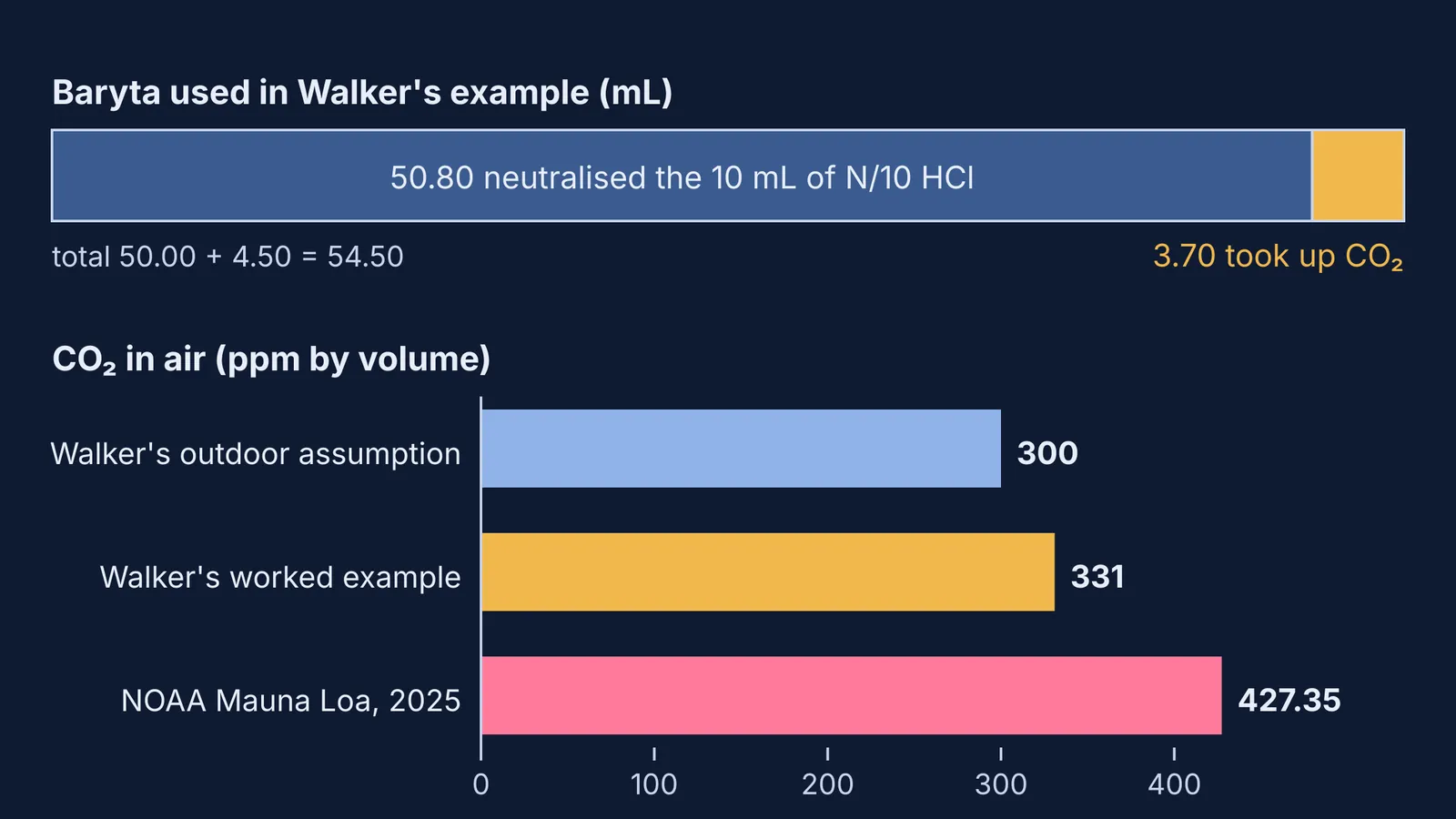
Be careful with that number. It is his worked example, and the paper does not say where or when that bottle was filled. The only value he gives for outdoor air is a round assumption: when warm factory air needs a correction, he says to assume "the external air contains 3 vols. in 10,000", which is 300 ppm. Neither number is a measured global level for 1900.
Why did Pettenkofer's method read too high?
Pettenkofer's method shakes air with baryta (barium hydroxide solution) and titrates the baryta left over. Walker's first sentence explains the problem: the results were "almost invariably too high from absorption of carbon dioxide from expired air during the process of titration."
Any CO₂ from the chemist's breath that dissolves during that titration uses up baryta, and the missing baryta is counted as CO₂ from the sample.
Mr John Foggie, who had "a very large experience of the method", ran the old method on samples collected at the same time as Walker's. The pairs (Pettenkofer, then Walker, in parts per 10,000) were:
4.4 and 3.7, a difference of 0.7, or 70 ppm
4.1 and 3.5, a difference of 0.6, or 60 ppm
26.4 and 26.2, a difference of 0.2, or 20 ppm
At ordinary levels the old method read about 17–19% high.
How does the back titration keep breath out?
Absorb. Run 50 c.c. of baryta, about 0.02 normal, into a dry Winchester quart bottle of known volume. Close it and shake it from time to time for 15 minutes: Ba(OH)₂ + CO₂ → BaCO₃ + H₂O.
Filter straight into acid. Suck the liquid through an asbestos filter into a flask holding 10 c.c. of decinormal HCl. In Walker's words, the clear baryta "is at once neutralised by the hydrochloric acid": Ba(OH)₂ + 2HCl → BaCl₂ + 2H₂O. The BaCO₃ stays behind on the filter.
Wash. Rinse the bottle three times with water that has already been neutralised to phenolphthalein, so the wash water brings in no CO₂ of its own.
Back titrate. Titrate the acid that is left with the same baryta.
The paper does not spell out why this works, but the chemistry does: the leftover alkali becomes acid before it stands open to the air, and an acid solution does not take up CO₂.
Worked example: from 3.70 mL of baryta to 331 ppm
These are Walker's own data from page 1112.
Strength of the baryta. 10 c.c. of 0.1 N HCl is 1 milliequivalent (meq). It needed 50.80 c.c. of baryta, so the baryta is 1 ÷ 50.80 = 0.01969 N.
CO₂ per mL of baryta. Ba(OH)₂ has two OH⁻, so its n-factor is 2. One mole of CO₂ uses one mole of Ba(OH)₂, which is 2 equivalents. So 1 meq of baryta takes up 0.5 mmol of CO₂, which is 11.2 mL at NTP (using 22.4 L per mol). Per mL of baryta: 11.2 ÷ 50.80 = 0.2205 mL of CO₂. That matches his printed 0.2205.
Baryta used by the CO₂. Total baryta: 50.00 in the bottle plus 4.50 in the back titration = 54.50 mL. The acid accounts for 50.80 mL, so 54.50 − 50.80 = 3.70 mL went into BaCO₃.
Volume of CO₂. 3.70 × 0.2205 = 0.816 mL at NTP, or 0.0364 mmol.
Volume of air. 2650 c.c. bottle − 50 c.c. baryta = 2600 c.c. of air, collected at 15 °C.
Correct for temperature. Walker uses 10,540 as the volume at 15 °C of 10,000 volumes of air at 0 °C. So CO₂ per 10,000 = 0.816 × 10,540 ÷ 2600 = 3.31, which is 331 ppm.
Charles's law gives 10,000 × 288 ÷ 273 = 10,549, slightly more than his printed 10,540; either way the answer rounds to 3.31. His formula corrects for temperature only.
How accurate was Walker's method?
He claimed an error of less than 0.1 part in 10,000, which is 10 ppm, and he tested it three ways.
Blanks. He filled the bottle with air "perfectly free from carbon dioxide" and ran the whole procedure. He found 0.09, 0.02 and 0.05 parts in 10,000, or 9, 2 and 5 ppm.
A known amount. He put 1.89 c.c. of CO₂, measured at 19° and 761 mm, into the empty bottle. That is 1.89 × (273/292) × (761/760) = 1.77 c.c. at NTP, as he printed. He found 1.78 c.c., an error he gives as 0.04 parts in 10,000.
In this bottle, 0.1 part in 10,000 is 0.1 × 2600 ÷ (0.2205 × 10,540) = 0.11 mL of baryta, about two drops. The 50 mL of baryta (0.98 meq) covers about 44.7 parts in 10,000, which fits his stated range of 0 to 40.
How does Walker's number compare with today's CO₂?
NOAA's Mauna Loa annual mean file gives 427.35 ppm for 2025.
Against Walker's assumed outdoor value of 300 ppm: 427.35 ÷ 300 = 1.42, a rise of about 42%.
The same 2600 mL bottle at 15 °C filled at 427.35 ppm would need 4.2735 × 2600 ÷ (0.2205 × 10,540) = 4.78 mL of baryta instead of 3.70 mL.
Keep the comparison honest: Mauna Loa reports dry air at a remote mountain station, while Walker's 331 ppm is one sample of unknown origin and his 300 ppm a rounded assumption. For how the modern record began, read Charles Keeling and the carbon dioxide curve.
Where does this come up in JEE and NEET?
Class 11, Some Basic Concepts of Chemistry: equivalents, n-factor of a diacidic base, and back titration.
Class 11, States of Matter: Charles's law to correct a gas volume to 0 °C, and ppm by volume.
The limewater test: baryta behaves like limewater, Ca(OH)₂; see why limewater turns milky, then clear, with excess CO₂.
For more numericals like this, Fermi Test Prep covers JEE Main and Advanced preparation with an AI tutor.
Quick checklist
3.31 parts in 10,000 = 331 ppm, from a sample of unstated origin.
His outdoor assumption was 3 in 10,000, or 300 ppm; NOAA's 2025 Mauna Loa mean is 427.35 ppm.
1 meq of Ba(OH)₂ absorbs 0.5 mmol of CO₂, which is 11.2 mL at NTP.
Baryta used by CO₂ = total baryta − baryta neutralised by the acid.
Correct the air volume to 0 °C before you divide.