On this page
The NMC's NEET (UG) 2026 syllabus puts animal classification under Unit 1 (Diversity in Living World) of Biology, and asks for at least two examples per non-chordate phylum and per chordate class. Example questions hand you a Latin name and ask its group, or the reverse.
This set uses only the organisms named in Chapter 4, Animal Kingdom, of NCERT Class 11 Biology (Reprint 2026-27), spelt as NCERT spells them. Part 1 sorts them into ten groups; Part 2 has 12 original questions. None is from a past paper or a prediction.
Which example organisms does NCERT name in Animal Kingdom?
Bracketed common names are NCERT's; "text" marks names from the description, not the Examples line.
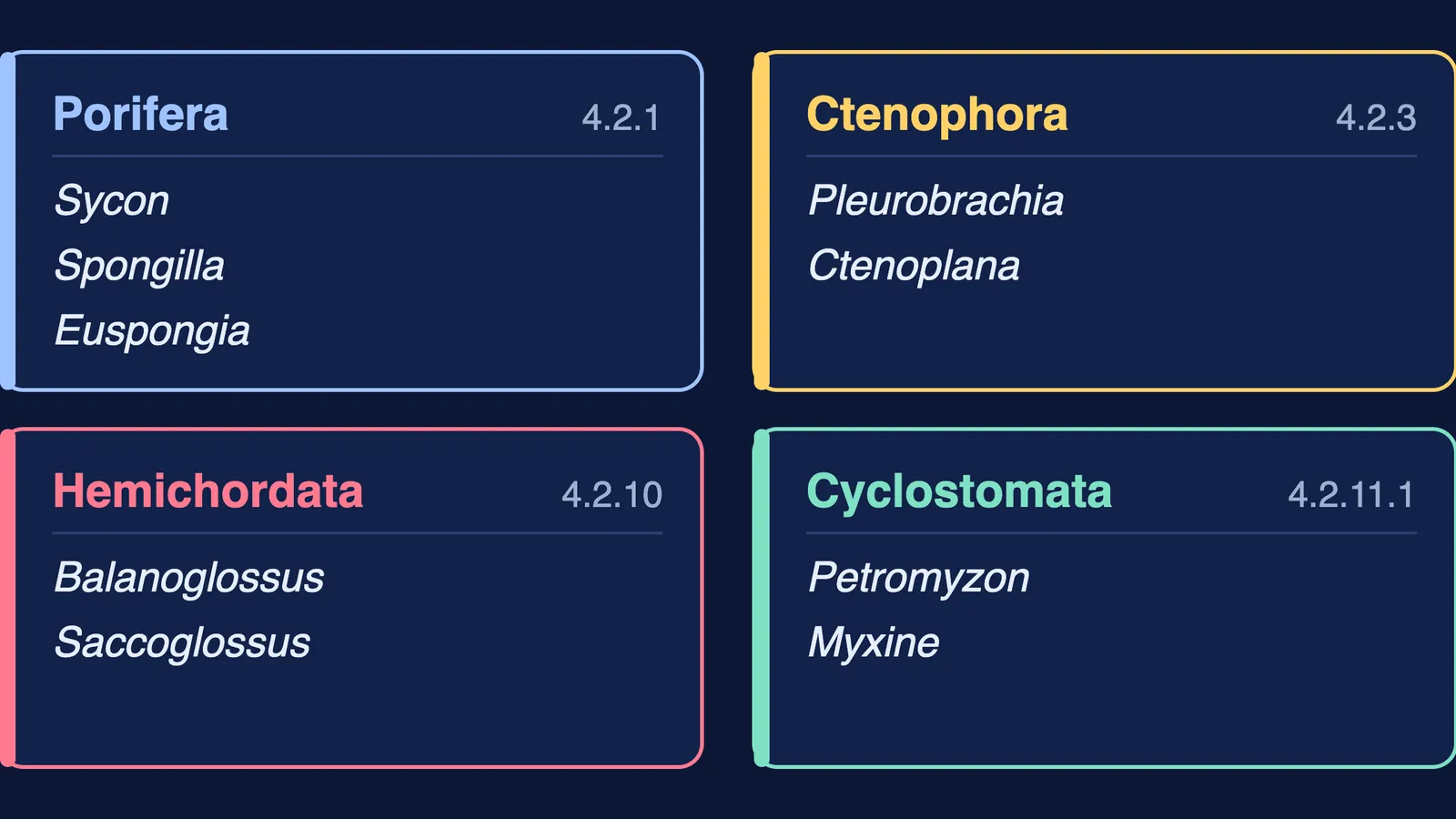
Porifera (4.2.1): *Sycon* (*Scypha*), *Spongilla* (fresh water sponge), *Euspongia* (bath sponge).
Coelenterata and Ctenophora (4.2.2, 4.2.3): *Physalia* (Portuguese man-of-war), *Adamsia*, *Pennatula*, *Gorgonia* (sea-fan), *Meandrina* (brain coral); text: *Hydra*, *Aurelia*, *Obelia*. Ctenophores: *Pleurobrachia*, *Ctenoplana*.
The three worm phyla (4.2.4 to 4.2.6): flatworms *Taenia* (tapeworm), *Fasciola* (liver fluke), text: *Planaria*; roundworms *Ascaris*, *Wuchereria* (filaria worm), *Ancylostoma* (hookworm); annelids *Nereis*, *Pheretima* (earthworm), *Hirudinaria* (blood sucking leech).
Arthropoda (4.2.7): living fossil *Limulus*; gregarious pest *Locusta*; vectors *Anopheles*, *Culex*, *Aedes*; economically important insects *Apis*, *Bombyx*, *Laccifer*.
Mollusca (4.2.8): *Pila*, *Pinctada*, *Sepia*, *Loligo* (squid), *Octopus*, *Aplysia*, *Dentalium* (tusk shell), *Chaetopleura* (chiton).
Echinodermata and Hemichordata (4.2.9, 4.2.10): *Asterias*, *Echinus*, *Antedon*, *Cucumaria* (sea cucumber), *Ophiura* (brittle star); *Balanoglossus*, *Saccoglossus*.
Protochordates and cyclostomes (4.2.11, 4.2.11.1): Urochordata *Ascidia*, *Salpa*, *Doliolum*; Cephalochordata *Branchiostoma*; Cyclostomata *Petromyzon*, *Myxine*.
Fishes (4.2.11.2, 4.2.11.3): cartilaginous *Scoliodon*, *Pristis*, *Carcharodon*, *Trygon* (sting ray), text: *Torpedo*; bony, marine *Exocoetus* (flying fish), *Hippocampus*; freshwater *Labeo* (rohu), *Catla*, *Clarias* (magur); aquarium *Pterophyllum* (angel fish), *Betta* (fighting fish).
Amphibia and Reptilia (4.2.11.4, 4.2.11.5): *Bufo*, *Rana*, *Hyla*, *Salamandra*, *Ichthyophis*; *Chelone*, *Testudo*, *Chameleon* (tree lizard), *Calotes* (garden lizard), *Crocodilus*, *Alligator*, *Hemidactylus*, poisonous snakes *Naja*, *Bangarus* (krait), *Vipera*.
Aves and Mammalia (4.2.11.6, 4.2.11.7): *Corvus*, *Columba*, *Psittacula*, *Struthio*, *Pavo*, *Aptenodytes*, *Neophron* (vulture); oviparous *Ornithorhynchus*; viviparous *Macropus*, *Pteropus*, *Camelus*, *Macaca* (monkey), *Rattus*, *Canis*, *Felis*, *Elephas*, *Equus*, *Delphinus* (common dolphin), *Balaenoptera*, *Panthera tigris*, *Panthera leo*.
How do you answer "which is an example of" questions?
Name every option's group before choosing: wrong options are usually real NCERT names from a neighbouring list.
Q1. Which is an example of Mollusca? (1) *Pheretima* (2) *Cucumaria* (3) *Dentalium* (4) *Echinus*
Answer: (3). The tusk shell is in NCERT's mollusc list; the others are an annelid and two echinoderms.
Q2. Which is a cartilaginous fish? (1) *Exocoetus* (2) *Trygon* (3) *Chelone* (4) *Pterophyllum*
Answer: (2). The sting ray is listed under Chondrichthyes; *Chelone* is a turtle.
Q3. Which is NOT an NCERT example of a fish? (1) *Labeo* (2) *Scoliodon* (3) *Delphinus* (4) *Betta*
Answer: (3). The common dolphin is in NCERT's viviparous mammal list.
Q4. Which is NOT an example of Reptilia? (1) *Testudo* (2) *Bangarus* (3) *Chameleon* (4) *Neophron*
Answer: (4). *Neophron*, the vulture, is one of NCERT's birds.
Q5. Which is NOT an example of Arthropoda? (1) *Bombyx* (2) *Wuchereria* (3) *Culex* (4) *Locusta*
Answer: (2). The filaria worm is a roundworm, under Aschelminthes.
How do you crack match-the-organism questions?
Fix the pair you are surest of, strike every option that disagrees, then check one more pair.
Q6. List-I: A. *Loligo* B. *Ophiura* C. *Planaria* D. *Physalia*. List-II: I. Platyhelminthes II. Coelenterata III. Mollusca IV. Echinodermata. (1) A-III, B-IV, C-I, D-II (2) A-IV, B-III, C-I, D-II (3) A-III, B-IV, C-II, D-I (4) A-III, B-I, C-IV, D-II
Answer: (1). NCERT names *Planaria* among flatworms for its regeneration; the rest come from the mollusc, echinoderm and coelenterate lists.
Q7. List-I: A. *Clarias* B. *Labeo* C. *Betta* D. *Exocoetus*. List-II: I. Fighting fish II. Rohu III. Flying fish IV. Magur. (1) A-II, B-IV, C-I, D-III (2) A-IV, B-II, C-I, D-III (3) A-IV, B-II, C-III, D-I (4) A-I, B-II, C-IV, D-III
Answer: (2). These are NCERT's freshwater, aquarium and marine bony-fish names.
Q8. List-I: A. *Corvus* B. *Psittacula* C. *Pavo* D. *Aptenodytes*. List-II: I. Peacock II. Penguin III. Crow IV. Parrot. (1) A-III, B-IV, C-I, D-II (2) A-IV, B-III, C-I, D-II (3) A-III, B-IV, C-II, D-I (4) A-III, B-I, C-IV, D-II
Answer: (1). All four are on NCERT's Aves list with these common names.
How do you handle two-statement and correct-pair questions?
Judge each statement alone. In pair questions, one wrong common name sinks the pair.
Options for Q9 and Q10: (1) Both correct (2) Both incorrect (3) I correct, II incorrect (4) I incorrect, II correct.
Q9. Statement I: *Salpa* and *Doliolum* are NCERT examples of Cephalochordata. Statement II: *Chaetopleura*, the chiton, is listed under Mollusca.
Answer: (4). Both are urochordates; *Branchiostoma* is NCERT's cephalochordate.
Q10. Statement I: *Rattus* and *Canis* are NCERT examples of viviparous mammals. Statement II: NCERT calls *Calotes* the tree lizard and *Chameleon* the garden lizard.
Answer: (3). The common names are swapped: *Chameleon* is the tree lizard.
Q11. Which pair is correctly matched? (1) *Pheretima*, blood sucking leech (2) *Gorgonia*, brain coral (3) *Macaca*, monkey (4) *Cucumaria*, brittle star
Answer: (3). The earthworm is *Pheretima*, the brain coral *Meandrina*, the brittle star *Ophiura*.
Q12. Which pair is correctly matched? (1) *Columba*, Mammalia (2) *Hyla*, Reptilia (3) *Clarias*, Chondrichthyes (4) *Alligator*, Reptilia
Answer: (4). The pigeon is a bird, the tree frog an amphibian, magur a bony fish.
This is a study summary, not medical advice. More formats on this chapter: the Animal Kingdom statement and match-the-list set, the Animal Kingdom exceptions and odd-one-out questions and the diagram-based Animal Kingdom questions.
Which list keeps slipping? Fermi's AI tutor works out what you already know and builds a plan for the session.