On this page
NCERT's Organisms and Populations chapter (Class 12 Biology, Chapter 11, Reprint 2026-27) names more than 40 organisms, and NEET items ask where each belongs. The NEET (UG) 2026 syllabus places it in Unit 10, Ecology and Environment. Below: the examples by group, then 11 original questions.
Which example organisms does NCERT name in Organisms and Populations?
Populations (11.1.1): lotus plants in a pond, wetland cormorants, teakwood trees in a forest tract, rats in an abandoned dwelling, bacteria in a culture plate; fruitflies in a laboratory.
Size and how to measure it (11.1.1): Siberian cranes at Bharatpur wetlands (can be below 10) against *Chlamydomonas* in a pond (millions); one banyan among 200 carrot grass (*Parthenium hysterophorus*) plants; fish per trap; tiger pug marks.
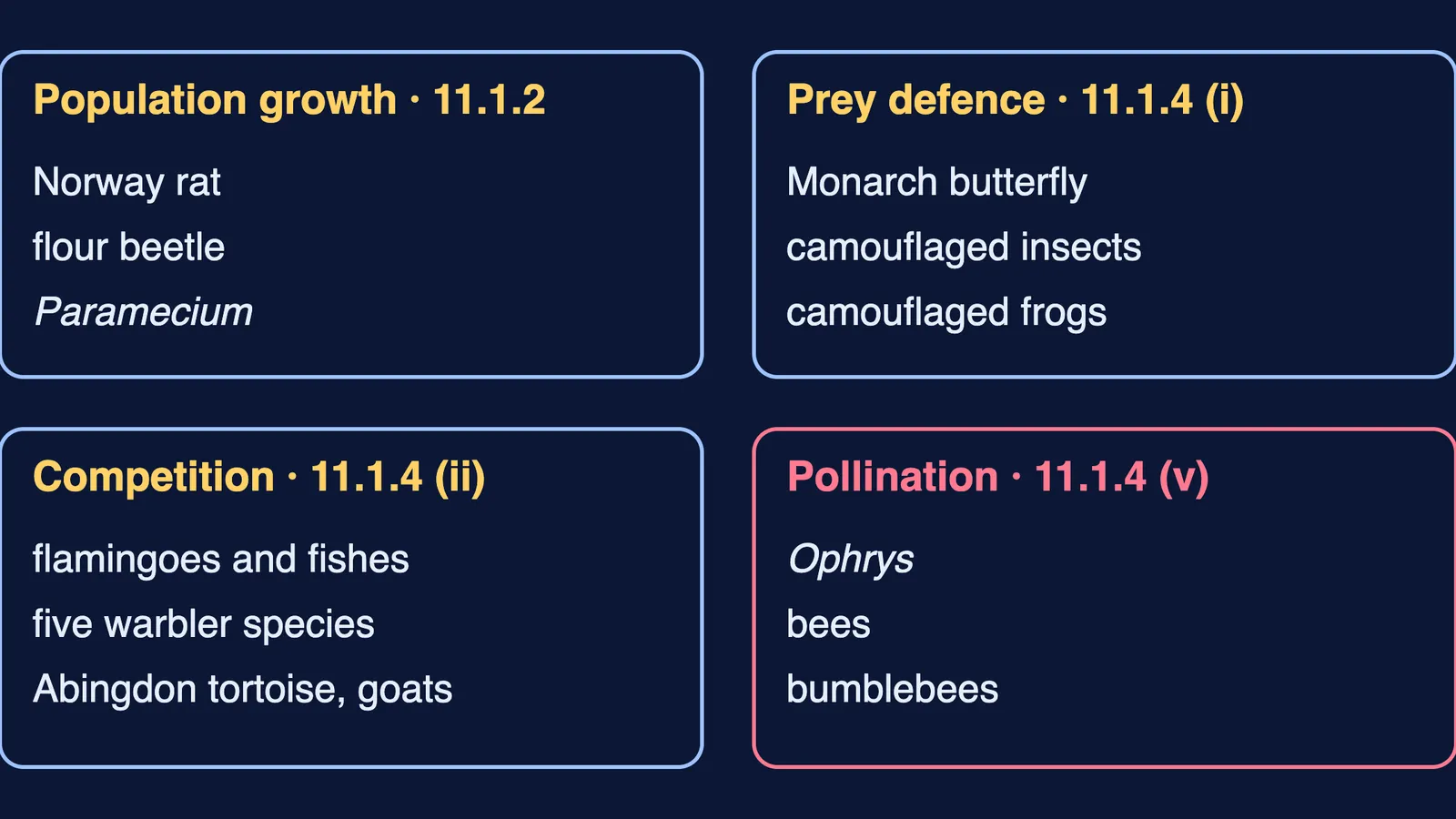
Growth (11.1.2): Norway rat (r = 0.015), flour beetle (r = 0.12), the human population of India (1981), Darwin's elephant, *Paramecium* doubling by binary fission.
Life history (11.1.3): Pacific salmon fish and bamboo breed once; Oysters and pelagic fishes make many small offspring.
Predation and defence (11.1.4 i): tiger and deer, a seed-eating sparrow; prickly pear cactus in Australia and a moth; the starfish *Pisaster* on the American Pacific Coast; camouflaged insects and frogs; the Monarch butterfly; thorns in *Acacia* and *Cactus*; *Calotropis* and its cardiac glycosides.
Competition (11.1.4 ii): flamingoes and resident fishes in South American lakes; the Abingdon tortoise and goats in the Galapagos Islands; *Balanus* and *Chathamalus* on the rocky sea coasts of Scotland; MacArthur's five warbler species.
Parasitism (11.1.4 iii): human liver fluke; malarial parasite; lice on humans, ticks on dogs, copepods on marine fish; *Cuscuta*; the female mosquito (not a parasite); cuckoo (koel) and crow.
Commensalism (11.1.4 iv): cattle egret with grazing cattle, an orchid on a mango branch, clown fish among sea anemone tentacles, barnacles on a whale.
Mutualism (11.1.4 v): lichens (fungus with algae or cyanobacteria), mycorrhizae, fig trees and their wasps, orchids with bees and bumblebees, *Ophrys* and a bee.
How do you remember the examples without rereading lists?
Most 11.1.4 examples are pairs, many with a place. Try a partner-and-place drill:
Write one partner (crow, whale, mango, fig); recall the other, who gains, and the sign pair.
Say each place aloud: Scotland, Galapagos, Australia, Bharatpur, the Mediterranean.
Next time, go out of section order.
How do you attack "example of" questions?
Name the group or feature the stem asks for and test each option against the chapter, not a guess. In NOT items, three options share a group; find the stray. In matches, fix your surest pair and strike clashing codes.
Organisms and Populations NCERT example questions
Two-statement key: (1) both correct (2) both wrong (3) only I correct (4) only II correct.
Q1. What r value does NCERT give for the human population of India in 1981? (1) 0.015 (2) 0.0205 (3) 0.12 (4) 0.205
Answer: (2). 0.015 is the Norway rat; 0.12 is the flour beetle.
Q2. Match the example to its NCERT use. List-I: A. Lotus plants in a pond B. Fruitflies in a laboratory C. Fish in a lake D. One banyan among carrot grass. List-II: I. Death-rate worked example II. Relative density from catch per trap III. Birth-rate worked example IV. Per cent cover or biomass beats a count. (1) A-III, B-I, C-II, D-IV (2) A-I, B-III, C-II, D-IV (3) A-III, B-I, C-IV, D-II (4) A-II, B-I, C-III, D-IV
Answer: (1). Lotus 8/20; fruitflies 4/40.
Q3. NCERT's carrot grass is: (1) *Parthenium hysterophorus* (2) *Calotropis* (3) *Cuscuta* (4) *Chlamydomonas*
Answer: (1). Named beside the single banyan (11.1.1).
Q4. Which is NOT one of NCERT's parasitism examples? (1) Human liver fluke (2) *Cuscuta* (3) Ectoparasitic copepods (4) *Pisaster*
Answer: (4). *Pisaster* is a starfish predator (11.1.4 i).
Q5. Which pair is correctly matched? (1) Snail: vector of the malarial parasite (2) Mosquito: vector of the malarial parasite (3) Copepods: endoparasites of marine fish (4) Fish: primary host of the human liver fluke
Answer: (2). Snail and fish are the fluke's intermediate hosts; copepods are ectoparasites.
Q6. I: NCERT's familiar ectoparasite examples are lice on dogs and ticks on humans. II: NCERT calls the human liver fluke a trematode parasite.
Answer: (4). NCERT pairs lice with humans and ticks with dogs.
Q7. Match who gets what in NCERT's mutualisms. List-I: A. Pollinators B. Seed dispersers C. Fungi in mycorrhizae D. Plants in mycorrhizae. List-II: I. Juicy, nutritious fruits II. Help absorbing essential soil nutrients III. Pollen and nectar IV. Energy-yielding carbohydrates. (1) A-III, B-I, C-II, D-IV (2) A-III, B-I, C-IV, D-II (3) A-I, B-III, C-IV, D-II (4) A-III, B-IV, C-I, D-II
Answer: (2). The plant's "fees" and the fungus's help (11.1.4 v).
Q8. I: In a lichen, the fungus partners photosynthesising algae or cyanobacteria. II: In NCERT's example, the sea anemone gains protection from predators by hosting the clown fish.
Answer: (3). The fish is protected; the anemone gains nothing apparent.
Q9. Match organism to NCERT's place. List-I: A. *Pisaster* B. Abingdon tortoise C. *Ophrys* D. Siberian cranes. List-II: I. Galapagos Islands II. Mediterranean III. Bharatpur wetlands IV. American Pacific Coast. (1) A-I, B-IV, C-II, D-III (2) A-IV, B-I, C-III, D-II (3) A-IV, B-I, C-II, D-III (4) A-II, B-I, C-IV, D-III
Answer: (3).
Q10. Which pair matches NCERT's setting? (1) *Calotropis*: abandoned fields (2) *Cuscuta*: rocky intertidal zone (3) *Pisaster*: shallow South American lakes (4) Rats: a forest tract
Answer: (1). *Cuscuta* is on hedge plants; rats in an abandoned dwelling.
Q11. I: Cattle egrets forage near grazing cattle because the moving cattle flush out insects. II: NCERT says you are most likely to see this pair in farmed rural areas.
Answer: (1). Both are in 11.1.4 (iv).
What should you do after this set?
Redo misses in two days, then try the Organisms and Populations statement and match-the-list set, the NCERT exceptions and odd-one-out questions and the diagram-based questions on this chapter.
Which example keeps landing in the wrong box? Fermi's AI tutor works out what you already know and builds a plan for the session.