On this page
This set draws on the first chapter of the NCERT Class 12 Biology textbook (Reprint 2026-27). The NEET (UG) 2026 syllabus places the topic in its Biology Unit 6, Reproduction. Part 1 groups the example plants the chapter names, with their sections. Part 2 has 10 original questions, none a prediction.
Which example plants does NCERT name in this chapter?
Each group lists only names printed in the chapter, spelt as NCERT spells them.
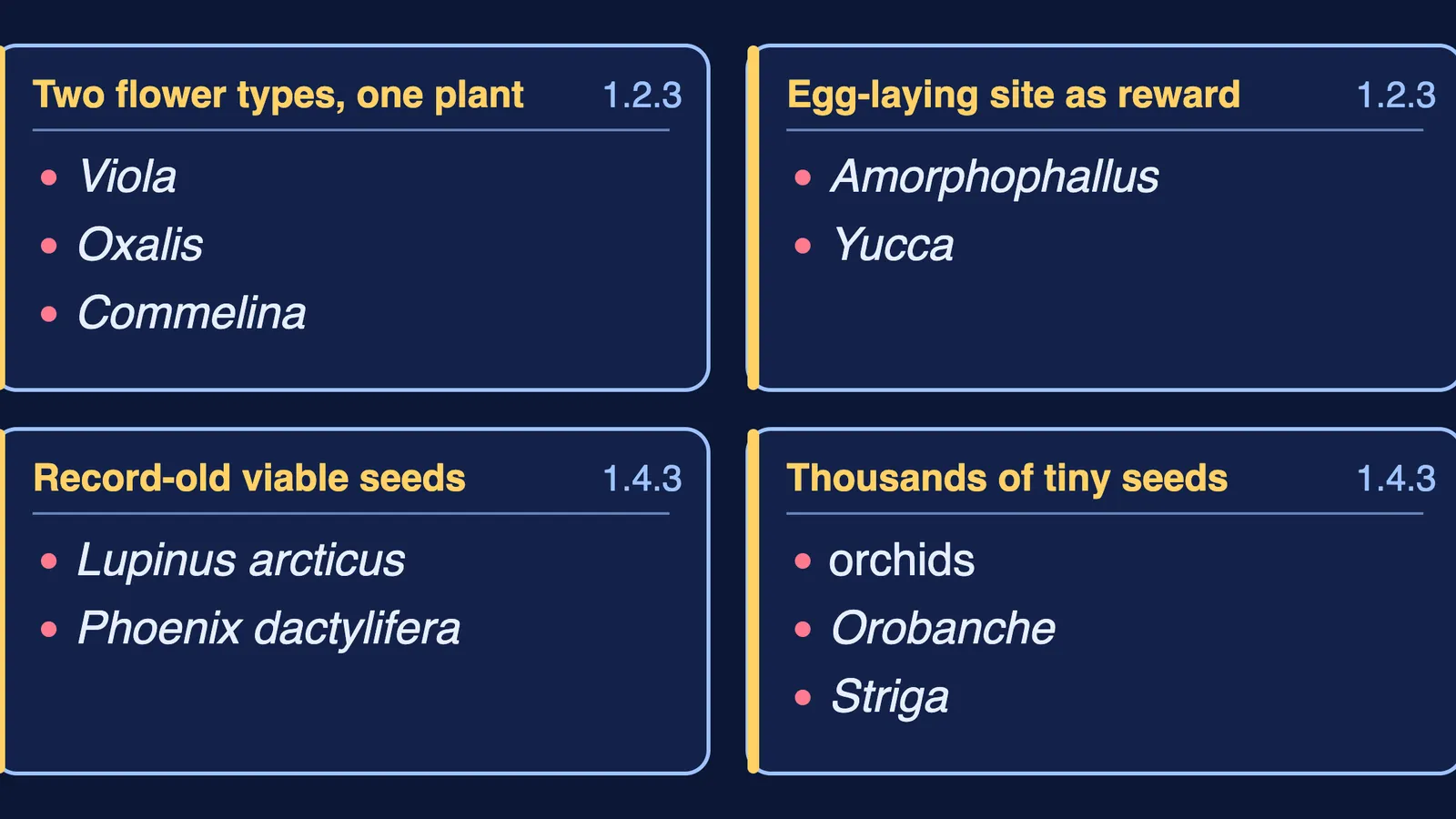
Two flower types on one plant (1.2.3): *Viola* (common pansy), *Oxalis* and *Commelina* bear both chasmogamous and cleistogamous flowers.
Pollinated by water (1.2.3): *Vallisneria* and *Hydrilla* in fresh water; marine sea-grasses such as *Zostera*. Aquatic yet pollinated by insects or wind: water hyacinth, water lily.
Wind and animal rewards (1.2.3): the corn cob and grasses for wind; *Amorphophallus* and *Yucca* offer an egg-laying site.
Pollen (1.2.1, 1.2.3): viability lost within 30 minutes in rice and wheat, kept for months in some Rosaceae, Leguminoseae and Solanaceae; allergy from *Parthenium* (carrot grass); germination on sugar solution in pea, chickpea, *Crotalaria*, balsam and *Vinca*; powdery pollen from *Hibiscus* anthers.
Pistil and ovules (1.2.2): syncarpous *Papaver*, apocarpous *Michelia*; one ovule in wheat, paddy, mango; many in papaya, water melon, orchids.
Unisexual flowers (1.2.3): monoecious castor and maize; dioecious papaya.
Endosperm and seeds (1.4.1, 1.4.3): endosperm used up in pea, groundnut, beans; persistent in castor and coconut; albuminous wheat, maize, barley, castor; perisperm in black pepper and beet.
Fruits (1.4.3): fleshy guava, orange, mango; dry groundnut, mustard; false fruits apple, strawberry, cashew; parthenocarpic banana.
Seed records (1.4.3): *Lupinus arcticus* and *Phoenix dactylifera* for long viability; orchids, *Orobanche* and *Striga* for thousands of seeds per fruit; *Ficus* for a tiny seed and a huge tree.
No fertilisation (1.5): apomixis in some species of *Asteraceae* and grasses; embryos grown from nucellar cells in many *Citrus* and *Mango* varieties.
The *Parthenium* line is a study summary, not medical advice.
How do you attack example questions?
Before reading options, name the group the stem asks about and its section. Then check each option against that group only. A plant NCERT lists elsewhere in the chapter is not automatically wrong; ask whether NCERT lists it here.
Can you answer these NCERT example questions?
Q1. Which plant does NCERT give as an ovary with many ovules? (1) Wheat (2) Paddy (3) Mango (4) Water melon Answer: (4). Wheat, paddy and mango are its one-ovule examples (1.2.2).
Q2. NCERT asks you to touch the opened anthers of which flower and look for yellowish powdery pollen on your fingers? (1) *Hibiscus* (2) *Vinca* (3) Balsam (4) *Crotalaria* Answer: (1). *Vinca*, balsam and *Crotalaria* are named only for pollen germination on sugar solution (1.2.1, 1.2.3).
Q3. Statement I: *Papaver* has a multicarpellary, syncarpous pistil. Statement II: *Michelia* has a multicarpellary gynoecium with fused pistils. (1) Both true (2) Both false (3) I true, II false (4) I false, II true Answer: (3). NCERT's *Michelia* gynoecium is apocarpous, its pistils free (1.2.2).
Q4. Match List-I with List-II. List-I: A. *Parthenium* B. Castor C. Beans D. Orange List-II: (i) Squeezed seeds show many embryos of different sizes (ii) Endosperm is used up before the seed matures (iii) Its pollen causes allergy (iv) Endosperm persists in the mature seed (1) A-iii, B-iv, C-ii, D-i (2) A-iii, B-ii, C-iv, D-i (3) A-i, B-iv, C-ii, D-iii (4) A-ii, B-i, C-iii, D-iv Answer: (1). Each row is NCERT's own example (1.2.1, 1.4.1, 1.5).
Q5. Which pair is correctly matched? (1) Balsam: false fruit (2) Beet: parthenocarpic fruit (3) Groundnut: dry fruit (4) Barley: dioecious Answer: (3). Balsam is a pollen-germination example, beet keeps perisperm and barley is an albuminous seed (1.2.3, 1.4.3).
Q6. NCERT names seed formation without fertilisation in some species of: (1) Asteraceae (2) Rosaceae (3) Solanaceae (4) Leguminoseae Answer: (1). NCERT names the other three for pollen that stays viable for months (1.2.1, 1.5).
Q7. Statement I: Mango is one of NCERT's examples of an ovary with a single ovule. Statement II: Many mango varieties show polyembryony from nucellar cells. (1) Both true (2) Both false (3) I true, II false (4) I false, II true Answer: (1). Both are NCERT lines (1.2.2, 1.5).
Q8. Statement I: NCERT gives water hyacinth and water lily as examples of water-pollinated plants. Statement II: Cashew is one of the few species in which the thalamus also forms part of the fruit. (1) Both true (2) Both false (3) I true, II false (4) I false, II true Answer: (4). Their flowers open above the water, where insects or wind pollinate them (1.2.3, 1.4.3).
Q9. Which plant does NCERT call the common pansy? (1) *Viola* (2) *Oxalis* (3) *Commelina* (4) *Vinca* Answer: (1). NCERT gives the common name in brackets after *Viola* (1.2.3).
Q10. How many of these does NCERT suggest for watching pollen germinate on a sugar solution? Pea, chickpea, *Crotalaria*, balsam, *Vinca*, rice. (1) Three (2) Four (3) Five (4) Six Answer: (3). Rice is not on the list; NCERT names it for pollen that loses viability within 30 minutes (1.2.1, 1.2.3).
What should you do next?
Mark each miss by group number from Part 1, reread that section, and redo the set after three days. Then try the NCERT exceptions and odd-one-out set and the statement and match-the-list questions on this chapter, or start with a NEET plan for the whole chapter.
Still mixing up which plant goes where? Fermi's AI tutor works out what you already know and builds a plan for the session.