On this page
Benzoic acid barely dissolves in cold water. Add some sodium acetate, which shares no ion with it, and more than twice as much benzoic acid goes into solution. In 1905 James Charles Philip, of the Royal College of Science, London, measured this effect for four sparingly soluble acids. He showed that one ratio of acid constants predicts it. His paper is "Influence of Various Sodium Salts on the Solubility of Sparingly Soluble Acids", J. Chem. Soc. Trans. 87 (1905) 987–997. We read it in the scanned 1905 volume and checked the table values below against the page images.
Why should a sodium salt make an acid more soluble?
Philip started from a base. Magnesium hydroxide dissolves better in ammonium chloride solution than in pure water. The explanation he cited (Lovén, 1896) is that NH₄⁺ and OH⁻ combine to form weakly dissociated ammonium hydroxide. That removes OH⁻, and more Mg(OH)₂ has to dissolve to replace it.
Now swap the roles. Take a sparingly soluble acid HA and add NaA′, the sodium salt of another weak acid. The A′⁻ ions pick up H⁺ and form undissociated HA′, so more HA has to dissolve. Philip predicted, and then found, that "the weaker the acid HA′, the more marked is the increase of solubility of HA produced by NaA′".
For benzoic acid and sodium acetate the reaction is:
C₆H₅COOH + CH₃COO⁻ ⇌ C₆H₅COO⁻ + CH₃COOH
Check the balance: C₉H₉O₄ and a charge of −1 on each side.
This is the opposite of the common-ion effect that Arthur Noyes measured with thallium chloride in 1890. There a shared ion lowers solubility. Here no ion is shared, and solubility goes up. It is also the acid-side mirror of why salts of weak acids dissolve more in acid.
What did Philip measure?
At 26.4 °C he shook each acid with water or a salt solution until it was saturated. Then he titrated the dissolved acid with 0.0351 N NaOH, using phenolphthalein. In pure water the solubilities, in mol/L, were: cinnamic acid 0.0038, benzoic acid 0.0289, salicylic acid 0.0171 and o-nitrobenzoic acid 0.0470.
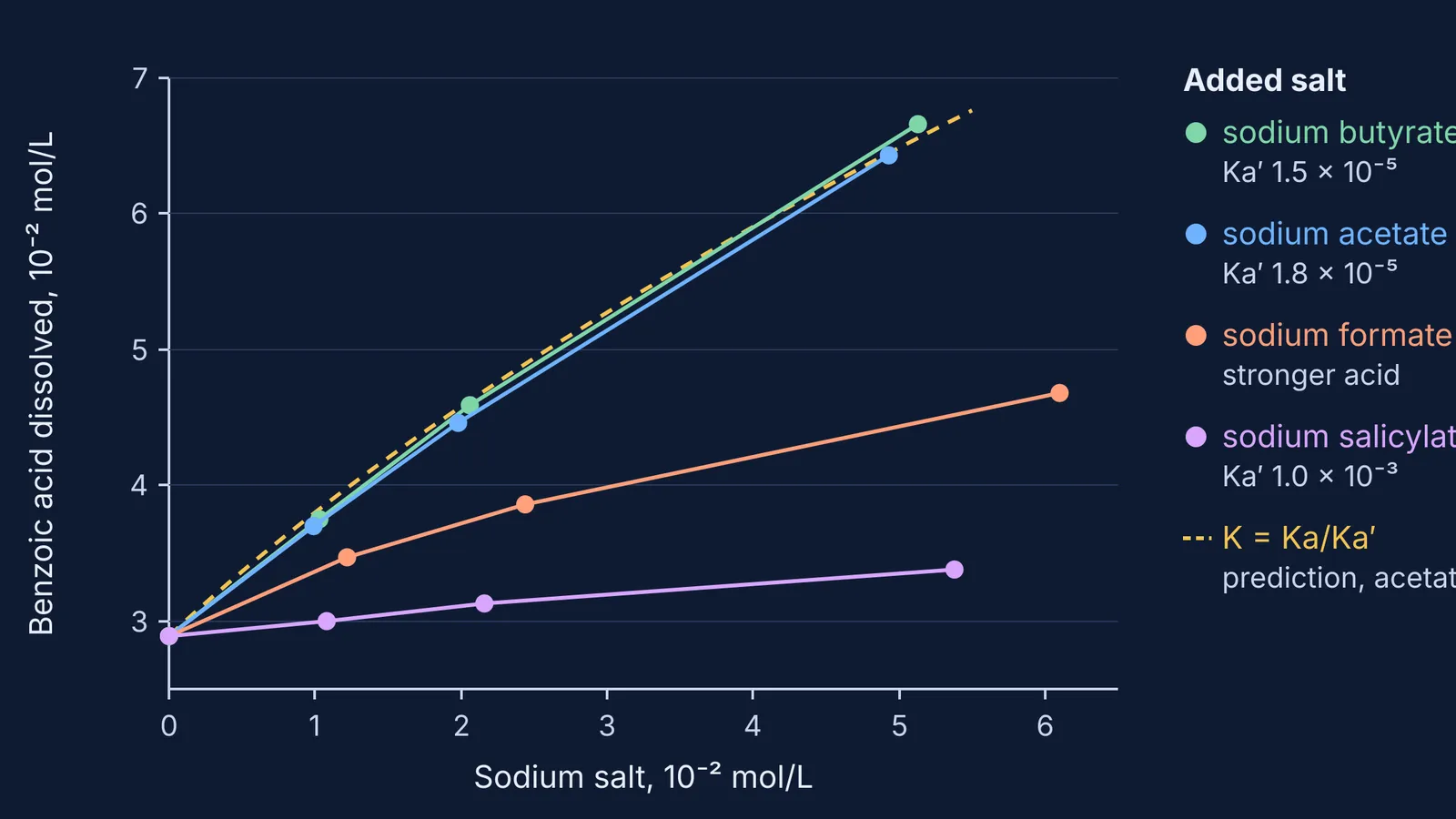
For benzoic acid, his tables give these pairs (salt concentration, then benzoic acid dissolved, both in mol/L):
sodium butyrate 0.0513: 0.0666
sodium acetate 0.0493: 0.0643
sodium formate 0.0610: 0.0468
sodium salicylate 0.0538: 0.0338
The order follows the weakness of the salt's parent acid. Philip quotes these constants at 25 °C: butyric acid 0.000015, acetic acid 0.000018 and salicylic acid 0.00102. Butyrate sits just above acetate because butyric acid is slightly weaker. Formic acid is stronger than acetic, so formate helps less. Salicylic acid is the strongest of these, so salicylate barely helps at all.
How does K = Ka/Ka′ predict the solubility?
Add the two acid equilibria and you get the exchange above. Its constant is K = [A⁻][HA′]/([HA][A′⁻]) = Ka/Ka′. With Philip's values for benzoic acid (6 × 10⁻⁵) and acetic acid (1.8 × 10⁻⁵), K = 3.3. The forward reaction is favoured, but only partly, because the two Ka values are close.
The key idea is this. While solid benzoic acid is present, the concentration of undissociated benzoic acid is fixed by saturation. Only the benzoate is free to grow.
Worked example: benzoic acid in 0.0493 M sodium acetate
Undissociated acid in saturated water. Total 0.0289 M. Solve x²/(0.0289 − x) = 6 × 10⁻⁵: x = 0.00129 M ionised (4.5%). So [C₆H₅COOH] = 0.0276 M, and it stays at 0.0276 M in the salt solution.
Set up the exchange. Let y mol/L of benzoate and acetic acid form. Acetate left = 0.0493 − y. Then 3.33 = y² / (0.0276 × (0.0493 − y)), so y² = 0.0920 × (0.0493 − y).
Solve the quadratic. y = 0.0356 M. About 72% of the acetate has taken a proton.
Predict the solubility. Philip took the extra solubility as about y. Predicted 0.0289 + 0.0356 = 0.0645 M. He measured 0.0643 M.
Check a second point. In 0.0198 M acetate, y = 0.0168 M, so the prediction is 0.0457 M. He measured 0.0446 M.
So the simple model lands within about 2.5% at both strengths. Philip ran the same calculation at 25 °C and printed "about 0·017" for 0.02 N acetate and 0.036 for 0.05 N; we get 0.0168 and 0.0357.
Do not read too much into the near-perfect 0.0645. The constants are for 25 °C, the measurements for 26.4 °C. Philip also dropped two small terms: undissociated sodium benzoate, and the acid's own ionisation in water. He estimated that what is left over is 5–7% of y at 0.05 N. If you instead add [C₆H₅COOH] + [C₆H₅COO⁻] strictly, you get 0.0632 M. Either way the solubility more than doubles.
What sets the pH, and why does that matter?
The acetate turns the solution into a buffer. [H⁺] = Ka′ × [CH₃COOH]/[CH₃COO⁻] = 1.8 × 10⁻⁵ × 0.0356/0.0137 = 4.7 × 10⁻⁵ M, so the pH is 4.33. That is close to benzoic acid's pKa of 4.22. Now the benzoate to benzoic acid ratio is Ka/[H⁺] = 1.29, against 0.047 in water, where the pH is 2.89.
This gives you a one-line formula for any sparingly soluble weak acid: solubility = [HA]sat × (1 + Ka/[H⁺]). The less acidic the buffer, the more dissolves.
Why does salicylic acid overtake benzoic acid?
In water, salicylic acid (0.0171 M) is less soluble than benzoic acid (0.0289 M). But Philip found that in sodium formate stronger than about N/25 it is the more soluble. At 0.0610 M formate he measured 0.0535 M salicylic acid against 0.0468 M benzoic acid.
His reason: salicylic acid is the stronger acid (K = 0.00102 against 0.00006, about 17 times). So its product Kp = Ka × [HA]sat, which sets how far the exchange goes in his formula, is larger. We get 1.37 × 10⁻⁵ for salicylic and 1.66 × 10⁻⁶ for benzoic, about 8 times larger. That extra acid strength comes from the ortho OH group, the ortho effect in substituted benzoic acids.
Relative gains in about N/20 sodium acetate were: cinnamic acid 5.0 times, salicylic 3.6, benzoic 2.2 and o-nitrobenzoic 1.9. The weakest acid (cinnamic, K = 0.0000355) gains most and the strongest (o-nitrobenzoic, K = 0.00616) least. Philip noted that benzoic and salicylic swap places in this order, for the reason above.
To see how Ka, buffers and solubility connect, the Concept Library gives each concept its own lesson and shows its place in the map.
Quick checklist
A salt of a weaker acid raises the solubility of a sparingly soluble acid.
Exchange constant: K = Ka/Ka′. Benzoic acid with acetate: 3.3.
Saturation fixes undissociated [HA]; only A⁻ can grow.
Philip: benzoic acid 0.0289 M in water, 0.0643 M in 0.0493 M sodium acetate; predicted 0.0645 M.
Weaker parent acid of the salt, bigger effect: butyrate > acetate > formate > salicylate.
Solubility = [HA]sat × (1 + Ka/[H⁺]).