On this page
NEET questions on this chapter often name an organism and ask where it belongs. Part 1 groups every example organism the NCERT Class 11 Biology chapter on Biological Classification (Chapter 2, Reprint 2026-27) names, with its section. Part 2 tests them with 12 original questions. The NMC NEET (UG)-2026 syllabus places the chapter in Unit 1, Diversity in Living World.
Which example organisms does NCERT name in Biological Classification?
Names below are spelt as NCERT spells them.
Reshuffled by the five kingdoms (chapter introduction): *Chlamydomonas* and *Spirogyra* were once placed together under algae; *Chlamydomonas* and *Chlorella* (walled) now share Protista with *Paramoecium* and *Amoeba* (wall-less, earlier in the animal kingdom).
Eubacteria (2.1.2): *Nostoc* and *Anabaena* form heterocysts, the cells that fix nitrogen; *Mycoplasma* has no cell wall at all.
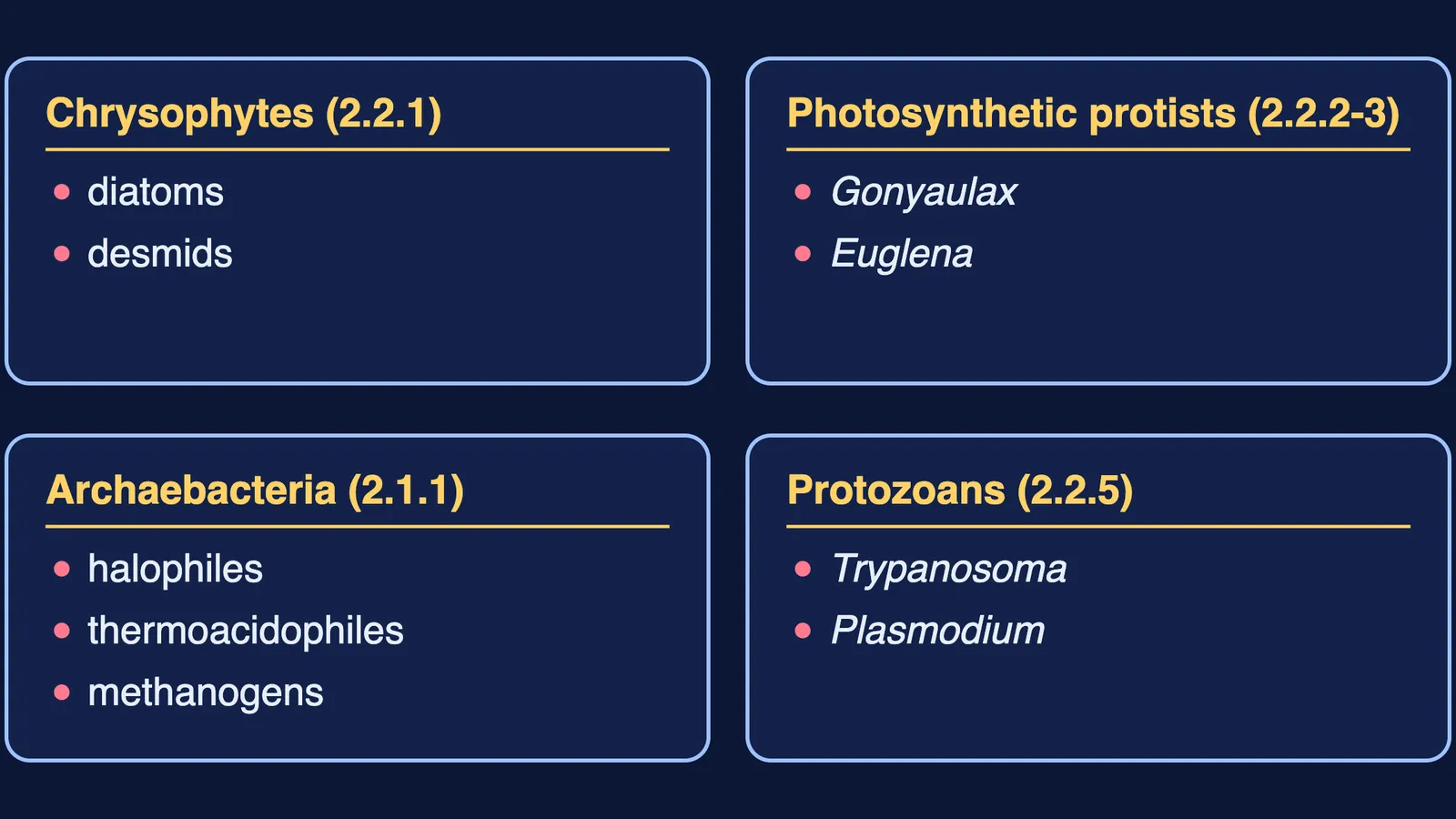
Photosynthetic protists (2.2.2, 2.2.3): *Gonyaulax*, a red dinoflagellate; *Euglena*, a euglenoid.
Protozoans (2.2.5): *Amoeba* and the parasite *Entamoeba* (amoeboid), *Trypanosoma* (flagellated, sleeping sickness), *Paramoecium* (ciliated), *Plasmodium* (sporozoan, malaria).
Phycomycetes (2.3.1): *Mucor*, *Rhizopus* (bread mould), *Albugo* (parasite on mustard).
Ascomycetes (2.3.2): *Penicillium*, yeast (*Saccharomyces*), *Aspergillus*, *Claviceps*, *Neurospora*; morels and truffles are edible members.
Basidiomycetes (2.3.3): *Agaricus* (mushroom), *Ustilago* (smut), *Puccinia* (rust fungus).
Deuteromycetes (2.3.4): *Alternaria*, *Colletotrichum*, *Trichoderma*.
Partly heterotrophic plants (2.4): bladderwort and Venus fly trap (insectivorous), *Cuscuta* (parasite).
Diseases appear here only as NCERT names them. This is a study summary, not medical advice.
How do you remember which organism goes where?
Learn each fungal class as a fixed headcount in NCERT's section order: phycomycetes, ascomycetes, basidiomycetes, deuteromycetes. Recite the class, then its genera, then check the count. A short list is a gap, and a long one means a stranger slipped in. For Monera and Protista, NCERT gives only one or two genera per group, so learn them as pairs tagged with the section number: 2.1.2 *Nostoc* and *Anabaena*, 2.2.5 *Amoeba* and *Entamoeba*.
How do you attack "which is an example of" questions?
Name the group for each option before reading the stem again. In "NOT" questions, three options will share a group; strike them and check the fourth. In match questions, fix your surest pair first.
Codes for two-statement items: (1) both correct (2) both incorrect (3) I correct, II incorrect (4) I incorrect, II correct.
Can you place these NCERT example organisms?
Q1. Which is an example of a deuteromycete? (1) *Claviceps* (2) *Ustilago* (3) *Albugo* (4) *Trichoderma*
Answer: (4). The others are an ascomycete, a basidiomycete and a phycomycete (2.3.1 to 2.3.4).
Q2. Which is NOT an NCERT example of an ascomycete? (1) *Aspergillus* (2) *Agaricus* (3) *Neurospora* (4) *Claviceps*
Answer: (2). *Agaricus*, the mushroom, is a basidiomycete (2.3.3).
Q3. Which pair are both NCERT examples of basidiomycetes? (1) *Agaricus* and *Claviceps* (2) *Puccinia* and *Alternaria* (3) *Ustilago* and *Puccinia* (4) *Ustilago* and *Neurospora*
Answer: (3). *Claviceps* and *Neurospora* are ascomycetes; *Alternaria* is a deuteromycete (2.3.2 to 2.3.4).
Q4. Which pair did older systems place together under algae, though one is unicellular and the other multicellular? (1) *Amoeba* and *Paramoecium* (2) *Saccharomyces* and *Penicillium* (3) *Chlamydomonas* and *Spirogyra* (4) *Mucor* and *Agaricus*
Answer: (3). NCERT uses this pair to show the old grouping mixing unicellular and multicellular forms (chapter introduction).
Q5. I: *Aspergillus* and yeast (*Saccharomyces*) belong to the same class. II: *Ustilago* belongs to the same class as *Mucor*.
Answer: (3). Both in I are ascomycetes; *Ustilago* is a basidiomycete and *Mucor* a phycomycete (2.3.1 to 2.3.3).
Q6. In Whittaker's five kingdoms, match List-I with List-II. A. *Anabaena* B. *Entamoeba* C. *Claviceps* D. *Cuscuta*; I. Plantae II. Fungi III. Protista IV. Monera. (1) A-III, B-IV, C-II, D-I (2) A-IV, B-III, C-II, D-I (3) A-IV, B-II, C-III, D-I (4) A-IV, B-III, C-I, D-II
Answer: (2). Cyanobacterium, parasitic protozoan, ascomycete and parasitic plant (2.1.2, 2.2.5, 2.3.2, 2.4).
Q7. How many of these are NCERT examples of ascomycetes: *Penicillium*, *Claviceps*, *Ustilago*, *Neurospora*, *Alternaria*, truffles? (1) 3 (2) 4 (3) 5 (4) 6
Answer: (2). *Penicillium*, *Claviceps*, *Neurospora* and truffles; *Ustilago* is a basidiomycete and *Alternaria* a deuteromycete (2.3.2).
Q8. Which members does NCERT call edible and delicacies? (1) Rusts and smuts (2) Morels and truffles (3) *Mucor* and *Albugo* (4) *Claviceps* and *Alternaria*
Answer: (2). They are ascomycetes (2.3.2).
Q9. Which set is made up only of NCERT examples from Kingdom Fungi? (1) *Alternaria*, *Anabaena*, *Agaricus* (2) *Ustilago*, *Entamoeba*, *Mucor* (3) *Puccinia*, *Neurospora*, *Nostoc* (4) *Albugo*, *Claviceps*, *Colletotrichum*
Answer: (4). *Anabaena* and *Nostoc* are Monera; *Entamoeba* is a protozoan (2.1.2, 2.2.5, 2.3).
Q10. Match List-I with the common name NCERT gives in List-II. A. *Rhizopus* B. *Ustilago* C. *Agaricus* D. *Saccharomyces*; I. smut II. bread mould III. mushroom IV. yeast. (1) A-I, B-II, C-III, D-IV (2) A-II, B-III, C-I, D-IV (3) A-IV, B-I, C-III, D-II (4) A-II, B-I, C-III, D-IV
Answer: (4). NCERT names each in 2.3.1, 2.3.2 and 2.3.3.
Q11. Which pair is correctly matched? (1) *Alternaria*: ascomycetes (2) *Agaricus*: deuteromycetes (3) *Rhizopus*: phycomycetes (4) *Albugo*: basidiomycetes
Answer: (3). *Alternaria* is a deuteromycete, *Agaricus* a basidiomycete and *Albugo* a phycomycete (2.3.1, 2.3.3, 2.3.4).
Q12. I: Rusts and smuts are basidiomycetes that live as parasites in plant bodies. II: Many deuteromycetes decompose litter and help in mineral cycling.
Answer: (1). Both appear in NCERT 2.3.3 and 2.3.4.
What should you do with your misses?
Write each missed organism with its group and section number, then re-count that group against Part 1. For deeper practice, try the Biological Classification statement and match-the-list set, the NCERT exceptions and odd-one-out set, or the diagram-based questions on Biological Classification.
Which fungal class still loses you marks?
Fermi's AI tutor works out what you already know and builds a plan for the session.