On this page
Sodium hexametaphosphate is the "Calgon" of your water-softening chapter. India's food-grade standard, IS 19004:2023, checks its purity as P₂O₅, and the method hides two exam skills. One is counting P–O–P bridges in ortho, pyro and metaphosphates. The other is the n-factor of the yellow ammonium phosphomolybdate precipitate, which turns out to be 23 OH⁻ for every phosphorus atom.
What is sodium hexametaphosphate, and what does IS 19004 require?
We read the full IS 19004:2023, Sodium Hexa Meta Phosphate, Food Grade — Specification and checked its numbers against the page images. The foreword lists the synonyms "Sodium hexametaphosphate, sodium tetra polyphosphate, Graham's salt", gives the formula (NaPO₃)₆ and molecular weight 611.77, and draws a six-membered ring of phosphorus atoms joined through oxygen. It lists uses as "an emulsifier, sequestrant, texturizer, water softening agent, and moisture binding agent".
Check: NaPO₃ = 101.96, and 6 × 101.96 = 611.77.
Table 1 asks for 67.0–68.0% P₂O₅ by mass on a dry basis, pH 5.8–6.6, an orthophosphate test, and at most 10.0 ppm fluoride, 3.0 ppm arsenic and 4.0 ppm lead.
Textbooks may write Calgon as Na₂[Na₄(PO₃)₆], as in our post on removing permanent hardness with washing soda, Calgon and ion exchange; the atoms are the same.
How do you count P–O–P bridges in ortho, pyro and metaphosphate?
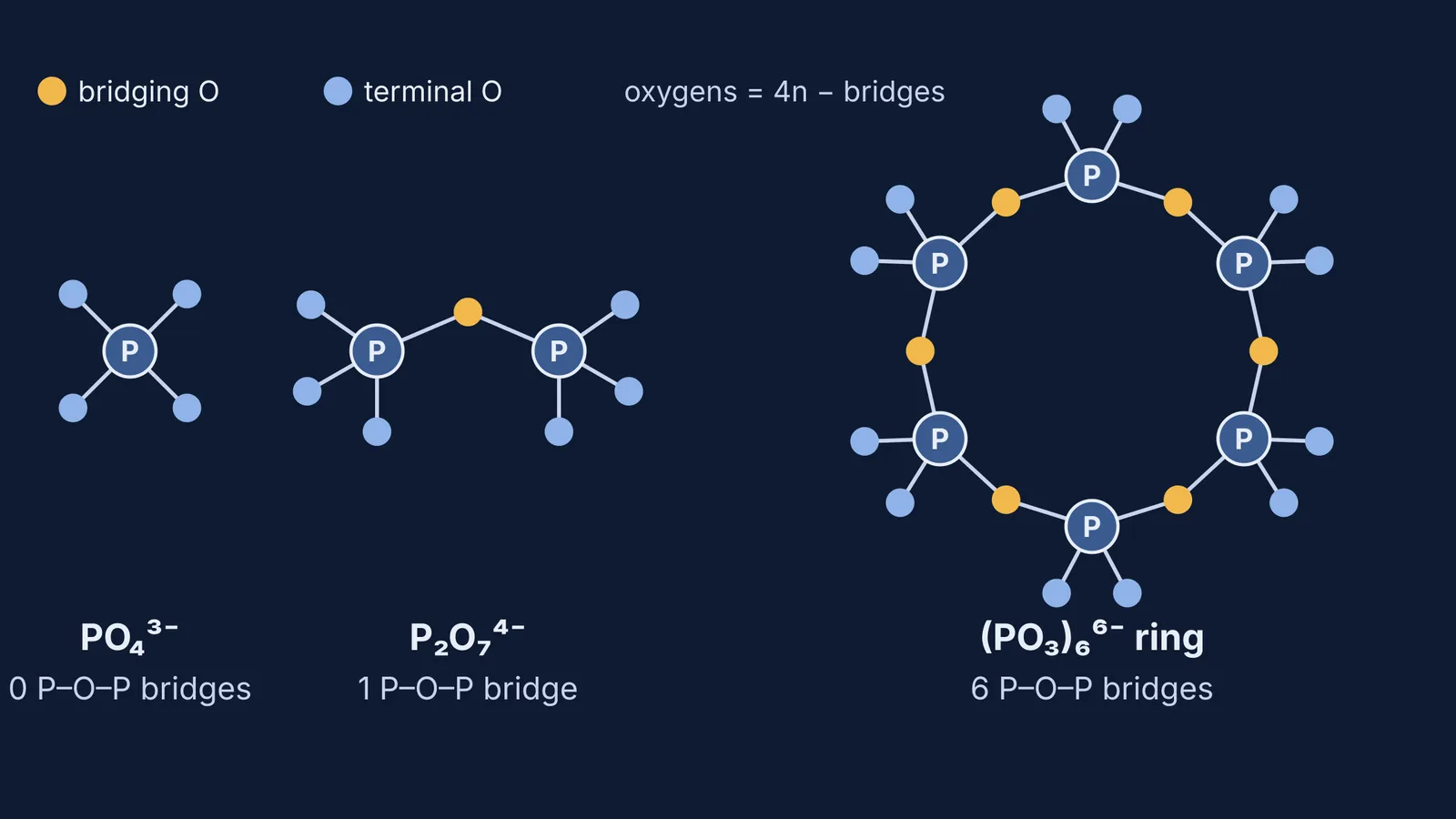
Every phosphate is built from PO₄ tetrahedra. Two tetrahedra can share a corner oxygen, which makes a P–O–P bridge. A shared oxygen belongs to two phosphorus atoms, so for n phosphorus atoms and b bridges:
number of oxygens = 4n − b
charge = 5n − 2(4n − b) = 2b − 3n (each P is +5, each O is −2)
Try it:
Orthophosphate, PO₄³⁻: n = 1, b = 0. Oxygens 4, charge −3.
Pyrophosphate, P₂O₇⁴⁻: n = 2, b = 1. Oxygens 7, charge −4.
Cyclic hexametaphosphate, (PO₃)₆⁶⁻: n = 6, b = 6. Oxygens 18, charge −6.
Cyclic (HPO₃)₃, the ring NCERT draws: n = 3, b = 3.
A straight chain of n units: b = n − 1, so the anion is PₙO₍₃ₙ₊₁₎ with charge −(n + 2).
A ring has as many bridges as phosphorus atoms; a chain has one fewer. Breaking each bridge takes one water: (PO₃)₆⁶⁻ + 6H₂O → 6H₂PO₄⁻. Check it: 6 P, 24 O, 12 H and a charge of −6 on each side. For the acids behind these anions, see how to draw the oxoacids of phosphorus and sulphur.
What does the orthophosphate test in IS 19004 do?
Annex D warms 0.1 g of sample in hot dilute nitric acid on a steam bath for 10 minutes, cools it, neutralises it to litmus with NaOH and adds silver nitrate. The standard says: "A yellow precipitate is formed which is soluble in dilute nitric acid test solution."
The yellow solid is silver orthophosphate: 3Ag⁺ + PO₄³⁻ → Ag₃PO₄. In textbook qualitative analysis, silver pyrophosphate and metaphosphate are white; only orthophosphate gives the yellow salt. The standard does not explain the warming step, but hot acid hydrolyses P–O–P bridges, turning metaphosphate into orthophosphate that silver can then show.
Where does 0.003086 g of P₂O₅ per mL of NaOH come from?
Annex A, the assay, works like this:
Dissolve 1 g of the dried sample and make it up to 500 ml. Pipette out 25 ml, which the standard notes is 50 mg of sample.
Add concentrated nitric acid, warm water, ammonium nitrate, then ammonium molybdate at 50 °C. Yellow ammonium phosphomolybdate precipitates.
Filter and wash until the washings are no longer acidic.
Dissolve the precipitate in 60 ml of 1 N NaOH and back-titrate the excess with 1 N H₂SO₄ to phenolphthalein.
The standard then says: "Each ml of 1 N sodium hydroxide consumed is equivalent to 0.003 086 g of P₂O₅."
Run it backwards: P₂O₅ = 141.94 g/mol, and 141.94 ÷ 3.086 = 46.0. So one P₂O₅ uses 46 OH⁻, which is 23 OH⁻ per phosphorus. Write the precipitate as (NH₄)₃PO₄·12MoO₃:
each MoO₃ needs 2 OH⁻ to become MoO₄²⁻, so 12 × 2 = 24 OH⁻;
at the phenolphthalein end point the phosphate is HPO₄²⁻, and turning PO₄³⁻ into HPO₄²⁻ gives back one OH⁻;
the ammonium ions are not titrated.
So 24 − 1 = 23. The ionic equation is (NH₄)₃PMo₁₂O₄₀ + 23OH⁻ → HPO₄²⁻ + 12MoO₄²⁻ + 3NH₄⁺ + 11H₂O. Check it: N 3, H 35, P 1, Mo 12, O 63 and a charge of −23 on both sides. How the precipitate forms is in our ammonium molybdate test for phosphate.
Worked example: from a titre to % P₂O₅
Suppose you dried and weighed exactly 1 g, took the 25 ml aliquot (50 mg), added 60.0 ml of 1 N NaOH, and the back titration took 49.0 ml of 1 N H₂SO₄.
NaOH used by the precipitate: x = 60.0 − 49.0 = 11.0 ml, or 11.0 meq.
Mass of P₂O₅: 11.0 × 3.0857 = 33.94 mg.
Percentage: 33.94 ÷ 50 × 100 = 67.9%. The standard's full formula, (60 − V₁N₁/N₂) × 0.06172/W × 100, gives the same answer: 0.06172 is just 20 × 0.003086, because the aliquot is one twentieth of the sample.
The shortcut: the standard also gives "x × 6.2", with this very example: 11 × 6.2 = 68.2%. The exact factor is 3.0857 ÷ 50 × 100 = 6.17% per ml.
The factor matters: 68.2% is above the 68.0% maximum, while 67.9% passes. The whole 67.0–68.0% window is 10.86 to 11.02 ml of NaOH, a span of 0.16 ml.
Why is the limit 67–68% and not 69.6%?
Pure (NaPO₃)ₙ contains 141.94 ÷ (2 × 101.96) × 100 = 69.61% P₂O₅ (11.28 ml in the assay), so a perfect ring of six would fail the 68.0% maximum. The standard does not explain this.
One calculation would explain it. This interpretation is ours, not the standard's, and we have not checked it against a source on commercial products. Suppose the material is a long chain with one extra Na₂O for the two chain ends, Na₍ₙ₊₂₎PₙO₍₃ₙ₊₁₎, which is n NaPO₃ + Na₂O. Then:
% P₂O₅ = (n/2 × 141.94) ÷ (n × 101.96 + 61.98) × 100
67.0% gives n ≈ 16, 67.5% gives n ≈ 20, and 68.0% gives n ≈ 26
Na₂O : P₂O₅ = 1 + 2/n, which is 1.13 to 1.08
A chain of only six, Na₈P₆O₁₉, would be 63.2%. So the limit fits an average chain of roughly 16 to 26 phosphorus atoms. Leftover moisture or impurities could also lower the figure; this does not rule them out.
Where does this come up in JEE and NEET?
Class 12 p-block: oxoacids of phosphorus, P–O–P links, ortho, pyro and meta.
Class 11 mole concept: percentage as an oxide, back titration, n-factors.
For more back-titration numericals, the Fermi Problem Library has a step-by-step solver that explains the reasoning, and the Fermi Concept Library covers every concept in chemistry with its own lesson.
Quick checklist
Oxygens = 4n − b; a ring has b = n, a chain b = n − 1.
Ortho has 0 bridges, pyro 1, cyclic hexametaphosphate 6.
Ammonium phosphomolybdate uses 23 OH⁻ per P, so 1 ml of 1 N NaOH = 3.086 mg P₂O₅.
On a 50 mg aliquot, % P₂O₅ = 6.17 × ml, not 6.2.
Pure NaPO₃ is 69.61% P₂O₅; IS 19004 asks for 67.0–68.0%.