

On this page
In the systematic qualitative salt analysis of inorganic compounds, detecting the orthophosphate radical (PO₄³⁻) relies on a characteristic precipitation reaction. When a solution containing phosphate is treated with concentrated nitric acid and excess ammonium molybdate, warming yields a bright canary yellow precipitate.
This reaction serves as the primary confirmatory test for phosphate in secondary school chemistry curricula, including CBSE and state boards, and appears regularly in examinations such as JEE Main and NEET-UG. Understanding the role of each reagent, the stoichiometry of the reaction, and the coordination structure of the resulting precipitate ensures accurate results at the laboratory bench.
How do you perform the test for phosphate ion?
According to the official NCERT chemistry laboratory manual, the test uses an aqueous solution of the salt or a neutral sodium carbonate extract. In systematic qualitative analysis, phosphate is an independent radical because it does not evolve gases with dilute or concentrated sulphuric acid and requires specific precipitation reagents.
The laboratory procedure follows these steps:
Prepare the solution: Dissolve the salt in water or take the sodium carbonate extract in a clean test tube.
Acidify the sample: Add concentrated nitric acid (HNO₃) to create a strongly acidic medium, and warm gently.
Add the reagent: Introduce an excess of ammonium molybdate solution, (NH₄)₂MoO₄.
Heat the mixture: Warm the contents of the test tube gently over a water bath or low Bunsen flame, taking care not to boil violently.
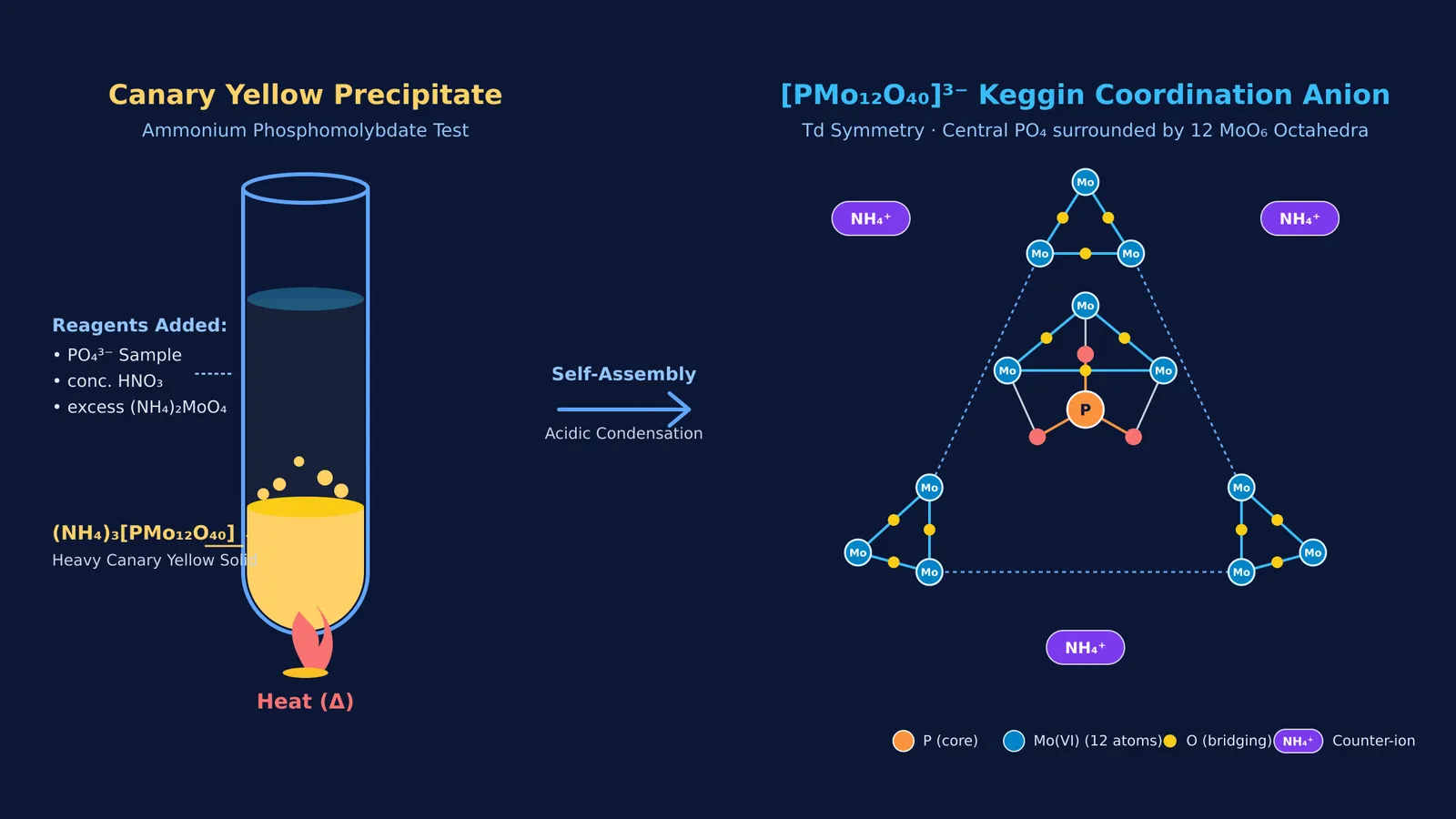
Upon heating, a heavy, canary yellow precipitate settles at the bottom of the tube, confirming the presence of phosphate.
For students working through anion identification, memorising precipitate colours is essential. The canary yellow solid formed here is as diagnostically distinct as the yellow precipitate obtained in the iodoform test for methyl ketones or the mirror formed during Tollens' test for aldehydes.
What is the ammonium molybdate yellow precipitate?
The bright yellow precipitate is ammonium phosphomolybdate, an inorganic coordination compound with the chemical formula (NH₄)₃[PMo₁₂O₄₀] [[1]](https://en.wikipedia.org/wiki/Ammonium_phosphomolybdate). In introductory textbooks, it is often written as the double-salt hydrate (NH₄)₃PO₄·12MoO₃ to simplify molar calculations, though crystallographic studies show that it contains a discrete heteropolyanion.
When phosphate reacts with ammonium molybdate in nitric acid, the condensation reaction is represented by the balanced equation:
Na₂HPO₄ + 12(NH₄)₂MoO₄ + 23HNO₃ ⟶ (NH₄)₃[PMo₁₂O₄₀] + 2NaNO₃ + 21NH₄NO₃ + 12H₂O
In this reaction, the orthophosphate ion acts as a template for 12 molybdate units. The resulting [PMo₁₂O₄₀]³⁻ complex is a classic example of a Keggin structure, first resolved by J. F. Keggin in the Proceedings of the Royal Society of London. Structural characterisations, such as the crystallographic analysis by Ghosh and colleagues in Nanoscale Advances, confirm that the phosphomolybdate anion crystallises in a cubic lattice (space group Pn-3m).
Inside the Keggin cage, a central PO₄ tetrahedron is coordinated to 12 MoO₆ octahedra grouped into four edge-sharing Mo₃O₁₃ triads. The polyoxometalate framework is enclosed by 40 oxygen atoms: 4 central oxygens bonded to phosphorus, 12 terminal oxo oxygens, and 24 bridging oxygens connecting the molybdenum centres. Three ammonium cations (NH₄⁺) balance the 3− charge of the cage, producing an insoluble salt that rapidly precipitates from acidic water.
When connecting reaction stoichiometry to underlying coordination geometry, the Fermi Concept Library covers every concept in chemistry with its own lesson and its place in the map, helping you trace how oxidation states and coordination numbers govern chemical tests.
Why is concentrated nitric acid added in the phosphate test?
A common question during laboratory vivas is why the reaction requires concentrated nitric acid rather than hydrochloric acid (HCl) or sulphuric acid (H₂SO₄). The NCERT practical curriculum specifies nitric acid for three critical chemical reasons:
Facilitating condensation: Acidic conditions drive molybdate ions (MoO₄²⁻) to condense into the [PMo₁₂O₄₀]³⁻ polyanion. In neutral or alkaline solutions, the equilibrium reverses, dissolving the yellow precipitate into simple molybdate and phosphate.
Preventing interference: Nitric acid introduces nitrate (NO₃⁻), avoiding insoluble sulphates (such as BaSO₄ or CaSO₄) that sulphuric acid would form, or chloro-complexes produced by hydrochloric acid.
Stabilising molybdenum in the +6 state: Molybdenum in the yellow Keggin complex is in its maximum +6 oxidation state. Nitric acid acts as an oxidising acid, preventing trace reducing agents from converting molybdenum(VI) to molybdenum(V). If reduction occurs, the solution turns a deep colloidal blue—known as molybdenum blue—ruining the canary yellow confirmation.
How do you avoid false test results in qualitative salt analysis?
When performing the phosphate confirmatory test at the bench, simple procedural mistakes can cause false negatives or ambiguous observations. To ensure reliable identification, keep these practical points in mind:
Add ammonium molybdate in excess: The stoichiometry established in the NCERT laboratory guidelines requires 12 moles of molybdate per mole of phosphate. Adding too little reagent causes false negatives. Always add an excess of ammonium molybdate solution.
Warm gently without violent boiling: The condensation reaction is endothermic and requires thermal energy to proceed at a measurable rate. However, overheating or boiling violently can decompose the reagent or cause acid splashing. Warm the tube gently in a water bath until the yellow solid appears.
Distinguish precipitate from solution colour: A positive confirmation requires a distinct, opaque canary yellow precipitate that settles to the bottom upon standing. A faint yellow colour in a transparent solution merely indicates dissolved molybdic acid, not a positive phosphate test.
Confirm by alkaline dissolution: If you need to re-verify the precipitate, decant the supernatant liquid and add dilute ammonium hydroxide (NH₄OH) or sodium hydroxide (NaOH). The yellow solid dissolves readily to form a clear, colourless solution of ammonium molybdate and phosphate.
For worked practice solving salt analysis problems and balancing multi-step inorganic reactions, the Fermi Problem Library provides worked problems with a step-by-step solver that explains the reasoning rather than printing an answer.


