On this page
Why doesn't boiling remove permanent hardness?
Hard water is water that does not lather easily with soap because it carries dissolved calcium and magnesium salts, as the University of Lucknow water technology notes define it. Temporary hardness comes from the hydrogencarbonates, which break down to insoluble CaCO₃ or Mg(OH)₂ when you boil the water. Permanent hardness comes from soluble calcium and magnesium salts other than hydrogencarbonate, such as chlorides and sulphates, and the same notes say boiling cannot remove it.
So every method for permanent hardness does one of three things to Ca²⁺ and Mg²⁺: pulls them out as a solid, locks them inside a soluble complex, or swaps them for a harmless ion.
For context, India's drinking-water standard IS 10500:2012 sets an acceptable limit of 200 mg/L total hardness as CaCO₃, and 600 mg/L where no other source exists (CPCB copy of IS 10500). If you first need to turn a titration result into that unit, see our guide to calculating hardness of water in ppm of CaCO₃.
How does washing soda remove permanent hardness?
Washing soda is crystalline sodium carbonate, Na₂CO₃·10H₂O, and the NIOS chemistry lesson on s-block elements lists the treatment of hard water among its uses. Its carbonate ions precipitate calcium and magnesium, leaving only sodium salts in solution. The Lucknow notes give all four reactions:
CaCl₂ + Na₂CO₃ → CaCO₃↓ + 2NaCl
CaSO₄ + Na₂CO₃ → CaCO₃↓ + Na₂SO₄
MgCl₂ + Na₂CO₃ → MgCO₃↓ + 2NaCl
MgSO₄ + Na₂CO₃ → MgCO₃↓ + Na₂SO₄
The pattern is a partner swap: the hardness leaves as a solid you can filter off.
How does Calgon soften water without a precipitate?
Calgon is sodium hexametaphosphate, written Na₂[Na₄(PO₃)₆] in the Lucknow notes. Here calcium takes the place of sodium in the complex and stays dissolved:
Na₂[Na₄(PO₃)₆] + 2CaSO₄ → Na₂[Ca₂(PO₃)₆] + 2Na₂SO₄
The notes describe this as internal treatment for boilers, where converting CaSO₄ into a soluble complex prevents scale. The exam trap: the calcium is still in the water, just tied up in the complex instead of being free to react.
What happens in the zeolite (permutit) process?
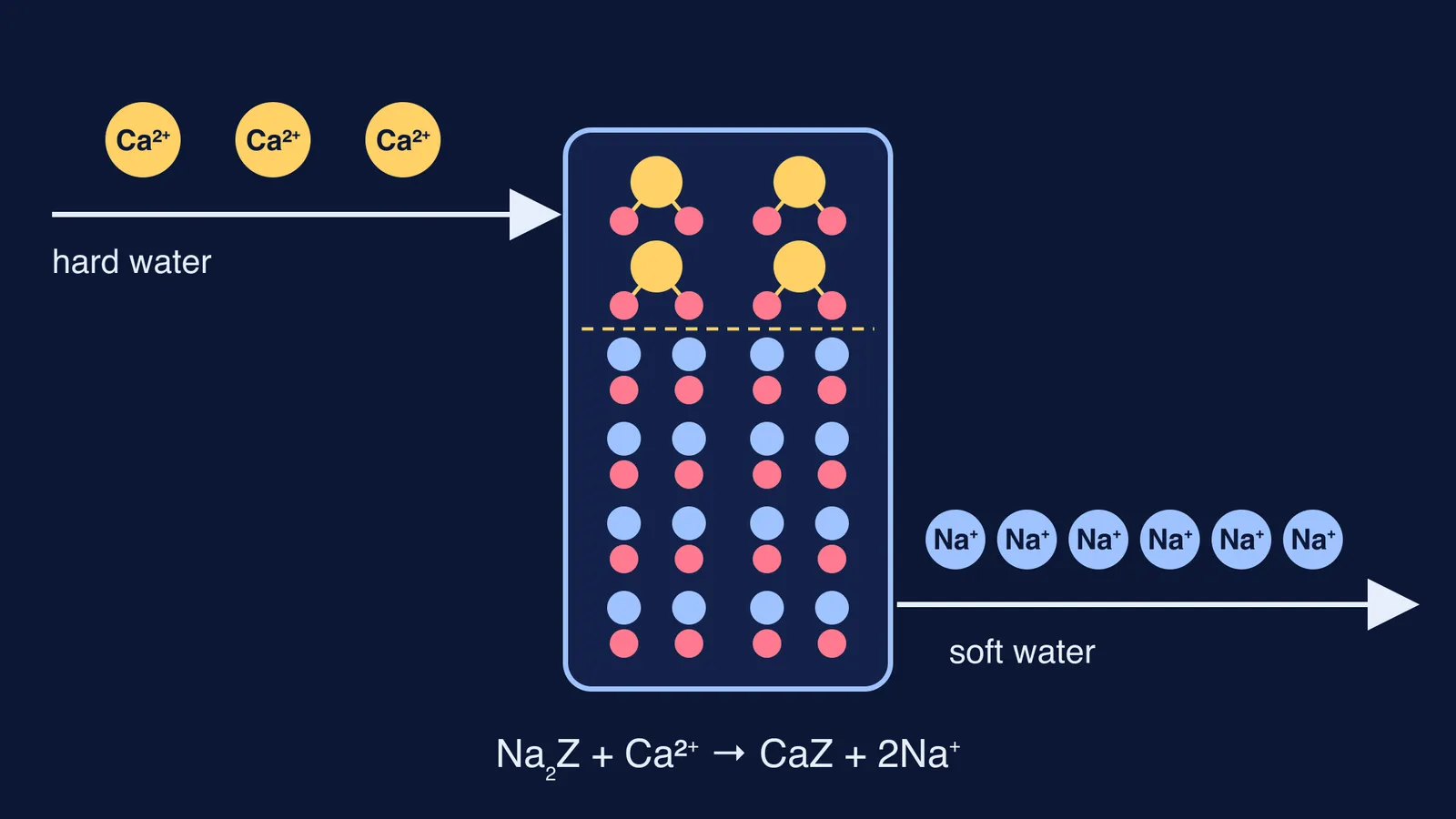
Zeolite is a hydrated sodium aluminium silicate, Na₂O·Al₂O₃·xSiO₂·yH₂O, written Na₂Ze in the notes and often shortened to Na₂Z; the method is also called the permutit process (Lucknow notes). Hard water flows through a bed of it, and each Ca²⁺ or Mg²⁺ takes the place of two Na⁺:
Na₂Z + Ca²⁺ → CaZ + 2Na⁺
Na₂Z + MgSO₄ → MgZ + Na₂SO₄
When all the sodium has been used up, the bed is exhausted. The same notes say it is regenerated with brine, a 10% NaCl solution, which pushes the reaction backwards (balanced here with 2NaCl):
CaZ + 2NaCl → Na₂Z + CaCl₂
MgZ + 2NaCl → Na₂Z + MgCl₂
How do ion-exchange resins demineralise water?
Synthetic resins go one step further and use two columns, as set out in the Lucknow notes. The cation-exchange resin carries –SO₃H groups and swaps metal ions for H⁺:
2R–SO₃H + Ca²⁺ → (R–SO₃)₂Ca + 2H⁺
2R–SO₃H + Mg²⁺ → (R–SO₃)₂Mg + 2H⁺
The anion-exchange resin carries –NR₃⁺OH⁻ groups and swaps anions such as Cl⁻ and SO₄²⁻ for OH⁻:
R–NR₃⁺OH⁻ + Cl⁻ → R–NR₃⁺Cl⁻ + OH⁻
H⁺ + OH⁻ → H₂O
The exhausted columns are regenerated with dilute H₂SO₄ or HCl (cation resin) and aqueous NaOH (anion resin). The key contrast: zeolite trades calcium for sodium, so sodium salts remain, while the resin pair removes both cations and anions.
Worked example: one sample, four methods
Take water with permanent hardness of 200 mg/L as CaCO₃, all present as CaCl₂ (the IS 10500 acceptable limit in the CPCB copy).
Moles: 200 mg ÷ 100 g/mol (CaCO₃) = 2 mmol Ca²⁺ per litre.
Washing soda reacts 1 : 1, so you need 2 mmol Na₂CO₃, or 212 mg of anhydrous Na₂CO₃ per litre.
Calgon binds two Ca²⁺ per formula unit, so 1 mmol per litre; the calcium stays dissolved.
Zeolite takes up 2 mmol Ca²⁺ and releases 4 mmol Na⁺, which is 92 mg of sodium per litre.
The resin pair turns 2 mmol Ca²⁺ into 4 mmol H⁺ and 4 mmol Cl⁻ into 4 mmol OH⁻, which neutralise to water.
If you mix up which product goes with which method, the Fermi Problem Library has worked problems with a step-by-step solver that explains the reasoning rather than printing an answer. If ion exchange itself still feels fuzzy, the Fermi Concept Library gives each concept its own lesson.
Next, see why hard water wastes soap but not detergent in our explainer on the difference between soap and detergent.