On this page
Drop a piece of chalk (calcium carbonate) into water and almost nothing happens. Drop it into dilute hydrochloric acid and it fizzes away. Silver chloride does not do this: it stays put in acid. The difference is the anion, and whether acid can take it out of the equilibrium.
Why do salts of weak acids dissolve more in acid?
Start with the solubility equilibrium of calcium fluoride: CaF2(s) ⇌ Ca2+ + 2F-, with Ksp = [Ca2+][F-]^2. The Ksp of CaF2 is 4.0 × 10^-11 at 25 °C, according to the OpenStax Chemistry 2e table of solubility products.
Fluoride is the conjugate base of hydrofluoric acid, a weak acid with Ka = 6.4 × 10^-4 (OpenStax table of weak-acid constants). So in acid, a second equilibrium runs alongside the first: H+ + F- ⇌ HF.
Every fluoride ion that becomes HF leaves the solubility equilibrium. The product [Ca2+][F-]^2 falls below Ksp, and by Le Chatelier's principle more solid dissolves to bring it back. This is protonation of the anion.
Which anions get protonated, and which do not?
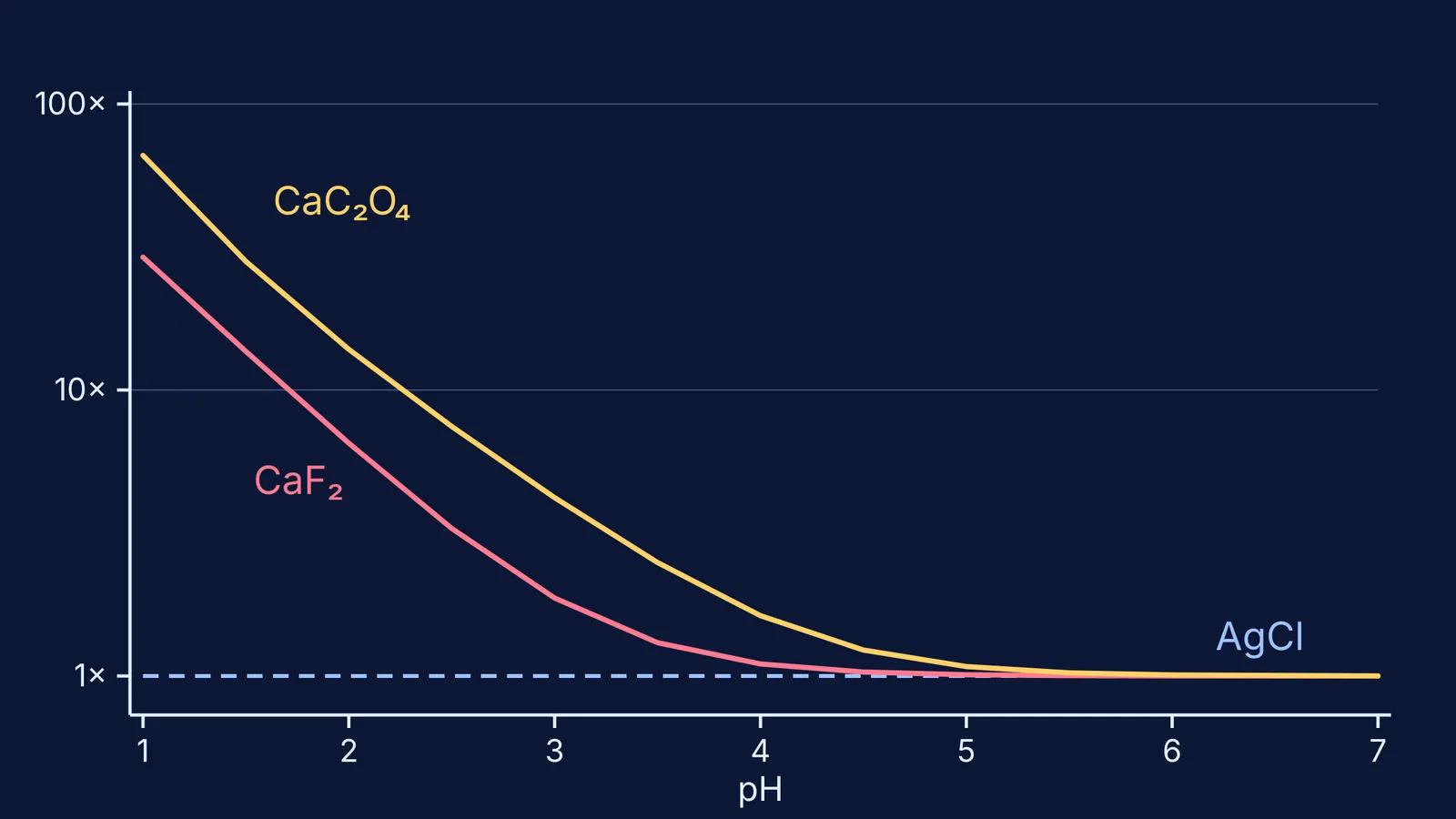
If the anion's parent acid is weak, acid removes the anion and solubility rises. If the parent acid is strong, the anion is too weak a base to pick up H+, and pH barely matters. OpenStax's section on coupled equilibria says the sharp rise in solubility with acidity "is typical of salts containing basic anions (e.g., carbonate, fluoride, hydroxide, sulfide)." The constants below are from the OpenStax weak-acid table.
Fluoride (CaF2): F- + H+ → HF.
Carbonate (CaCO3): CO3 2- + H+ → HCO3- (Ka2 of carbonic acid is 4.7 × 10^-11), then HCO3- + H+ → H2CO3 → CO2 + H2O. The gas escapes, so the reaction keeps going.
Oxalate (CaC2O4): C2O4 2- + H+ → HC2O4- (Ka2 = 6.1 × 10^-5), then on to H2C2O4 (Ka1 = 6.0 × 10^-2). Two protonation steps make the effect grow quickly as pH falls.
Chloride (AgCl): HCl is a strong acid, so Cl- is not protonated. Adding dilute HCl does not help; the extra chloride lowers solubility through the common-ion effect.
For calcium carbonate, OpenStax combines the two steps into CaCO3(s) + H3O+ ⇌ Ca2+ + HCO3- + H2O with K = Ksp/Ka2 = 180, and notes this is "much greater than the Ksp for calcium carbonate" of 8.7 × 10^-9 (OpenStax). Check it yourself: 8.7 × 10^-9 ÷ 4.7 × 10^-11 ≈ 185.
How much more does CaF2 dissolve at pH 1?
Here is the calculation, using Ksp = 4.0 × 10^-11 from the OpenStax Ksp table and Ka(HF) = 6.4 × 10^-4 from the OpenStax Ka table.
In pure water: Ksp = s(2s)^2 = 4s^3, so s = (1.0 × 10^-11)^(1/3) ≈ 2.2 × 10^-4 mol/L.
In acid, the total fluoride, 2s, is split between F- and HF. The fraction left as free F- is α = Ka/(Ka + [H+]).
At pH 1, [H+] = 0.10 M, so α = 6.4 × 10^-4 ÷ 0.10064 ≈ 6.4 × 10^-3. Only about 1 fluoride in 160 is free.
Put only the free fluoride into Ksp: Ksp = s(2sα)^2 = 4s^3α^2, so s = (Ksp/4α^2)^(1/3) ≈ 6.3 × 10^-3 mol/L.
Compare: 6.3 × 10^-3 ÷ 2.2 × 10^-4 ≈ 29. CaF2 is about 29 times more soluble at pH 1 than in water.
At pH 3, α ≈ 0.39, giving s ≈ 4.0 × 10^-4 mol/L: less than twice the water value. The effect is large only when [H+] is well above Ka, that is, when pH is well below the pKa of HF (about 3.2). This model ignores activity coefficients and the HF2- ion, which is fine for exam-level answers.
If step 4 is where your algebra slips, the Fermi Problem Library has worked problems with a step-by-step solver that explains the reasoning rather than printing an answer.
How do you spot this in a JEE or board question?
Use this check when a question gives a sparingly soluble salt and a pH:
Name the anion's parent acid. Strong (HCl, HBr, HI, HNO3)? pH does not matter, apart from any common ion. Weak? Expect more solubility in acid.
Compare [H+] with Ka (Ka2 first, for oxalate or carbonate). If [H+] is much smaller than Ka, the change is small.
For a quick yes or no, combine the equilibria: K = Ksp/Ka for one protonation step.
For a number, put the free-anion fraction α into the Ksp expression, never the total anion.
Sanity check: for a weak-acid anion, the answer in acid must be larger than in pure water.
The same chemistry explains why tooth decay starts when mouth pH falls below 5.5. For the measurement side, see how to find the solubility and Ksp of AgCl from conductivity, or practise predicting Le Chatelier shifts in a simulation.
To revise Ksp, Ka and Le Chatelier together, the Fermi Concept Library gives each concept its own lesson and shows its place in the map.