On this page
Inverse trigonometric functions suit numerical-value questions well: the standard values are simple fractions of π, and a question turns them into a whole number by multiplying by 6/π or 12/π. The official JEE Main 2027 syllabus lists inverse trigonometric functions and their properties in Unit 14 (Trigonometry), and Unit 7 adds their differentiation. The eight questions below are original, ordered easy to hard, and every answer is an integer.
How are JEE Main numerical value questions marked?
The JEE Main 2027 Information Bulletin from NTA gives Paper 1 Mathematics 20 multiple-choice questions in Section A and 5 numerical-value questions in Section B, for 100 marks. A correct numerical answer earns +4, an incorrect one −1 and an unanswered question 0. You type the integer with an on-screen keypad, and the bulletin says the answer should be rounded off to the nearest integer.
With no options to compare against, your own check is the only safety net, and a wrong number costs a mark.
Which inverse trigonometric questions come up as numerical values?
Q1. Find (6/π)[sin⁻¹(−1/2) + cos⁻¹(−1/2) + tan⁻¹√3].
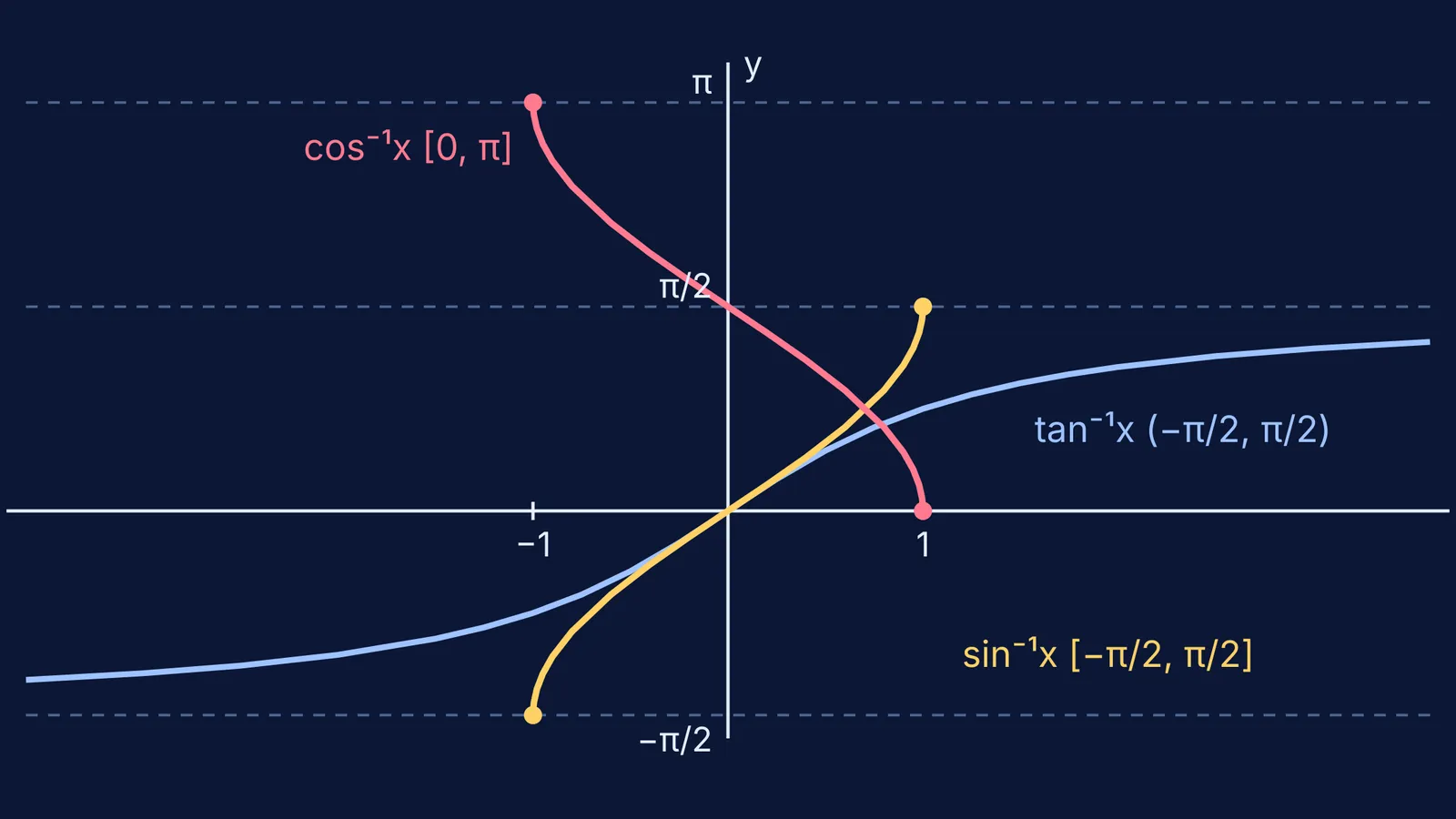
sin⁻¹(−1/2) = −π/6, cos⁻¹(−1/2) = 2π/3 and tan⁻¹√3 = π/3. The sum is −π/6 + 4π/6 + 2π/6 = 5π/6.
Answer: 5. Check: cos⁻¹ of a negative number lies between π/2 and π, and 2π/3 does. Slip: taking cos⁻¹(−1/2) = −π/3, which gives −1.
Q2. Find (12/π)[cos⁻¹(cos 7π/6) + sin⁻¹(sin 5π/6)].
7π/6 lies outside [0, π]. Since cos(7π/6) = −√3/2 = cos(5π/6), cos⁻¹(cos 7π/6) = 5π/6. Likewise sin(5π/6) = 1/2, so sin⁻¹(sin 5π/6) = π/6. The sum is π.
Answer: 12. Check: 5π/6 and π/6 each sit inside their principal ranges. Slip: cancelling straight away to 7π/6 + 5π/6 = 2π, which gives 24.
Q3. Find 65 sin[sin⁻¹(3/5) + cos⁻¹(12/13)].
Let A = sin⁻¹(3/5), so sin A = 3/5 and cos A = 4/5. Let B = cos⁻¹(12/13), so cos B = 12/13 and sin B = 5/13. Then sin(A + B) = (3/5)(12/13) + (4/5)(5/13) = 56/65.
Answer: 56. Check: 56/65 is less than 1, as a sine must be. Slip: swapping sin B and cos B gives 15/65 + 48/65, so 63.
Q4. Find (4/π)(tan⁻¹2 + tan⁻¹3).
The rule tan⁻¹x + tan⁻¹y = tan⁻¹[(x + y)/(1 − xy)] holds only when xy < 1. Here x, y > 0 and xy = 6 > 1, so add π: tan⁻¹(5/(−5)) + π = −π/4 + π = 3π/4.
Answer: 3. Check: each angle lies between π/4 and π/2, so the sum lies between π/2 and π. Slip: forgetting the π gives −1.
What do the harder inverse trigonometric numerical questions look like?
Q5. If tan⁻¹(x + 1) + tan⁻¹(x − 1) = tan⁻¹(8/31), find 100x.
Take tan of both sides: 2x/(2 − x²) = 8/31, so 4x² + 31x − 8 = 0, which factors as (4x − 1)(x + 8) = 0. For x = −8 both angles on the left are negative, but tan⁻¹(8/31) is positive, so reject it. That leaves x = 1/4.
Answer: 25. Check: tan⁻¹1.25 − tan⁻¹0.75 ≈ 0.896 − 0.644 = 0.253, and tan⁻¹(8/31) ≈ 0.253. Slip: keeping x = −8 and typing −800.
Q6. Let S = tan⁻¹(1/3) + tan⁻¹(1/7) + … + tan⁻¹(1/111), the sum of tan⁻¹[1/(r² + r + 1)] for r = 1 to 10. Find 60 tan S.
Write 1/(r² + r + 1) = [(r + 1) − r]/[1 + r(r + 1)], so each term is tan⁻¹(r + 1) − tan⁻¹r. The sum telescopes to tan⁻¹11 − tan⁻¹1 = tan⁻¹[(11 − 1)/(1 + 11)] = tan⁻¹(5/6).
Answer: 50. Check: for r = 1 alone, tan⁻¹2 − tan⁻¹1 = tan⁻¹(1/3), the first term. Slip: ending the telescope at tan⁻¹10 gives 60 × 9/11 ≈ 49.09, typed as 49.
Q7. M and m are the greatest and least values of (sin⁻¹x)² + (cos⁻¹x)². Find M/m.
Let t = sin⁻¹x, with t in [−π/2, π/2], so cos⁻¹x = π/2 − t. Then f = t² + (π/2 − t)² = 2t² − πt + π²/4, an upward parabola with its vertex at t = π/4, so m = π²/8. The far endpoint t = −π/2 gives M = π²/4 + π² = 5π²/4.
Answer: 10. Check: at t = π/2, f is only π²/4, smaller than at t = −π/2. Slip: taking M at t = π/2 gives 2.
Q8. If f(x) = sin⁻¹[2x/(1 + x²)], find 10[f′(1/3) − f′(3)].
Put x = tan θ, so 2x/(1 + x²) = sin 2θ. For |x| ≤ 1, 2θ lies in [−π/2, π/2], so f = 2tan⁻¹x and f′ = 2/(1 + x²). For x > 1, 2θ lies in (π/2, π), so f = π − 2tan⁻¹x and f′ = −2/(1 + x²). So f′(1/3) = 9/5 and f′(3) = −1/5.
Answer: 20. Check: differentiate directly at x = 3, where the inside is 0.6 with derivative −0.16; f′ = −0.16/√(1 − 0.36) = −0.2. Slip: using 2/(1 + x²) for both points gives 16.
How should you practise these before the exam?
Solve all eight with the solutions covered, writing each function's principal range in the margin first.
Note every miss and its slip in one line.
Two days later, redo only the misses.
For option-based practice, work through inverse trigonometric functions: 8 JEE Main questions solved; for the syllabus and a plan, read inverse trigonometric functions for JEE Main: how to prepare.
If a solution makes sense once you read it but you could not have started it yourself, the Fermi Problem Library has worked problems with a step-by-step solver that explains the reasoning rather than printing an answer. For the rest of your JEE preparation, Fermi Test Prep is our JEE Main and Advanced preparation.