On this page
A numerical value question cannot ask you to type a function or "+C". So a JEE Main Section B question on indefinite integrals has to ask for a number: a constant inside the antiderivative, or a value fixed by one condition. That format is worth practising on its own.
How are JEE Main numerical value questions marked?
The rules are in NTA's JEE (Main) 2027 Information Bulletin. In Paper 1, each of Mathematics, Physics and Chemistry has 20 multiple-choice questions in Section A and 5 numerical value questions in Section B. A correct Section B answer earns +4, a wrong one loses 1 mark, and a blank scores 0. You enter an integer on an on-screen keypad, and the answer should be rounded off to the nearest integer.
Because a wrong number costs a mark, type an answer only after you have checked it.
What do numerical value questions on indefinite integrals look like?
These are original questions in the Section B style, easiest first. Try each before reading on.
Q1. The chain factor
If ∫(2x+3)⁴dx = (2x+3)⁵/k + C, find k.
Solution: put u = 2x+3, so dx = du/2, giving (1/2)(u⁵/5) = (2x+3)⁵/10.
Answer: 10.
Check: d/dx of (2x+3)⁵/10 is 5·2·(2x+3)⁴/10 = (2x+3)⁴.
Slip: forgetting the 1/2 and typing 5.
Q2. Completing the square
If ∫dx/(x²+6x+13) = (1/a)tan⁻¹((x+b)/a) + C with a > 0, find a+b.
Solution: x²+6x+13 = (x+3)²+2², and ∫du/(u²+a²) = (1/a)tan⁻¹(u/a). So a = 2, b = 3.
Answer: 5.
Check: the derivative is (1/4)/(1+(x+3)²/4) = 1/((x+3)²+4).
Slip: taking a = 4, the square instead of its root, and typing 7.
Q3. An odd power of sine
If ∫sin³x cos²x dx = −cos³x/a + cos⁵x/b + C, find a+b.
Solution: write sin³x = (1−cos²x)sin x and put u = cos x, du = −sin x dx. The integral is −∫(u²−u⁴)du = −u³/3 + u⁵/5, so a = 3, b = 5.
Answer: 8.
Check: the derivative is sin x cos²x(1−cos²x) = sin³x cos²x.
Slip: dropping the minus in du, which flips both signs and gives −8.
Q4. Partial fractions
If ∫dx/(x²−5x+6) = ln|(x−a)/(x−b)| + C, find 10a+b.
Solution: 1/((x−2)(x−3)) = 1/(x−3) − 1/(x−2), which integrates to ln|x−3| − ln|x−2|. So a = 3, b = 2.
Answer: 32.
Check: at x = 4, the fractions give 1 − 1/2 = 1/2, and 1/(16−20+6) = 1/2.
Slip: swapping the partial fractions and typing 23.
Q5. The constant matters
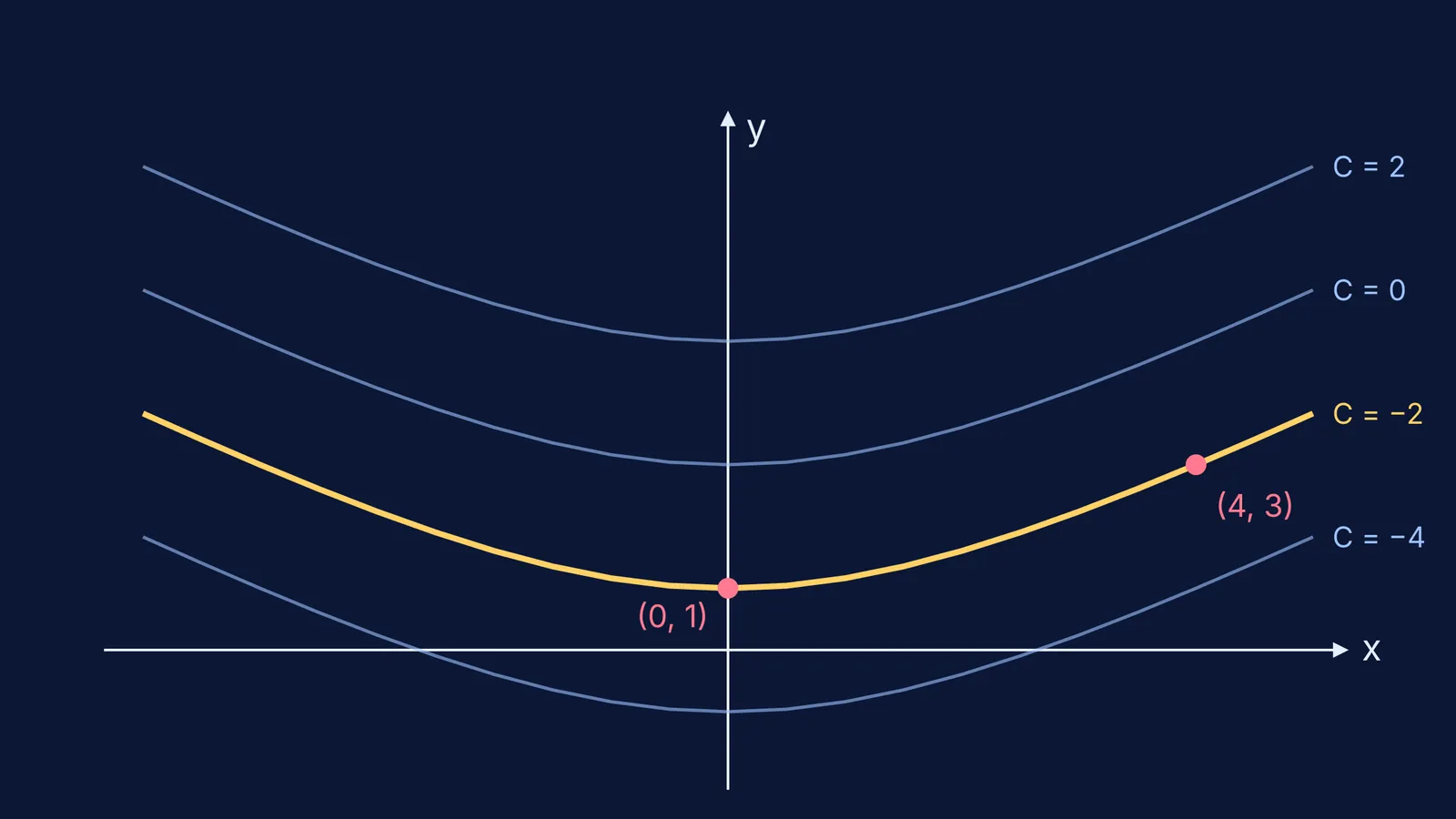
Let f(x) = ∫x/√(x²+9) dx with f(0) = 1. Find f(4).
Solution: with u = x²+9 the integral is √(x²+9) + C. Then 3 + C = 1, so C = −2 and f(4) = 5 − 2.
Answer: 3.
Check: f′(x) = x/√(x²+9), and f(0) = 3 − 2 = 1.
Slip: ignoring C and typing 5. Each C gives a different curve; the condition picks one.
Q6. By parts, twice
If ∫x²eˣdx = eˣ(x²+px+q) + C, find q−2p.
Solution: ∫x²eˣdx = x²eˣ − 2∫xeˣdx = x²eˣ − 2(xeˣ−eˣ). So p = −2, q = 2.
Answer: 6.
Check: the derivative of eˣ(x²−2x+2) is eˣ(x²−2x+2+2x−2) = x²eˣ.
Slip: writing ∫xeˣdx = xeˣ+eˣ, which makes q = −2 and the answer 2.
Q7. The eˣ(f+f′) pattern
If ∫eˣ(x+3)/(x+4)² dx = eˣ/(x+k) + C, find k.
Solution: split (x+3)/(x+4)² = 1/(x+4) − 1/(x+4)². With f = 1/(x+4), this is f+f′, so the integral is eˣf + C.
Answer: 4.
Check: the derivative of eˣ/(x+4) is eˣ[1/(x+4) − 1/(x+4)²].
Slip: reading k off the numerator and typing 3.
Q8. A sine-cosine denominator
If ∫dx/(sin x + √3cos x) = (1/a)ln|tan(x/2 + π/b)| + C, find ab.
Solution: sin x + √3cos x = 2sin(x + π/3). Since ∫cosec θ dθ = ln|tan(θ/2)|, the integral is (1/2)ln|tan(x/2 + π/6)| + C. So a = 2, b = 6.
Answer: 12.
Check: with θ = x/2 + π/6, the derivative is (1/4)sec²θ/tan θ = 1/(2sin 2θ) = 1/(2sin(x + π/3)).
Slip: forgetting to halve the angle, taking b = 3 and typing 6.
How should you practise integrals for Section B?
Solve each question against a timer with no options in view.
Differentiate your answer before you type the number.
Log every wrong number against its slip: chain factor, sign, missing constant or missed identity.
Redo the logged questions a few days later, without your old working.
If the same slip keeps returning from one step, the Fermi Problem Library has worked problems with a step-by-step solver that explains the reasoning rather than printing an answer.
For JEE Main and Advanced preparation beyond integrals, see Fermi Test Prep.