On this page
Section B of JEE Main gives you no options to eliminate: you type a number, and it matches or it doesn't. Application of Derivatives suits this format, since rates, tangents and optimisation all end in one value. Try each question before reading the solution.
How are JEE Main numerical value questions marked?
The JEE (Main) 2027 Information Bulletin from the National Testing Agency says Paper 1 has 5 Section B questions in each of Mathematics, Physics and Chemistry. The bulletin gives four marks (+4) for a correct numerical answer, minus one (−1) for an incorrect one and zero for a question left unanswered. You type the answer on an on-screen keypad, rounded off to the nearest integer. A wrong number costs a mark, so check before you type.
What do easy Application of Derivatives numerical questions look like?
1. Approximation
Using differentials, √36.6 ≈ a. Find 100a.
With y = √x, x = 36, Δx = 0.6: dy = Δx/(2√x) = 0.6/12 = 0.05, so a = 6.05. Answer: 605. Check: 6.05² = 36.6025, just above 36.6, as a tangent-line estimate of √x should be. Slip: dividing by √36 = 6 instead of 2√36 = 12 gives 610.
2. Rate of change
A balloon's radius grows at 0.5 cm/s. At radius 10 cm, its volume grows at kπ cm³/s. Find k.
V = (4/3)πr³, so dV/dt = 4πr² × dr/dt = 4π(100)(0.5) = 200π. Answer: 200. Check: dV/dt is surface area (400π at r = 10) times 0.5. Slip: writing dV/dr as (4/3)πr² gives 66.67, which you would enter as 67.
3. Mean value theorem
For f(x) = x² − 4x + 5 on [1, 5], find the c in (1, 5) given by Lagrange's mean value theorem.
f(5) = 10 and f(1) = 2, so the chord's slope is 8/4 = 2. Setting f′(c) = 2c − 4 = 2 gives c = 3. Answer: 3. Check: for a quadratic, c is the interval's midpoint, (1 + 5)/2. Slip: setting f′(c) = 0 (Rolle's habit) gives 2.
4. Tangents
The tangent to xy = 4 at (2, 2) meets the axes at A and B. Find the area of triangle OAB.
y = 4/x, so y′ = −4/x², which is −1 at x = 2. The tangent is y − 2 = −(x − 2), or x + y = 4, with intercepts 4 and 4. Area = ½ × 4 × 4. Answer: 8. Check: at (1, 4) the intercepts are 2 and 8, area 8 again; for xy = c² it is always 2c². Slip: dropping the ½ gives 16.
How do you solve the harder ones?
5. Local extrema
Find the sum of the local maximum and local minimum values of f(x) = x³ − 6x² + 9x + 1.
f′(x) = 3(x − 1)(x − 3), and f″(x) = 6x − 12 marks x = 1 as the maximum and x = 3 as the minimum. f(1) = 5, f(3) = 1. Answer: 6. Check: the maximum value exceeds the minimum value, 5 > 1. Slip: adding the points 1 + 3 instead of the values gives 4.
6. Monotonicity
How many integers k make f(x) = x³ + kx² + 27x + 5 increasing on the whole real line?
f′(x) = 3x² + 2kx + 27 must never be negative, so 4k² − 324 ≤ 0 and −9 ≤ k ≤ 9. Answer: 19. Check: at k = 9, f′(x) = 3(x + 3)², which is zero only at x = −3, so f still increases. Slip: demanding a strictly negative discriminant drops ±9 and gives 17.
7. Optimisation
Squares of side x cm are cut from the corners of a 24 cm square sheet, which is folded into an open box. Find the maximum volume in cm³.
V = x(24 − 2x)². V′ = (24 − 2x)(24 − 6x) = 0 gives x = 4 (x = 12 leaves no box). V(4) = 4 × 16². Answer: 1024. Check: V(3) = 972 and V(5) = 980, both smaller. Slip: forgetting that each side loses 2x and writing (24 − x)² gives 2048.
8. Shortest distance
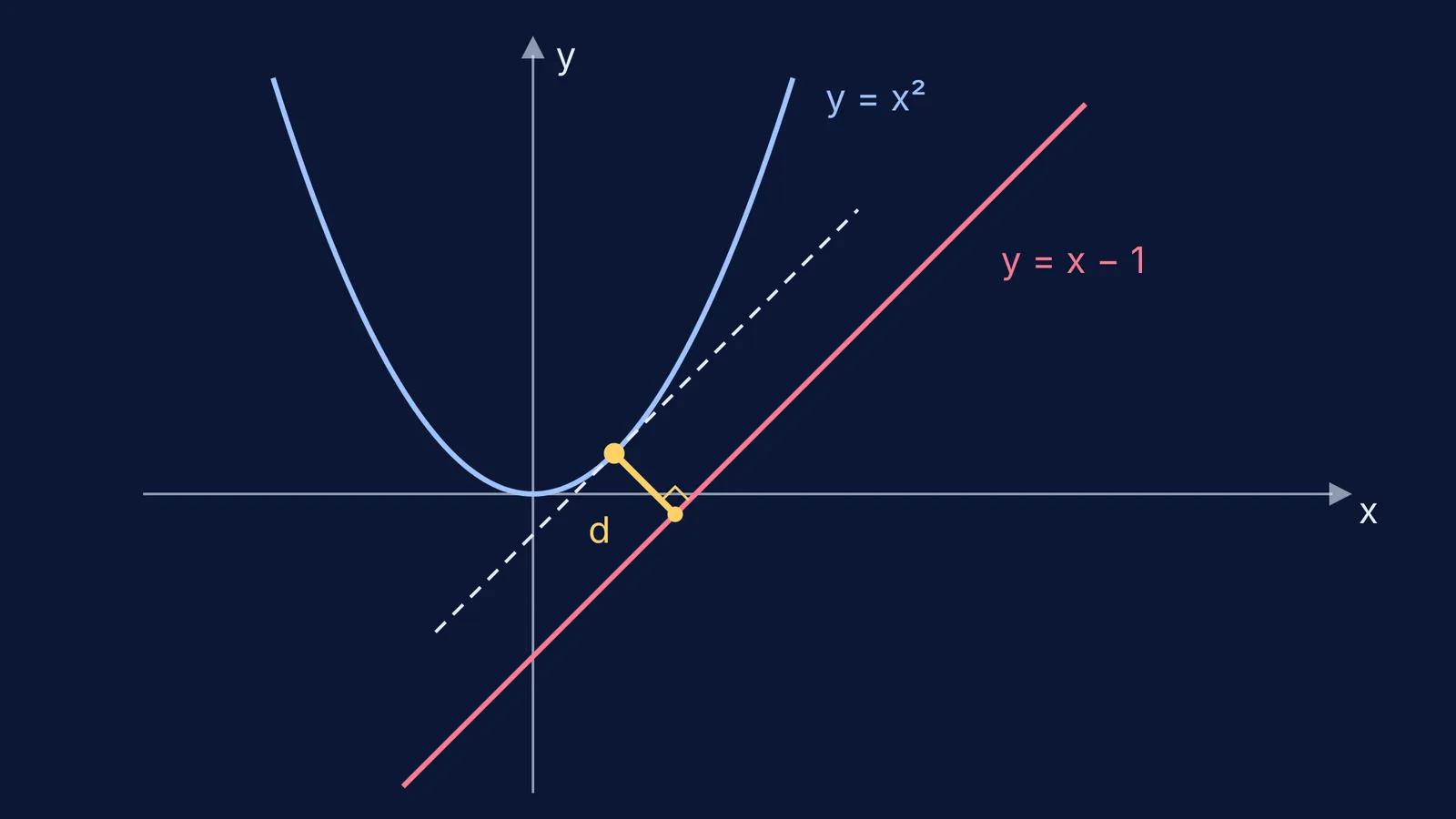
If d is the shortest distance between the parabola y = x² and the line y = x − 1, find 32d².
At the nearest point the tangent is parallel to the line: 2x = 1, giving (½, ¼). Its distance from x − y − 1 = 0 is ¾ ÷ √2, so d² = 9/32. Answer: 9. Check: the segment to its foot (7/8, −1/8) has slope −1, perpendicular to the line. Slip: using the vertical gap x² − x + 1 instead gives 18.
How should you practise these before the exam?
Check by a second route: a substitution, a nearby value or a shortcut.
Keep a slip log naming which slip cost you.
Mix the types to practise spotting the right tool.
When a method goes wrong, the Fermi Problem Library has worked problems with a step-by-step solver that explains the reasoning rather than printing an answer. For wider JEE Main and Advanced preparation, see Fermi Test Prep.