On this page
In JEE Main Section B there are no options to fall back on: you type a number. Here are eight original practice questions on limits, continuity and differentiability, each with a full solution, a quick check and the slip that most often gives a wrong number.
How are JEE Main numerical value questions marked?
In JEE Main Paper 1, each subject has 20 multiple-choice questions in Section A and 5 numerical value questions in Section B, according to the NTA's JEE (Main) 2026 Information Bulletin.
A correct numerical answer earns four marks, a wrong answer loses one mark, and a question left blank scores zero, under section 2.4.2 of the same bulletin. The bulletin also says the answer should be rounded off to the nearest integer, so every answer below is a whole number. Rules can change, so read the bulletin for your own session.
Can you solve these limits and continuity questions?
Q1. Find the limit of (x³ − 8)/(x − 2) as x → 2.
Factor: x³ − 8 = (x − 2)(x² + 2x + 4). Cancel and put x = 2. Answer: 12. Check: x = 2.001 gives about 12.006. Slip: substituting x = 2 straight away, seeing 0/0 and typing 0.
Q2. Find the limit of (1 − cos 6x)/x² as x → 0.
Write 1 − cos 6x = 2 sin²3x. Since sin 3x/x → 3, the limit is 2 × 9. Answer: 18. Check: the standard result (1 − cos kx)/x² → k²/2 gives 36/2. Slip: forgetting the half and typing 36.
Q3. If the limit of (1 + 3/x)^(2x) as x → ∞ equals e^k, find k.
This is the 1^∞ form, so k is the limit of 2x × (3/x), which is 6. Answer: 6. Check: x = 1000 gives about e^5.99. Slip: typing e⁶, roughly 403, when the question asks for k.
Q4. Let f(x) = (√(x + 16) − 4)/x for x ≠ 0, and f(0) = k. If f is continuous at 0, find 1/k.
Rationalise: f(x) = 1/(√(x + 16) + 4) → 1/8, so k = 1/8. Answer: 8. Check: x = 0.01 gives about 0.125. Slip: typing k = 0.125 itself, which rounds to 0.
Can you solve these harder limits and differentiability questions?
Q5. If L is the limit of (tan x − sin x)/x³ as x → 0, find 10L.
Write tan x − sin x = tan x (1 − cos x). Near 0 this behaves like x × x²/2, so L = 1/2. Answer: 5. Check: x = 0.01 gives about 0.500. Slip: replacing tan x and sin x by x separately, getting 0.
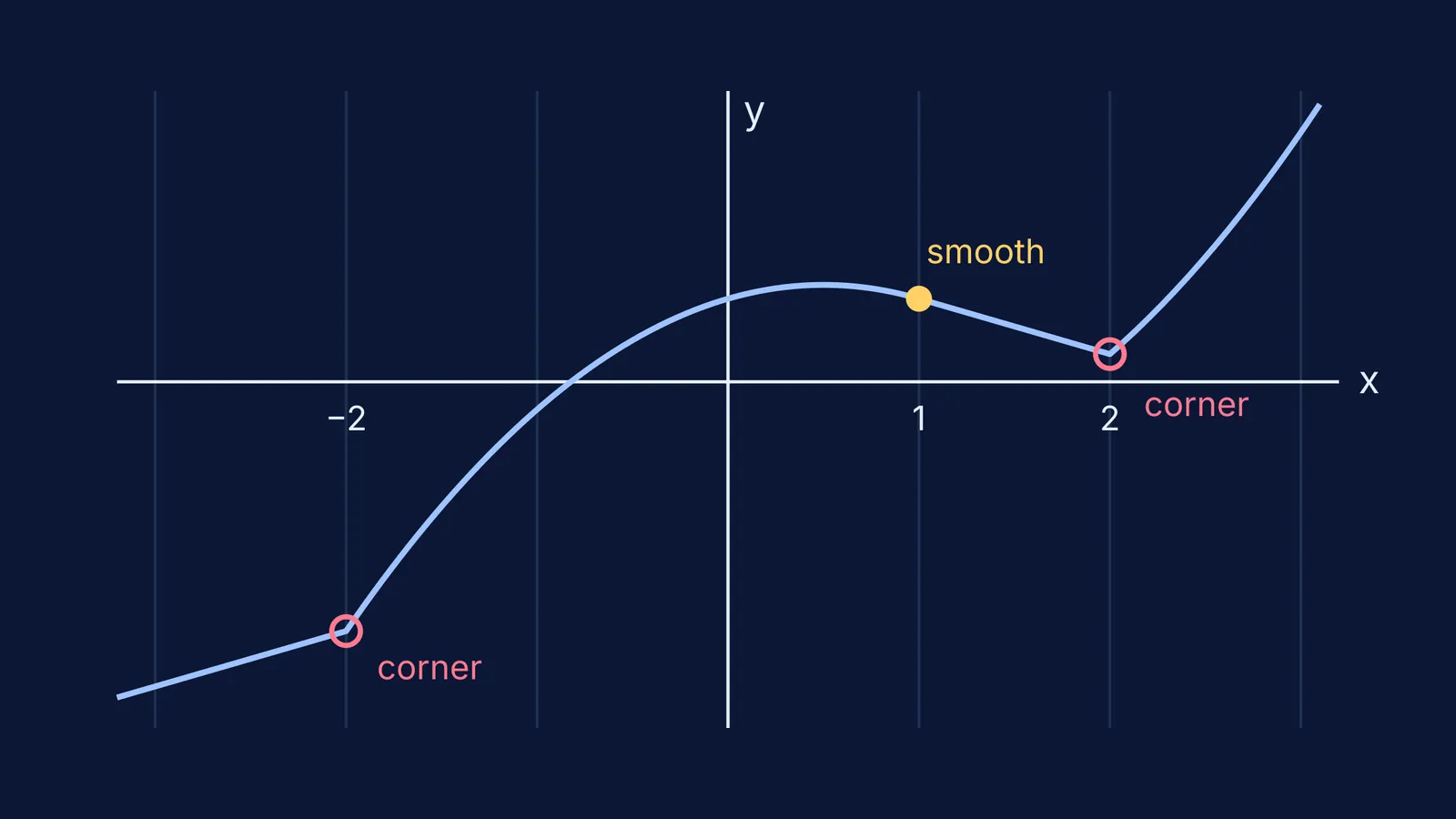
Q6. At how many points is f(x) = (x − 1)|x − 1| + |x² − 4| not differentiable?
|x² − 4| has corners at x = −2 and x = 2, where x² − 4 changes sign. The term (x − 1)|x − 1| has derivative 2|x − 1|, which is continuous, so x = 1 is smooth. Answer: 2. Check: at x = 2 the slope from the left is −2 and from the right is 6. Slip: counting x = 1 and typing 3.
Q7. Let f(x) = ax² + b for x ≤ 1, and f(x) = 6x − 2 for x > 1. If f is differentiable everywhere, find 10a + b.
Slopes must match at 1: 2a = 6, so a = 3. Values must match: a + b = 4, so b = 1. Answer: 31. Check: both pieces give f(1) = 4 and f′(1) = 6. Slip: using continuity alone, which cannot fix two unknowns.
Q8. A differentiable f satisfies f(x + y) = f(x) + f(y) + 2xy for all x, y, and f′(0) = 3. Find f(2).
Put x = y = 0 to get f(0) = 0. Then f′(x) is the limit of [f(h) + 2xh]/h as h → 0, which is f′(0) + 2x = 3 + 2x. So f(x) = x² + 3x, using f(0) = 0. Answer: 10. Check: x² + 3x satisfies the equation. Slip: stopping at f′(2) = 7.
How should you practise numerical value questions?
Use this routine on every question:
Re-read the last line: k or e^k, L or 10L.
Run one check: a nearby value, or slope and value on both sides of a joint.
Round only at the very end.
Log each slip in one line and redo that question type until it stops.
If you are stuck on a step rather than a slip, the Fermi Problem Library has a step-by-step solver that explains the reasoning rather than printing an answer. For wider planning, see Fermi Test Prep for JEE Main and Advanced preparation.
Try all eight again next week without the solutions.