On this page
Your textbook lists BeO, ZnO and PbO as amphoteric: they dissolve in acids and in alkalis. It rarely says how basic or how acidic each one is. In 1910 John Kerfoot Wood, of University College, Dundee, measured both sides. He worked out how far solutions of BeCl₂, ZnCl₂ and PbCl₂ are hydrolysed, and how far their sodium salts are hydrolysed in alkali. His paper is "Amphoteric Metallic Hydroxides. Part II", J. Chem. Soc. Trans. 97, 878–890. We read it in the scanned 1910 volume and checked every number below against the page images. Beryllium and lead compounds are toxic, so this post covers only the measurements and the maths.
Why does a solution of BeCl₂ or ZnCl₂ turn acidic?
Wood called beryllium "glucinum" (symbol Gl), the name used at the time. He wrote the hydrolysis like this, shown here with today's symbol:
BeCl₂ + H₂O ⇌ Be(OH)Cl + HCl
Check the balance: one Be, two Cl, two H and one O on each side. Today you would write the same idea with the hydrated ion: [Be(H₂O)₄]²⁺ ⇌ [Be(H₂O)₃(OH)]⁺ + H⁺. The charge is 2+ on both sides.
Only a few per cent of the salt hydrolyses, so Wood treated it as one step. Let x be the fraction of the chlorine present as free HCl. Then the basic chloride is also x, the unchanged chloride is 1 − 2x, and his hydrolysis constant is:
h = x² / ((1 − 2x)v)
Here v is the dilution: v = 1 for a normal solution and v = 10 for an N/10 one. From h he got the strength of the base with Kb = Kw/h, using Kw = 1.21 × 10⁻¹⁴, the value he took. This is the same Kh = Kw/Kb you use in Class 11. He was careful to say it gives only the "weaker hydroxyl" of each M(OH)₂.
How did Wood measure such small amounts of acid?
The free HCl was too dilute to titrate, so he compared each solution with known HCl in three ways.
Ester catalysis. H⁺ speeds up the hydrolysis of methyl formate, and the rate is proportional to [H⁺]. Equal amounts of ester hydrolysed in a time that is inversely proportional to the acid present.
A hydrogen electrode. He measured the EMF of H₂ | solution | NH₄NO₃ | Hg₂Cl₂ and compared it with the same cell filled with HCl of known strength.
Diazoacetic ester. For lead he timed the nitrogen given off, a method of Bredig and Fraenkel.
The careful part was the comparison solution. He always added KCl or BaCl₂ so that its total chloride matched the salt solution. He showed why it mattered: adding BaCl₂ to N/160 HCl moved the EMF from 0.4066 V to 0.4194 V, a shift of 0.0128 V. That is more than the 0.0092 V difference he was trying to read.
The ester method gave a quick result for N/8 BeCl₂ (N/8 with respect to chlorine). The rate constant was 0.00055, against 0.00053 for N/128 HCl. So [HCl] = (0.00055/0.00053) × (1/128) = 0.00811 N. Divide by 0.125: 6.5%, as he printed.
Worked example: degree of hydrolysis from an EMF
Wood's two cells were:
H₂ | N/8 BeCl₂ | NH₄NO₃ | Hg₂Cl₂, EMF 0.4076 V
H₂ | N/104 HCl + 12N/104 BaCl₂ | NH₄NO₃ | Hg₂Cl₂, EMF 0.3984 V
Note that the comparison side also has a total chloride of 13/104 = N/8. He used Nernst's rule d = 0.0572 log(c₁/c₂). The 0.0572 is 2.303RT/F at about 15 °C; at 25 °C it would be 0.0592.
Difference: ΔE = 0.4076 − 0.3984 = 0.0092 V.
Which side has more acid? More H⁺ makes the hydrogen electrode less negative and lowers this cell's EMF. The BeCl₂ cell reads higher, so it has less acid than N/104.
Ratio: c₁/c₂ = 10^(0.0092/0.0572) = 1.448.
Acid in BeCl₂: (1/104)/1.448 = N/151.
Degree of hydrolysis: (1/151)/(1/8) = 8/151 = 5.3%.
Wood printed N/145 and 8/145 = 5.5%. With the printed N/104, our arithmetic gives N/151. The gap is small, and we cannot tell from the page where it comes from. Either way the two methods agree roughly, and he gave about 6% as the mean.
What did Wood find for the three hydroxides?
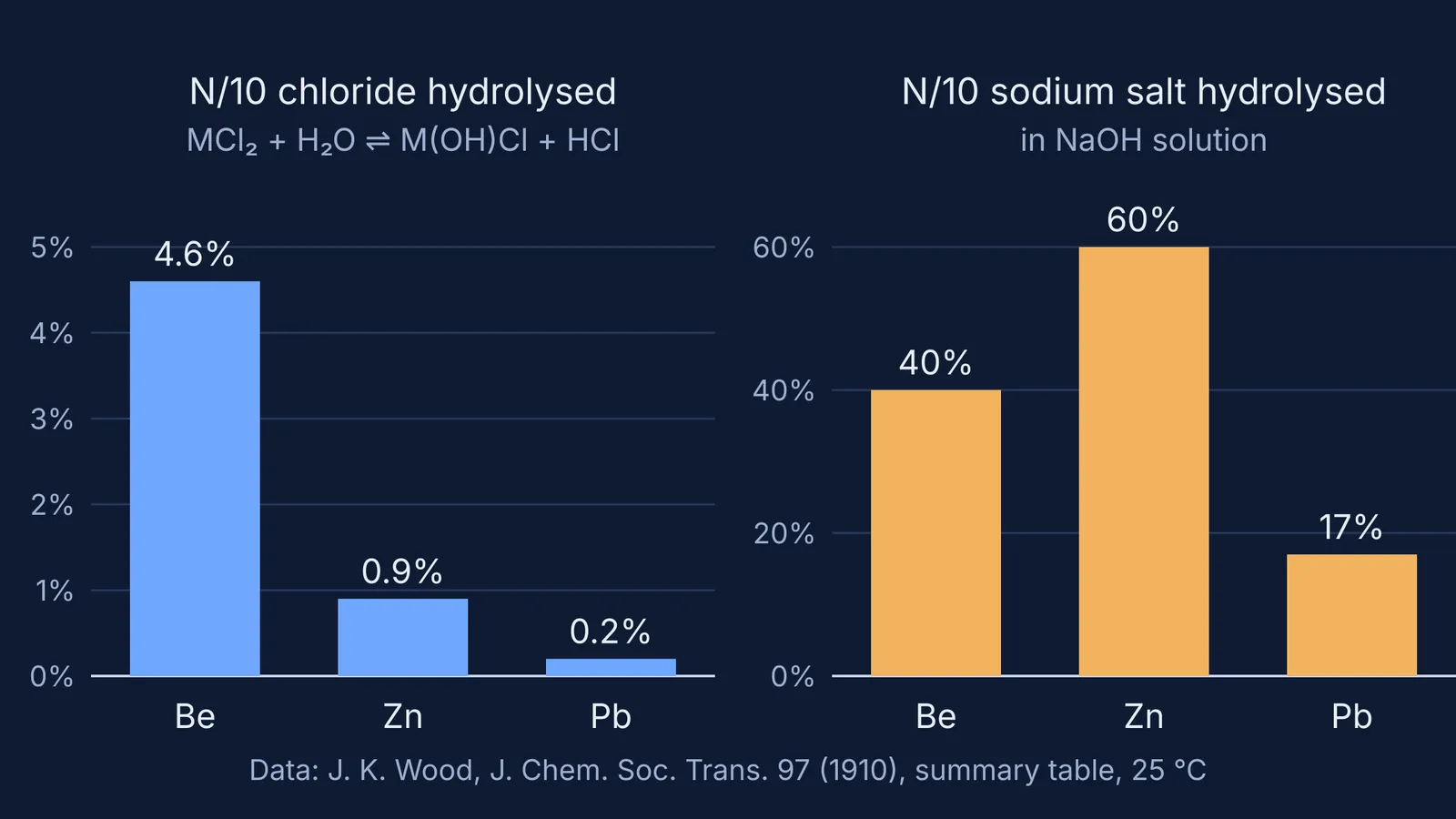
His summary table, for N/10 solutions at 25 °C:
Beryllium: chloride hydrolysed 4.6%; Kb of the weaker hydroxyl 5.2 × 10⁻¹¹; sodium salt hydrolysed 40%.
Zinc: chloride 0.9%; Kb 1.45 × 10⁻⁹; sodium salt 60%.
Lead: chloride 0.2%; Kb 3.09 × 10⁻⁸; sodium salt 17%.
So, as a base, Pb(OH)₂ is the strongest and Be(OH)₂ the weakest. This disagreed with Ley, who had put zinc first. As an acid, the least hydrolysed sodium salt belongs to the strongest acid. So Pb(OH)₂ is the strongest acid and Zn(OH)₂ the weakest. This matched Hantzsch's order, found by another method.
He also argued about formulas. For lead, his solubility data in NaOH fit Pb(OH)ONa; for zinc, Zn(ONa)₂. Today you would write zincate as [Zn(OH)₄]²⁻; our post on amphoteric oxides with equations shows that form.
Why does Be²⁺ hydrolyse its salt the most?
Take Shannon's six-coordinate radii: Be²⁺ about 45 pm, Zn²⁺ about 74 pm, Pb²⁺ about 119 pm (ionic radius table). Charge divided by radius gives about 0.044, 0.027 and 0.017. The tiny Be²⁺ pulls hardest on the O–H bonds of the water around it, so it releases H⁺ most easily. Wood's chloride order, Be > Zn > Pb, follows the same trend. This is the anomalous beryllium of the s-block, explained in why beryllium differs from group 2.
The acid order of the hydroxides, Pb > Be > Zn, does not follow this simple size rule, and his salts in alkali had different formulas. Treat that ranking as his result, not a rule.
Worked example: from Kh to Kb, then to a new dilution
Wood concluded that a normal BeCl₂ solution is at least 1.5% hydrolysed.
h at v = 1: h = 0.015² / (0.97 × 1) = 2.32 × 10⁻⁴. He printed 0.000232.
Kb: 1.21 × 10⁻¹⁴ / 2.32 × 10⁻⁴ = 5.2 × 10⁻¹¹.
Dilute to N/10 (v = 10): solve x² = 10 × 2.32 × 10⁻⁴ × (1 − 2x). This gives x = 0.046, or 4.6%, the figure in his table.
Ten times more dilute and the hydrolysis rises about √10 ≈ 3.2 times, the square-root rule that John Shields found for salts of weak acids in 1893.
Lead checks the same way. The diazoacetic ester ran equally fast in 0.0575 N PbCl₂ and 0.00015 N HCl. So x = 0.00015/0.0575 = 0.26%, h = 3.9 × 10⁻⁷, and Kb = 3.1 × 10⁻⁸, matching his 3.09 × 10⁻⁸.
If you want more salt hydrolysis and Nernst numericals worked step by step, the Fermi Problem Library has a step-by-step solver that explains the reasoning.
Quick checklist
BeCl₂, ZnCl₂ and PbCl₂ solutions are acidic because M²⁺ hydrolyses.
Wood: N/10 chlorides hydrolysed 4.6% (Be), 0.9% (Zn), 0.2% (Pb).
As bases: Pb(OH)₂ > Zn(OH)₂ > Be(OH)₂. As acids: Pb(OH)₂ > Be(OH)₂ > Zn(OH)₂.
Kb = Kw/Kh, and hydrolysis rises roughly as √(dilution).
EMF method: ratio = 10^(ΔE/0.0572) in Wood's paper; 0.059 at 25 °C in your book.
Match the chloride in the comparison solution, or the EMF misleads you.