On this page
In 1910 Irvine Masson of the University of Melbourne published a paper in the Journal of the Chemical Society, Transactions with a plain title: The Action of Water of Crystallisation on Calcium Carbide (vol. 97, pages 851–867). He mixed 22 powdered hydrates with excess powdered calcium carbide and measured the acetylene. The gas volume told him how many water molecules each crystal had given up. Oxalic acid crystals, written H₂C₂O₄·2H₂O, came out at a mean of 1.89 in the cold and 1.90 at 100 °C, instead of 2. A permanganate titration of the same crystals gave 1.92. Here is the arithmetic and his explanation. This is history, not a practical: acetylene is a flammable gas.
Who was Irvine Masson, and what question did he ask?
The paper is signed "Irvine Masson", the address is "The University of Melbourne", and the last line thanks "Professor Orme Masson for guidance throughout the course of the work". We have not verified anything else about his life.
The question came from moisture testing. Masson credits H. A. Danne (1900) as the first to measure moisture with calcium carbide, and P. V. Dupré (1906) with a similar method. An Australian conference on moisture in wool simply shook wool clippings with excess powdered carbide. Masson asked whether carbide in direct contact also acts on the water locked inside salt crystals, whether it works in the cold, and how completely.
How can calcium carbide count water molecules?
The reaction is the one you learn for making ethyne:
CaC₂ + 2H₂O → C₂H₂ + Ca(OH)₂
Two water molecules give one acetylene molecule. So 1 mmol of water gives 0.5 mmol of C₂H₂, which is 0.5 × 22.4 = 11.2 mL at 0 °C and 760 mm. Masson quotes 11.17 c.c. He collected the gas over mercury, because acetylene dissolves in water, and reduced every volume to 0 °C and 760 mm.
Then he calibrated with about 0.2 c.c. of weighed distilled water. The mean volume per millimole of water was 10.48 c.c. with carbide A in the cold, and 10.36, 10.73 and 10.68 c.c. with carbide B in the cold, at 100° and at 170°. He took 10.5 c.c. per millimole as his working factor, which he said should keep results within about 2 per cent of the true values. That is about 94% of the 11.2 mL theory. Commercial carbide gives less gas; he suggested quicklime in it as a reason.
His working formula was:
N = V × M ÷ (10.5 × W)
where W is the mass of hydrate in mg, V is the gas volume in c.c. at 0 °C and 760 mm, M is the molar mass of the hydrate, and N is the number of water molecules that reacted per formula unit.
Worked example: how many water molecules did oxalic acid give up?
Take Masson's first oxalic acid row, run in the cold. He used M = 126.0.
Data: W = 730.8 mg of crystals, V = 116.7 c.c. of acetylene.
Water reacted: 116.7 ÷ 10.5 = 11.11 mmol of H₂O.
Crystals taken: 730.8 ÷ 126.0 = 5.800 mmol of H₂C₂O₄·2H₂O.
Ratio: 11.11 ÷ 5.800 = 1.92 water molecules per formula unit.
Why calibration matters: if you used the theoretical 11.2 instead of 10.5, you would get 116.7 ÷ 11.2 = 10.42 mmol of water and N = 1.80. That is further from the truth, not closer.
For the whole crystal, the balanced equation is H₂C₂O₄·2H₂O + CaC₂ → H₂C₂O₄ + C₂H₂ + Ca(OH)₂. One mole of crystals gives one mole of acetylene.
The other three cold rows give 1.95, 1.88 and 1.81, a mean of 1.89. Two runs at 100° gave 1.92 and 1.87, a mean of 1.90. Masson also titrated the crystals with permanganate and got 1.92 H₂O (calculated 2.00). The carbide and the titration agree, which suggests the crystals themselves held a little less than 2.
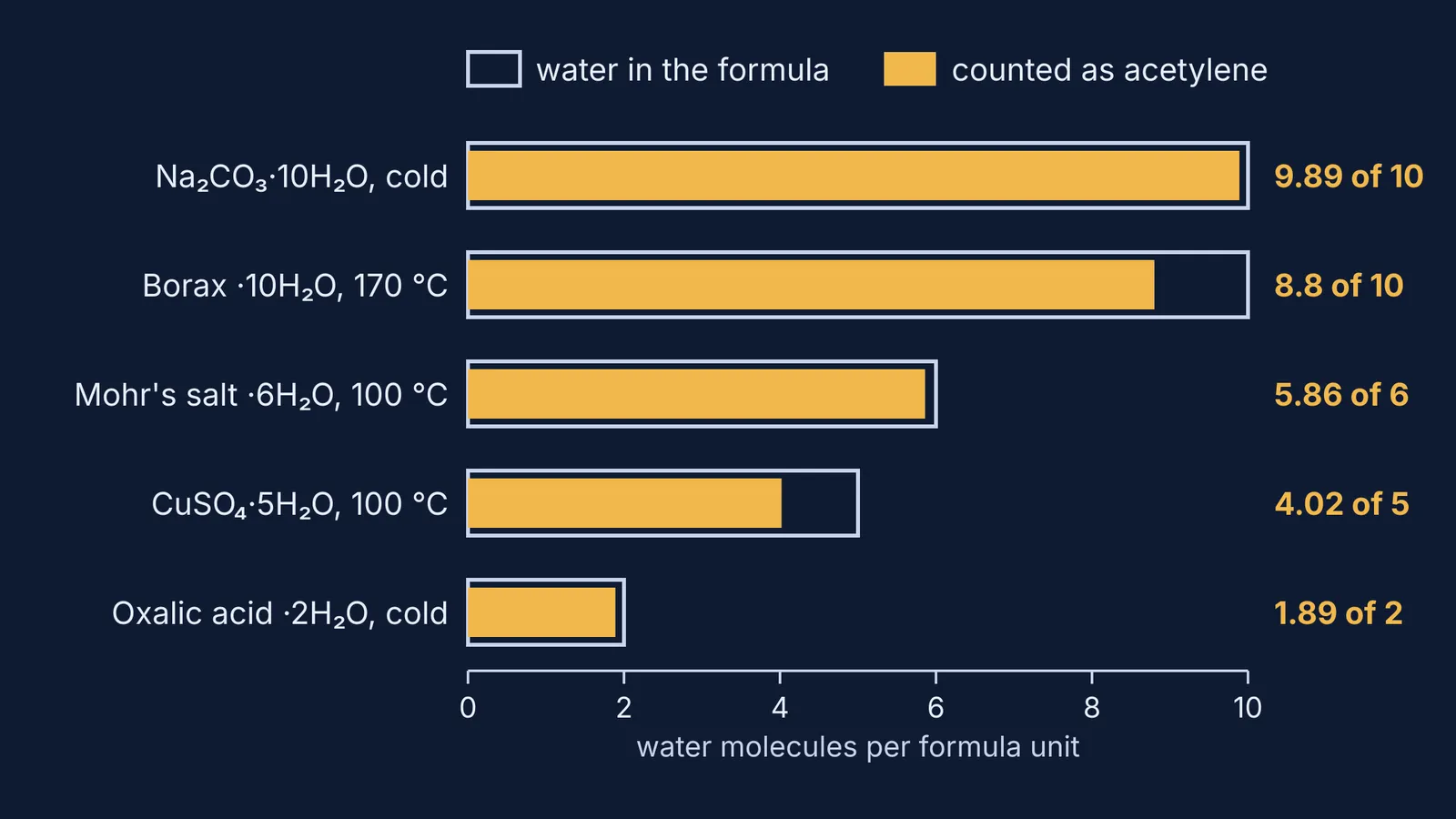
Try one yourself. Mohr's salt, (NH₄)₂Fe(SO₄)₂·6H₂O, M = 392.2, heated to 100° with carbide: 656.7 mg gave 104.0 c.c. The answer is 104.0 × 392.2 ÷ (10.5 × 656.7) = 5.92. His second run gave 5.81, a mean of 5.86 of 6. For more mole-concept problems like this, the Fermi Problem Library has a step-by-step solver that explains the reasoning.
Which salts lost all their water, and which stopped at a lower hydrate?
Washing soda, Na₂CO₃·10H₂O: the reaction was practically over in thirty seconds, without external heating. The cold runs averaged 9.89 of 10.
Blue vitriol, CuSO₄·5H₂O: very slow in the cold, complete at 100°, at 4.02 molecules. That leaves the monohydrate. Above about 140° the gas volume started to fall, because the copper salt absorbed acetylene and formed a black insoluble solid. That is why the copper runs stopped there.
ZnSO₄·7H₂O and MgSO₄·7H₂O: both lost about 5 water molecules in the cold, leaving dihydrates. With heating, both went on to the monohydrate.
Borax, Na₂B₄O₇·10H₂O: the final value after heating to 170° was 8.8, not 10. Fusing the salt gave 10.01. He wrote that "a satisfactory explanation of this fact is wanting".
Carbide also showed which lower hydrates are stable, the stepwise picture in how to find x in a hydrate from heating data.
Why did carbide dry crystals faster than a desiccator?
Masson found it "somewhat surprising" that a salt dried slowly in a desiccator lost its water in seconds next to carbide. Point 2 of his summary puts it this way: the carbide acts "on water vapour which the hydrate emits", and intimate contact prevents "return of water molecules to the hydrate surface".
You can say the same thing with Class 11 equilibrium. For oxalic acid:
H₂C₂O₄·2H₂O(s) ⇌ H₂C₂O₄(s) + 2H₂O(g), with Kp = p(H₂O)²
The solids do not appear in Kp. A hydrate keeps losing water as long as the water vapour pressure around it stays below its equilibrium value. In a desiccator the vapour has to travel to the drying agent, and some molecules land back on the crystal. With carbide pressed against every grain, each water molecule is used up as soon as it leaves, so p(H₂O) stays close to zero and dehydration runs one way. The same idea explains why some crystals lose water in dry air, covered in when blue vitriol loses water: Kp and humidity.
He also noted that hydrates with high vapour pressure reacted fast, and the heat released sped them up further.
How does this connect to measuring water today?
Masson measured water by a chemical reaction rather than by loss on heating, which counts anything volatile. Twenty-five years later Karl Fischer did the same with a titration; see Karl Fischer and the 1935 titration that counts water. If you want to review the equilibrium idea behind hydrates first, the Concept Library covers every concept in chemistry, each with its own lesson.
Quick checklist
CaC₂ + 2H₂O → C₂H₂ + Ca(OH)₂: 2 mol water per mol acetylene.
1 mmol H₂O gives 11.2 mL at STP in theory; Masson's calibrated factor was 10.5 c.c.
N = V × M ÷ (10.5 × W): moles of water over moles of hydrate.
Oxalic acid crystals: about 1.9 by carbide, 1.92 by permanganate, against 2.
Carbide stops some salts at lower hydrates: CuSO₄·H₂O, ZnSO₄·2H₂O.
For a hydrate pair, Kp is set by p(H₂O); keep p(H₂O) near zero and the crystal keeps losing water.