On this page
In 1935 the German chemist Karl Fischer published a three-page paper in *Angewandte Chemie* with a long German title. In English it reads: a new method for the volumetric determination of the water content of liquids and solids (DOI record of Fischer's 1935 paper). His method is now used to measure water in medicines, foods, oils, plastics and gases, each covered by a chapter of the instrument maker Metrohm's monograph on Karl Fischer titration. The chemistry behind it is Class 11 and 12 material: a redox reaction, 1:1 stoichiometry and Faraday's law.
Why was measuring water so hard before 1935?
The obvious method is to weigh a sample, dry it in an oven and weigh it again. The Metrohm monograph lists two problems. First, loss on drying records everything volatile that escapes, not just water. Second, it can take several hours in a drying oven.
A titration responds only to water, if no side reactions happen, and normally takes a few minutes. It also picks up water held inside crystals. If you have studied hygroscopic, deliquescent and efflorescent substances, you know how much water a solid can quietly hold.
How did Karl Fischer invent his titration?
Fischer started from the Bunsen reaction, which chemists already used to measure sulfur dioxide in water: SO2 + I2 + 2 H2O → H2SO4 + 2 HI (Metrohm monograph). With sulfur dioxide in excess and a base to mop up the acids, the reaction stops when the water runs out, so the iodine used up tells you how much water was there.
Fischer's base was pyridine. The monograph says the choice was completely at random: "pyridine was just standing in the rack". His original reagent contained 254 g of iodine in 5 litres of anhydrous methanol, with 790 g of pyridine and 192 g of liquid sulfur dioxide. One millilitre reacted with about 3 mg of water. He judged the end point by eye, as the solution turned from yellow to brown with excess iodine.
Fischer also got one thing wrong. He assumed 2 water molecules per iodine molecule, as in the Bunsen reaction in water. In 1939 Donald M. Smith, W. M. D. Bryant and J. Mitchell showed the molar ratio of water to iodine is 1:1 (Journal of the American Chemical Society, 1939; ratios as summarised in the Metrohm monograph). Because pyridine smelled bad and was toxic, many modern reagents use other bases such as imidazole.
How does Karl Fischer titration measure micrograms of water?
There are two versions. In volumetric titration, iodine solution of known strength comes from a burette. The Metrohm monograph puts its lower limit at about 50 to 100 ppm of water. In coulometric titration, an electric current makes iodine from iodide at an anode. The charge passed tells you how much iodine was made. Metrohm says its coulometers cover 10 micrograms to 200 mg of water.
The end point is no longer judged by colour. Two platinum electrodes sense the moment free iodine appears, much as you read the jump in a potentiometric titration. Even room air matters: 0.5 mL of air at 25 °C and 60% relative humidity holds about 7 micrograms of water, so the titration cell has to be sealed.
Worked example: from coulombs to ppm
A 2.00 g sample of transformer oil is injected into a coulometric cell. To reach the end point, 1.50 C of charge is passed.
Iodine is made at the anode: 2 I⁻ → I2 + 2 e⁻, so each mole of I2 needs 2 F of charge, with F = 96,485 C/mol (Faraday's law as given in the Metrohm monograph).
Moles of I2 = 1.50 ÷ (2 × 96,485) = 7.77 × 10⁻⁶ mol.
Water reacts 1:1 with iodine, so moles of water = 7.77 × 10⁻⁶ mol.
Mass of water = 7.77 × 10⁻⁶ × 18.015 g/mol = 1.40 × 10⁻⁴ g = 140 µg.
Water content = 140 µg ÷ 2.00 g = 70 µg/g, or 70 ppm.
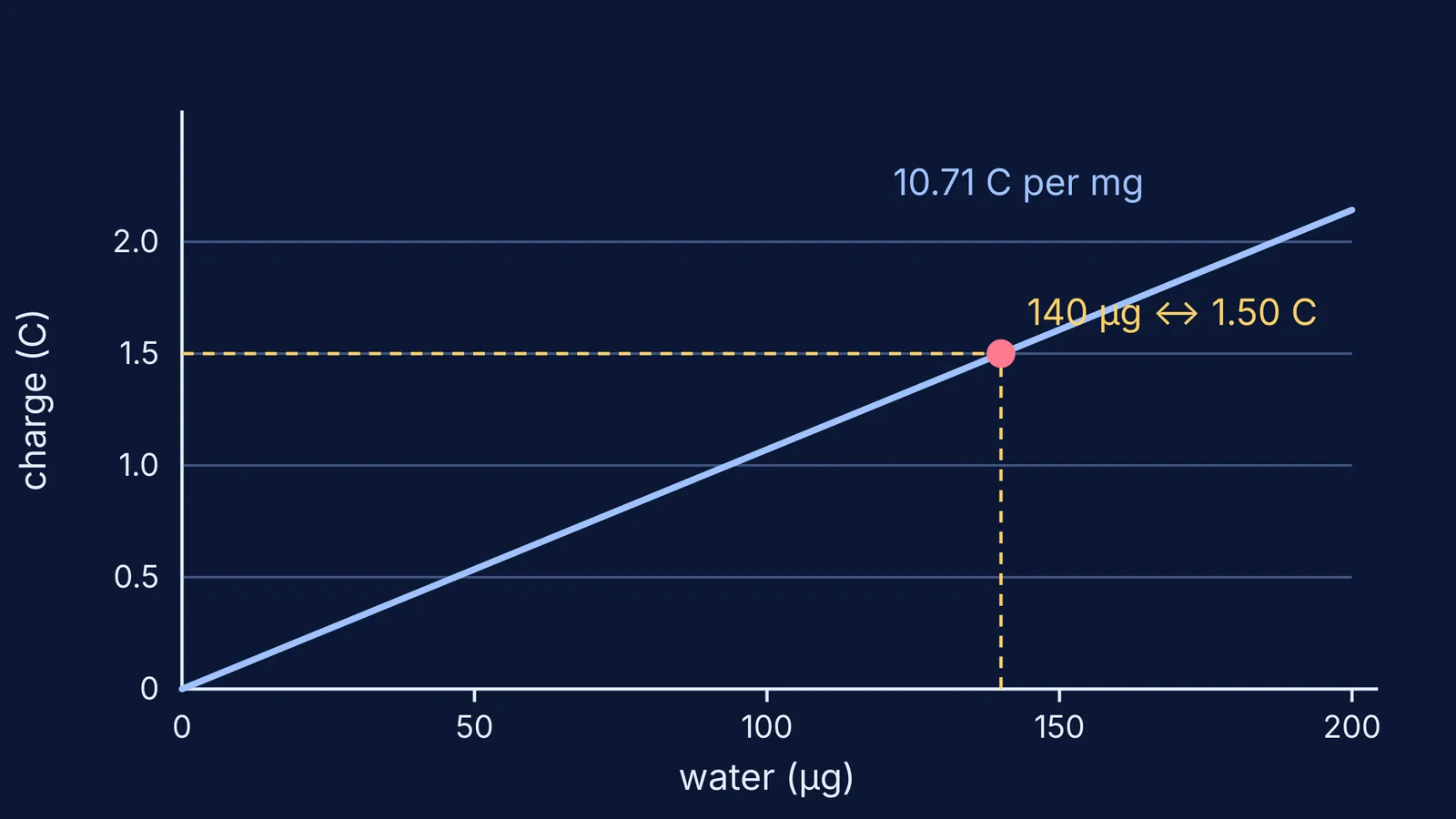
Shortcut: 2 × 96,485 ÷ 18.015 gives 10.71 C per milligram of water, the straight line in the diagram above.
If step 1 trips you up, revisit half-reactions. Our post on iodometric and iodimetric titrations works through the iodine side. For more practice, the Fermi Problem Library has worked problems with a step-by-step solver that explains the reasoning rather than printing an answer.
What can you learn from Karl Fischer's method?
Use this checklist when you meet any new analytical method in your syllabus:
What reaction does it use, and what is the mole ratio?
What must be in excess, so that only the substance you want limits the reaction?
How is the end point detected: colour, current or voltage?
What could add error, such as moist air, side reactions or a titre that drifts?
Fischer got the mole ratio wrong, and other chemists corrected it within four years. If a concept in the chain, such as Faraday's law or the mole ratio, still feels shaky, the Fermi Concept Library gives every chemistry concept its own lesson and shows where it fits on the map.