On this page
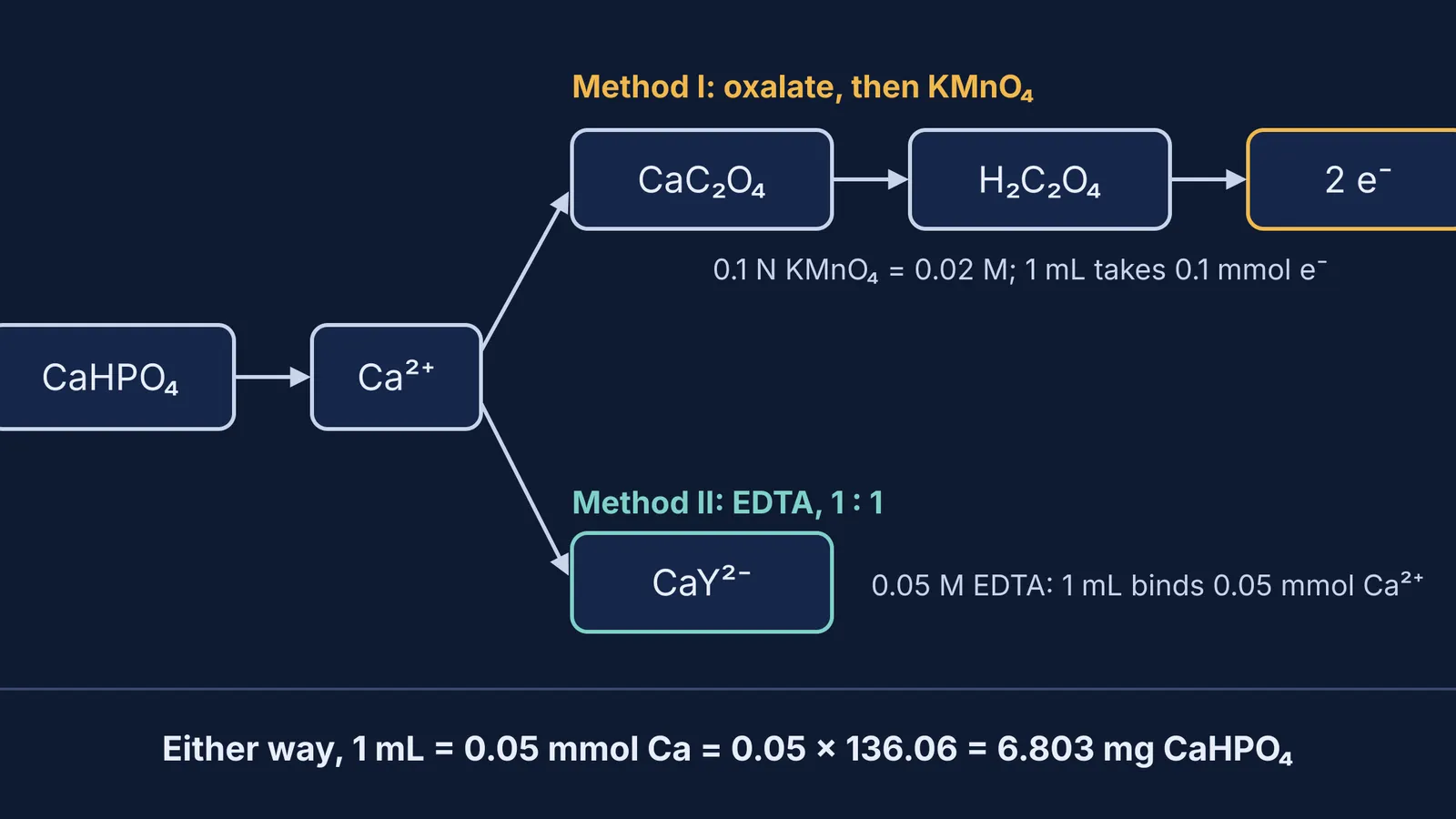
Dicalcium phosphate, CaHPO₄, is a white powder with its own Indian Standard: IS 9970:1981, Dicalcium Phosphate, Food Grade. Its foreword says the compound "has been permitted as dough conditioner for manufacture of certain foods" and "is also used as nutrient supplement". To check purity, the standard does not titrate the phosphate at all. It counts the calcium, and it gives two ways to do it: an oxalate–permanganate redox titration and an EDTA titration. The permanganate method says each mL of 0.1 N KMnO₄ "is equivalent to 6.803 mg of CaHPO₄". The EDTA method works out to the same 6.803 mg per mL. Seeing why is a clean lesson in n-factors.
What is dicalcium phosphate, and why is it called dibasic?
The standard lists two types, anhydrous CaHPO₄ (molar mass 136.06) and the dihydrate CaHPO₄·2H₂O (172.09). Its synonyms include calcium hydrogen phosphate, dibasic calcium phosphate and calcium hydrogen orthophosphate.
The anion is HPO₄²⁻. Phosphoric acid, H₃PO₄, has three replaceable hydrogens. Replace two and you get HPO₄²⁻, the "secondary" or "dibasic" salt. Phosphorus sits at the centre of a tetrahedron of four oxygens, and one of those oxygens still carries its H, as one P–OH group. If you want the acid side of this story, see why phosphoric acid shows only two end points with NaOH.
The standard's identification tests are all salt-analysis reactions you know:
Calcium: ammonium oxalate gives a white precipitate.
Phosphate: ammonium molybdate in nitric acid gives a yellow precipitate.
Orthophosphate: wet the sample with silver nitrate solution and "a yellow colour shall be produced".
How does the oxalate–permanganate method count calcium?
Method I turns every calcium ion into an oxalate ion that permanganate can titrate. The 1981 text filters through an asbestos mat, which is not something to copy; here we follow only the chemistry.
Dissolve. The dried sample is dissolved in dilute hydrochloric acid.
Precipitate calcium oxalate. Ammonium oxalate is added, then dilute ammonia until methyl red just loses its pink colour. The solution stays mildly acidic, and the very insoluble calcium oxalate comes down: Ca²⁺ + C₂O₄²⁻ → CaC₂O₄(s).
Wash. Washing with a dilute oxalate solution and cold water removes the excess oxalate, which would otherwise be titrated too.
Release the oxalate. The precipitate goes into dilute sulphuric acid: CaC₂O₄ + H₂SO₄ → CaSO₄ + H₂C₂O₄.
Titrate. 0.1 N KMnO₄ is added, the solution is heated to about 70 °C, and the titration is finished hot: 2MnO₄⁻ + 5H₂C₂O₄ + 6H⁺ → 2Mn²⁺ + 10CO₂ + 8H₂O.
Charge balances: +4 on each side. Steps 2 to 5 are the same chemistry as the confirmatory test for oxalate with calcium chloride and KMnO₄, made quantitative.
Why is each mL of 0.1 N KMnO₄ worth 6.803 mg of CaHPO₄?
Follow one calcium through the chain:
1 CaHPO₄ → 1 Ca²⁺ → 1 C₂O₄²⁻ → 2CO₂ + 2e⁻
Calcium is never oxidised, but each calcium carries one oxalate, which gives up 2 electrons (carbon goes from +3 to +4). So in this assay, the n-factor of CaHPO₄ is 2.
Equivalent mass of CaHPO₄ = 136.06 ÷ 2 = 68.03.
1 mL of 0.1 N KMnO₄ = 0.1 milliequivalent.
0.1 × 68.03 = 6.803 mg of CaHPO₄.
Check it with molarity instead. KMnO₄ takes 5 electrons in acid, so 0.1 N KMnO₄ is 0.1 ÷ 5 = 0.02 M. One mL holds 0.02 mmol of MnO₄⁻. By the 2 : 5 ratio, that oxidises 0.02 × 5/2 = 0.05 mmol of oxalate, which came from 0.05 mmol of Ca²⁺, which is 0.05 × 136.06 = 6.803 mg of CaHPO₄. Same number, no equivalents needed. More cases are in the n-factor and equivalent concept explainer.
Why does the EDTA method give the same 6.803 mg?
Method II dissolves about 400 mg of sample, adds sodium hydroxide and hydroxynaphthol blue indicator, and titrates with 0.05 M disodium EDTA. EDTA binds calcium one to one:
Ca²⁺ + H₂Y²⁻ → CaY²⁻ + 2H⁺
So 1 mL of 0.05 M EDTA = 0.05 mmol of Ca²⁺ = 0.05 × 136.06 = 6.803 mg of CaHPO₄.
One honest note. In the scanned 1981 standard we read, the EDTA line is printed with the number missing: each mL "is equivalent to mg of CaHPO₄". The 6.803 mg for Method II is our calculation from the 1 : 1 ratio, not a figure printed in the standard.
The match is not luck. 0.1 N KMnO₄ and 0.05 M EDTA both account for exactly 0.05 mmol of calcium per mL, so the same sample needs the same titre by either method.
Worked example: does this sample pass?
The standard requires purity of 98.0 to 102.0 per cent as CaHPO₄, after drying at 200 °C for 3 hours. Suppose 0.3000 g of dried sample needs 43.6 mL of 0.1 N KMnO₄. (The titre is illustrative.)
Milliequivalents of KMnO₄: 43.6 × 0.1 = 4.36 meq.
Millimoles of Ca²⁺ (n = 2): 4.36 ÷ 2 = 2.18 mmol.
Mass of CaHPO₄: 2.18 × 136.06 = 296.6 mg. (Shortcut: 43.6 × 6.803 = 296.6 mg.)
Purity: 296.6 ÷ 300.0 × 100 = 98.87%, which passes.
Sense check: a perfectly pure 0.3000 g would need 300 ÷ 6.803 = 44.10 mL, by either method.
For the dihydrate, the standard sets loss on drying at 200 °C for 3 h at 18 to 22 per cent. The theory, if exactly two waters leave, is 2 × 18.015 ÷ 172.09 = 20.94%, inside the range. For the anhydrous type the limit is 2 per cent maximum.
If you want this kind of redox and equivalent-weight practice built into your JEE plan, Fermi Test Prep is for JEE Main and Advanced preparation, with an AI tutor.
Why does the drying temperature matter: orthophosphate or pyrophosphate?
Heat CaHPO₄ strongly and two HPO₄²⁻ ions condense, losing one water and forming a P–O–P bridge:
2CaHPO₄ → Ca₂P₂O₇ + H₂O
The theoretical mass loss is 18.02 ÷ (2 × 136.06) = 6.62%. This is the solid-state version of the ortho and pyro acids in NCERT's oxoacids of phosphorus: H₃PO₄ against H₄P₂O₇. The standard fixes drying at 200 °C for 3 h; it does not say at what temperature pyrophosphate starts to form, so we do not quote one.
Our calculation shows why it matters for the assay. The titration counts calcium. Pyrophosphate keeps all the calcium but weighs less, so a sample that had turned completely into Ca₂P₂O₇ would read 2 × 136.06 ÷ 254.10 = 107.1% "CaHPO₄", outside the 102.0% limit. The silver nitrate test also tells the two apart: orthophosphate gives yellow Ag₃PO₄, while pyrophosphate gives white Ag₄P₂O₇.
The standard has one amendment, No. 1 of August 2017. We read it: it substitutes "4" for "10" in one impurity row of Table 1. It does not touch the assay methods or the 6.803 mg factor.
Quick checklist
CaHPO₄: anhydrous 136.06, dihydrate 172.09; HPO₄²⁻ keeps one P–OH.
Method I: Ca²⁺ → CaC₂O₄ → H₂C₂O₄, titrated with KMnO₄; n-factor of CaHPO₄ = 2.
0.1 N KMnO₄ = 0.02 M; 1 mL = 0.05 mmol Ca = 6.803 mg CaHPO₄.
Method II: Ca²⁺ : EDTA = 1 : 1; 1 mL of 0.05 M = 6.803 mg (derived; the printed line is blank).
Dihydrate water: 20.94% in theory, 18–22% allowed.
2CaHPO₄ → Ca₂P₂O₇ + H₂O loses 6.62%; ortho gives yellow Ag₃PO₄, pyro gives white Ag₄P₂O₇.