

On this page
In a systematic salt analysis scheme, confirming the oxalate ion (C₂O₄²⁻) begins with selective precipitation. You first treat the aqueous salt solution or neutral sodium carbonate extract with dilute acetic acid (CH₃COOH) to eliminate carbonate without lowering pH excessively. Adding calcium chloride (CaCl₂) solution precipitates calcium oxalate as a dense white solid:
Ca²⁺(aq) + C₂O₄²⁻(aq) → CaC₂O₄(s)
As catalogued in PubChem's compound record for calcium oxalate, the salt has a low solubility product constant of approximately 2.3 × 10⁻⁹ at 25 °C, making precipitation instantaneous.
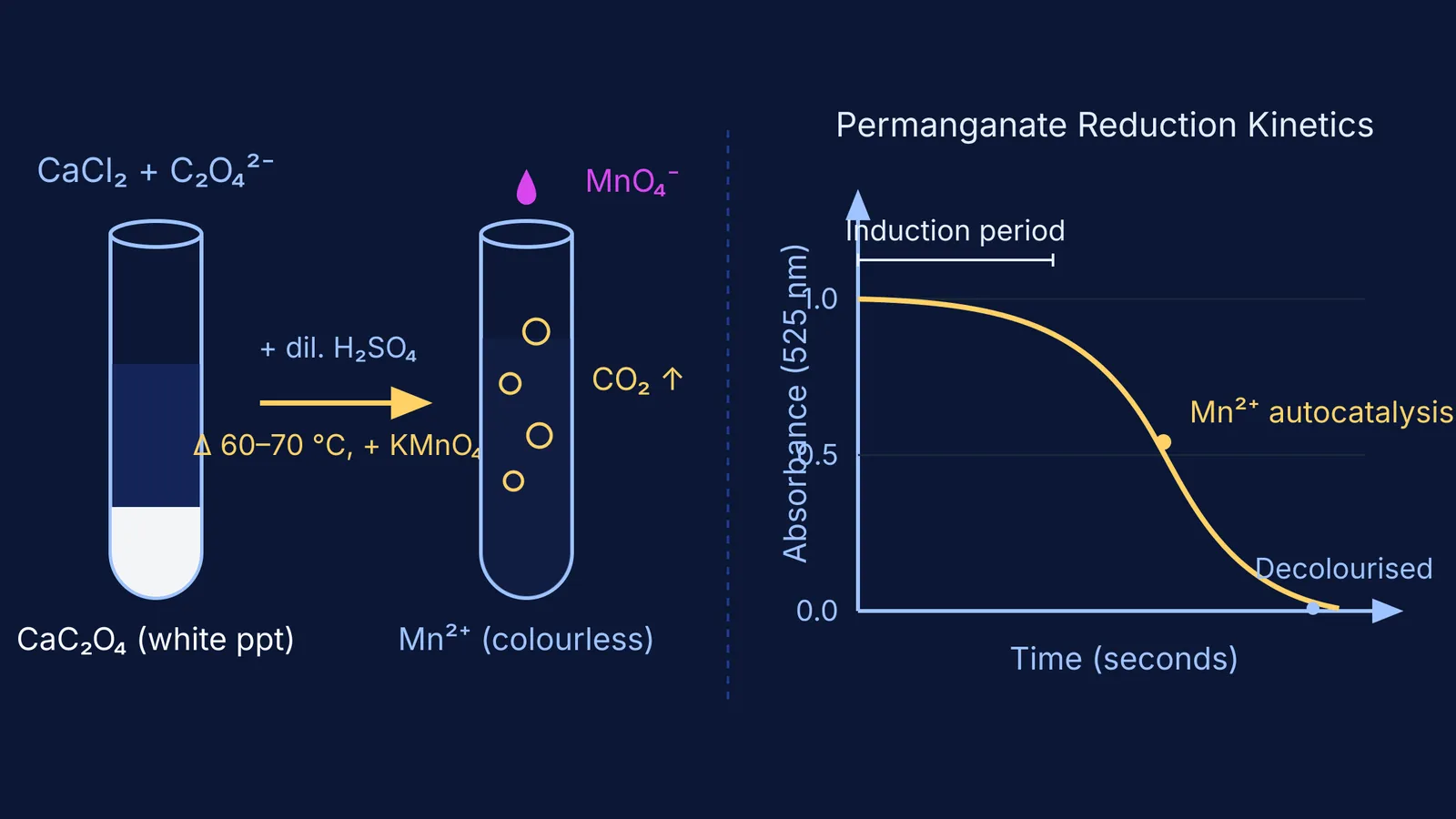
Calcium oxalate is insoluble in dilute acetic acid, distinguishing it from calcium carbonate. However, adding dilute sulphuric acid (H₂SO₄) protonates the oxalate ions into unionized oxalic acid (H₂C₂O₄), shifting the equilibrium and dissolving the precipitate:
CaC₂O₄(s) + H₂SO₄(aq) → CaSO₄(aq) + H₂C₂O₄(aq)
The Fermi Concept Library maps every concept across inorganic chemistry, connecting solubility products with acid-base equilibria.
Why does acidified potassium permanganate decolourise?
Once dissolved in dilute sulphuric acid, oxalic acid reduces potassium permanganate (KMnO₄). Potassium permanganate contains manganese in the +7 oxidation state, imparting a deep purple colour as noted in PubChem CID 516875.
In an acidic medium, permanganate gains 5 electrons to form colourless manganese(II) ions:
MnO₄⁻ + 8 H⁺ + 5 e⁻ → Mn²⁺ + 4 H₂O
Concurrently, oxalic acid oxidizes to carbon dioxide, losing 2 electrons per molecule:
H₂C₂O₄ → 2 CO₂ + 2 H⁺ + 2 e⁻
Combining both half-reactions gives the overall equation documented in David Harvey's Analytical Chemistry/09%3A_Titrimetric_Methods/9.04%3A_Redox_Titrations):
2 MnO₄⁻ + 5 H₂C₂O₄ + 6 H⁺ → 2 Mn²⁺ + 10 CO₂↑ + 8 H₂O
In molecular terms:
2 KMnO₄ + 5 H₂C₂O₄ + 3 H₂SO₄ → K₂SO₄ + 2 MnSO₄ + 10 CO₂↑ + 8 H₂O
The purple colour disappears because Mn²⁺ is virtually colourless in dilute solution. Tiny bubbles of carbon dioxide confirm oxidation. When calculating equivalent weights, students use the n-factor in redox reactions, where KMnO₄ has an n-factor of 5 and oxalic acid has an n-factor of 2.
Why must the solution be heated before adding KMnO4?
At room temperature (20–25 °C), the purple colour lingers because MnO₄⁻ and oxalate are both negative ions. Their electrostatic repulsion creates a substantial kinetic activation barrier, causing a notable induction lag as documented by Kalbus, Lieu, and Kalbus in the Journal of Chemical Education.
Heating the acidified mixture to 60–70 °C provides the thermal energy needed to overcome this barrier and initiate reduction, sharply shortening the lag time.
Once started, the reaction is autocatalytic. As analyzed by Kovács and colleagues in The Journal of Physical Chemistry A, trace Mn²⁺ formed in the opening seconds reacts with MnO₄⁻ to form reactive intermediate manganese complexes. These intermediates accelerate subsequent steps, so later drops of KMnO₄ decolourise almost instantly.
What mistakes ruin the oxalate confirmatory test?
Common mistakes documented in standard titrimetric and redox procedures/09%3A_Titrimetric_Methods/9.04%3A_Redox_Titrations) can compromise your observations:
Adding hydrochloric acid: Permanganate oxidizes Cl⁻ to chlorine gas (Cl₂), discharging the purple colour prematurely and giving a false positive.
Overheating past 80 °C: Boiling decomposes oxalic acid into carbon monoxide, carbon dioxide, and water (H₂C₂O₄ → CO + CO₂ + H₂O), eliminating the reducing agent.
Insufficient acid: A shortage of H₂SO₄ causes partial reduction of permanganate into brown manganese dioxide (MnO₂), creating a muddy precipitate instead of a clear solution.
How do you run the oxalate test step-by-step in the laboratory?
To perform the test reliably under the CBSE Senior Secondary Chemistry Curriculum or during KMnO4 titration with oxalic acid, follow these steps:
Acidify: Take 2 mL of salt solution in a test tube and add dilute acetic acid dropwise until effervescence ends.
Precipitate: Add 1 mL of 5% CaCl₂ solution to produce a white precipitate of calcium oxalate.
Dissolve: Discard the clear supernatant, add 2 mL of dilute H₂SO₄, and shake until the precipitate dissolves completely.
Warm and test: Heat the solution to 60–70 °C. Add 0.02 M KMnO₄ dropwise with constant swirling. The purple colour disappears with rising CO₂ bubbles.
When solving complex stoichiometry and equivalent calculations, the Fermi Problem Library offers worked problems with a step-by-step solver that explains the underlying reasoning.


