

On this page
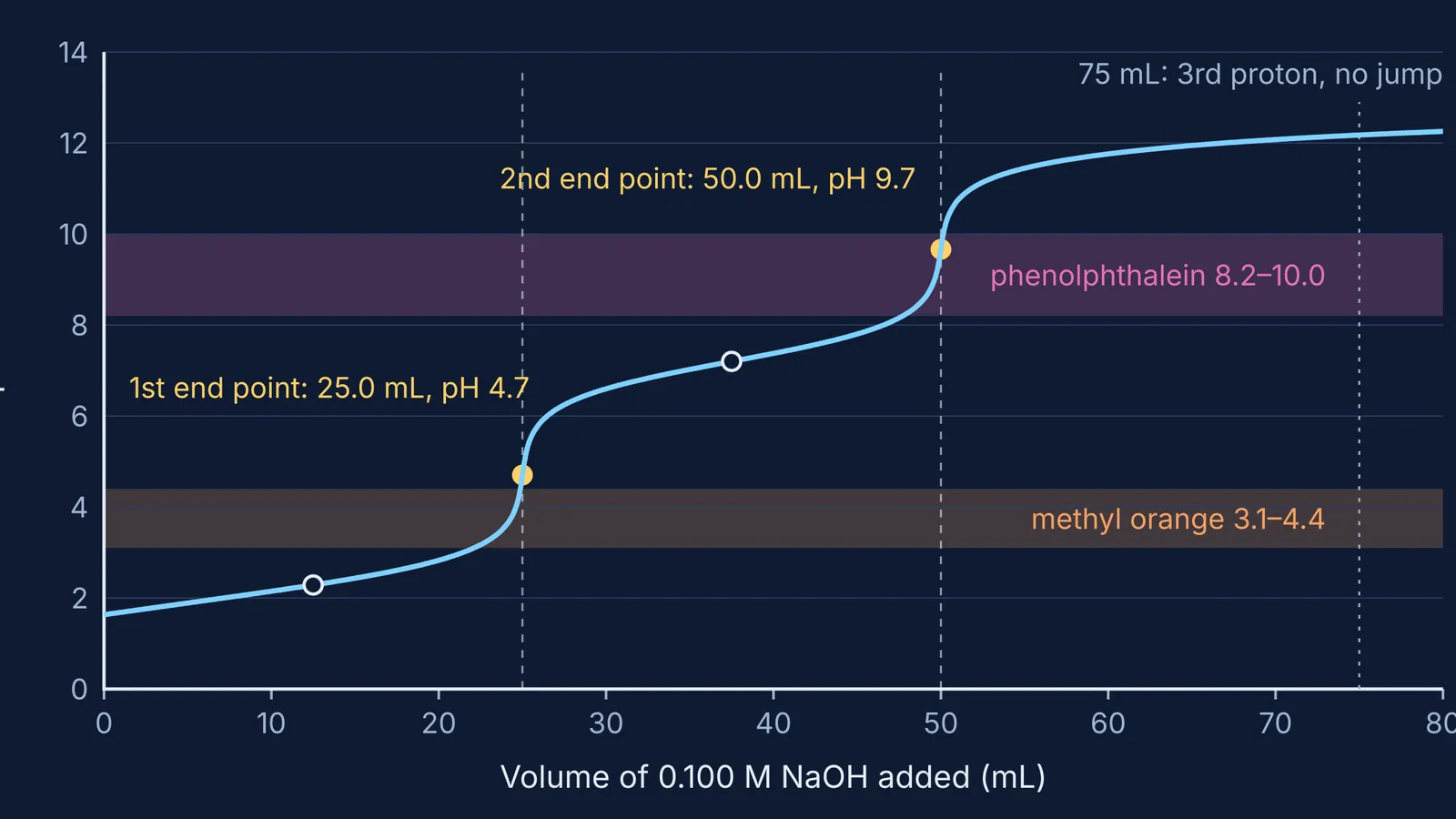
Phosphoric acid, H₃PO₄, is tribasic: it has three replaceable hydrogens. So you might expect three jumps when you titrate it with NaOH. The curve shows only two. JEE and NEET use this to test polyprotic acids, amphiprotic salts and indicator choice. This post walks through the three neutralisation steps, the pH at each key point, which indicator catches which end point, and a fully worked numerical.
What are the three dissociation steps of phosphoric acid?
H₃PO₄ has three P–OH groups and one P=O. All three O–H hydrogens are acidic, which is why it is tribasic; our post on the oxoacids of phosphorus and their basicity explains why the P–H hydrogens in H₃PO₃ and H₃PO₂ do not count. Each proton comes off in turn, and each step is weaker than the one before. The values below are the usual textbook figures at 25 °C, all approximate:
H₃PO₄ ⇌ H⁺ + H₂PO₄⁻, pKa₁ ≈ 2.15 (Ka₁ ≈ 7.1 × 10⁻³)
H₂PO₄⁻ ⇌ H⁺ + HPO₄²⁻, pKa₂ ≈ 7.20 (Ka₂ ≈ 6.3 × 10⁻⁸)
HPO₄²⁻ ⇌ H⁺ + PO₄³⁻, pKa₃ ≈ 12.35 (Ka₃ ≈ 4.5 × 10⁻¹³)
With NaOH the three neutralisation steps are:
H₃PO₄ + NaOH → NaH₂PO₄ + H₂O
NaH₂PO₄ + NaOH → Na₂HPO₄ + H₂O
Na₂HPO₄ + NaOH → Na₃PO₄ + H₂O
Overall: H₃PO₄ + 3NaOH → Na₃PO₄ + 3H₂O. The pKa values are about 5 units apart, so each step is essentially finished before the next one starts.
Why does the titration curve show only two end points?
An end point is visible only when the pH jumps sharply for a tiny volume of NaOH. That needs the neutralisation reaction to go almost to completion. You can check this with the equilibrium constant of each step with OH⁻, which is Ka divided by Kw (10⁻¹⁴):
Step 1: K = Ka₁/Kw ≈ 7 × 10¹¹, essentially complete
Step 2: K = Ka₂/Kw ≈ 6 × 10⁶, essentially complete
Step 3: K = Ka₃/Kw ≈ 45, far from complete
HPO₄²⁻ is nearly as weak an acid as water itself. Put the other way, PO₄³⁻ is a strong base (Kb = Kw/Ka₃ ≈ 0.022), so much of it takes a proton back from water and regenerates HPO₄²⁻ and OH⁻. By the time you reach the third equivalence point, the pH is already above 12 and is mostly set by the OH⁻ in the solution. Adding more NaOH barely changes it. There is no sharp rise, so no indicator can pick out a third end point.
What is the pH at each equivalence point and half-equivalence point?
At the first equivalence point the flask holds only NaH₂PO₄. H₂PO₄⁻ can both lose and gain a proton, so it is amphiprotic, and its pH is about ½(pKa₁ + pKa₂) = ½(2.15 + 7.20) ≈ 4.7. Our post on why the pH of NaHCO₃ is ½(pKa₁ + pKa₂) derives this formula; it works the same way here.
At the second equivalence point the flask holds Na₂HPO₄, also amphiprotic, so pH ≈ ½(pKa₂ + pKa₃) = ½(7.20 + 12.35) ≈ 9.8.
Halfway to each equivalence point you have equal amounts of an acid and its conjugate base, a buffer. Henderson's equation then gives pH = pKa. Halfway to the first end point pH ≈ pKa₁, and halfway to the second pH ≈ pKa₂ = 7.20. The flat stretches of the curve around these points are the buffer regions.
Which indicator should you use for each end point?
Pick an indicator whose colour-change range falls inside the steep jump. For a general walk-through of curve shapes, see acid-base titration curves and choosing indicators.
First end point (pH ≈ 4.7): methyl orange, range about 3.1 to 4.4. It turns from red to yellow as the first proton is used up.
Second end point (pH ≈ 9.7): phenolphthalein, range about 8.2 to 10.0. It turns from colourless to pink as the second proton is used up.
What this means in a lab estimation: with methyl orange, H₃PO₄ behaves as a monobasic acid (n-factor 1). With phenolphthalein, it behaves as a dibasic acid (n-factor 2). The phenolphthalein titre is twice the methyl orange titre for the same sample.
Worked example: 25.0 mL of 0.100 M H₃PO₄ with 0.100 M NaOH
Question. 25.0 mL of 0.100 M H₃PO₄ is titrated with 0.100 M NaOH. Find the volumes at the two end points and the pH at 0, 12.5, 25.0, 37.5 and 50.0 mL of NaOH. Take pKa₁ = 2.15, pKa₂ = 7.20, pKa₃ = 12.35.
Step 1: end point volumes. Moles of H₃PO₄ = 25.0 mL × 0.100 M = 2.50 mmol. Each end point uses 2.50 mmol of NaOH, which is 25.0 mL of 0.100 M NaOH. So the first end point is at 25.0 mL and the second at 50.0 mL. The third (75.0 mL) shows no jump.
Step 2: pH at the start (0 mL). Only the first dissociation matters. Solve x²/(0.100 − x) = 7.1 × 10⁻³. The quadratic gives x = [H⁺] = 0.0233 M, so pH = 1.63. The shortcut [H⁺] = √(Ka·C) gives pH 1.58, which is off because about 23% of the acid dissociates, too much to ignore x in the denominator.
Step 3: 12.5 mL (half-way to the first end point). 1.25 mmol of H₃PO₄ and 1.25 mmol of H₂PO₄⁻ in 37.5 mL. Henderson's equation gives pH = pKa₁ = 2.15. A full calculation (charge balance with all three equilibria) gives 2.29. Henderson's equation ignores the acid's own dissociation, which is noticeable for H₃PO₄ at 0.033 M and converts some H₃PO₄ into H₂PO₄⁻.
Step 4: 25.0 mL (first end point). 2.50 mmol NaH₂PO₄ in 50.0 mL, 0.0500 M. pH ≈ ½(2.15 + 7.20) = 4.68. The full calculation gives 4.70, so the formula works here.
Step 5: 37.5 mL (half-way to the second end point). 1.25 mmol each of H₂PO₄⁻ and HPO₄²⁻ in 62.5 mL. pH = pKa₂ = 7.20, and the full calculation agrees.
Step 6: 50.0 mL (second end point). 2.50 mmol Na₂HPO₄ in 75.0 mL, 0.0333 M. The formula gives ½(7.20 + 12.35) = 9.78. The full calculation gives 9.66. The formula assumes Ka₃ × C is much larger than Kw, but here Ka₃ × C ≈ 1.5 × 10⁻¹⁴, about the same as Kw, so water's own ionisation pulls the pH down a little.
Step 7: how sharp are the jumps? From the full calculation, going from 24 to 26 mL raises the pH by about 2.2 units, and so does going from 49 to 51 mL. Going from 74 to 76 mL changes it by only 0.04 units. That is the missing third end point in numbers.
For more polyprotic and buffer numericals like this, the Fermi Problem Library has a step-by-step solver that explains the reasoning at each step.
Quick checklist before the exam
pKa₁ ≈ 2.15, pKa₂ ≈ 7.20, pKa₃ ≈ 12.35 (approximate textbook values).
Three protons, two visible end points; the third step has K ≈ 45, too small for a jump.
First end point: NaH₂PO₄, pH ≈ ½(pKa₁ + pKa₂) ≈ 4.7, methyl orange, n-factor 1.
Second end point: Na₂HPO₄, pH ≈ ½(pKa₂ + pKa₃) ≈ 9.7 to 9.8, phenolphthalein, n-factor 2.
At half-equivalence, pH ≈ pKa; this is the buffer region.
For 25.0 mL of 0.100 M H₃PO₄ with 0.100 M NaOH: end points at 25.0 and 50.0 mL.
Starting pH needs the quadratic (1.63), not the √(Ka·C) shortcut.


