On this page
Get the same second-order rate constant at five moments in one run, and the reaction must be second order. Or must it? In 1910 Frederick George Donnan and Harold Edward Potts, at the Muspratt Laboratory of Physical and Electro-Chemistry, University of Liverpool, showed that the answer can be no. Their reaction was silver nitrate with ethyl iodide. Inside one run the constant looked steady. Between runs started at different concentrations it was not. Their paper is "Kinetics of the Reaction between Silver Salts and Aliphatic Iodides", J. Chem. Soc. Trans. 97, 1882–1895. We read it in the scanned 1910 volume and checked the numbers below against the page images. The paper prints only their names and laboratory; we have not checked other details of their lives.
Why can a steady k still give the wrong order?
Earlier work by Burke and Donnan (Trans., 1904) had found that in alcohol the simple equation −dc/dt = kc² gave a fairly constant k in each run. They called the reaction "pseudo-bimolecular". But k was smaller when the starting solutions were more dilute, and they traced this to some product that speeds the reaction up.
Donnan and Potts spelled out what that means. If a product accelerates the reaction, a rate constant for the true, higher order would fall during a run, and the acceleration would hold it up. The two effects cancel and k looks constant. In their words, "the constancy of the velocity-coefficient of the 'bimolecular' equation in any given case does not prove that the reaction is really one of the second order."
To dodge the product, they used only the first 10% of two of Burke and Donnan's runs in dry alcohol, at N/40 and N/80. They compared how long each took to change by the same fraction (the Noyes–van 't Hoff method) and got n = 2.8 for the exponent of c.
What happened when no acid could form?
In alcohol the reaction makes free acid, so they repeated it in dry acetonitrile, where it cannot. All runs were at 25 °C, with silver left in solution titrated against thiocyanate. Their concentration unit was N/100, so "10" means N/10. The mean constants were:
N/10 (Table VII): k = 0.00155, falling within the run from 0.00173 to 0.00137
N/20 (Table VIII): k = 0.00105
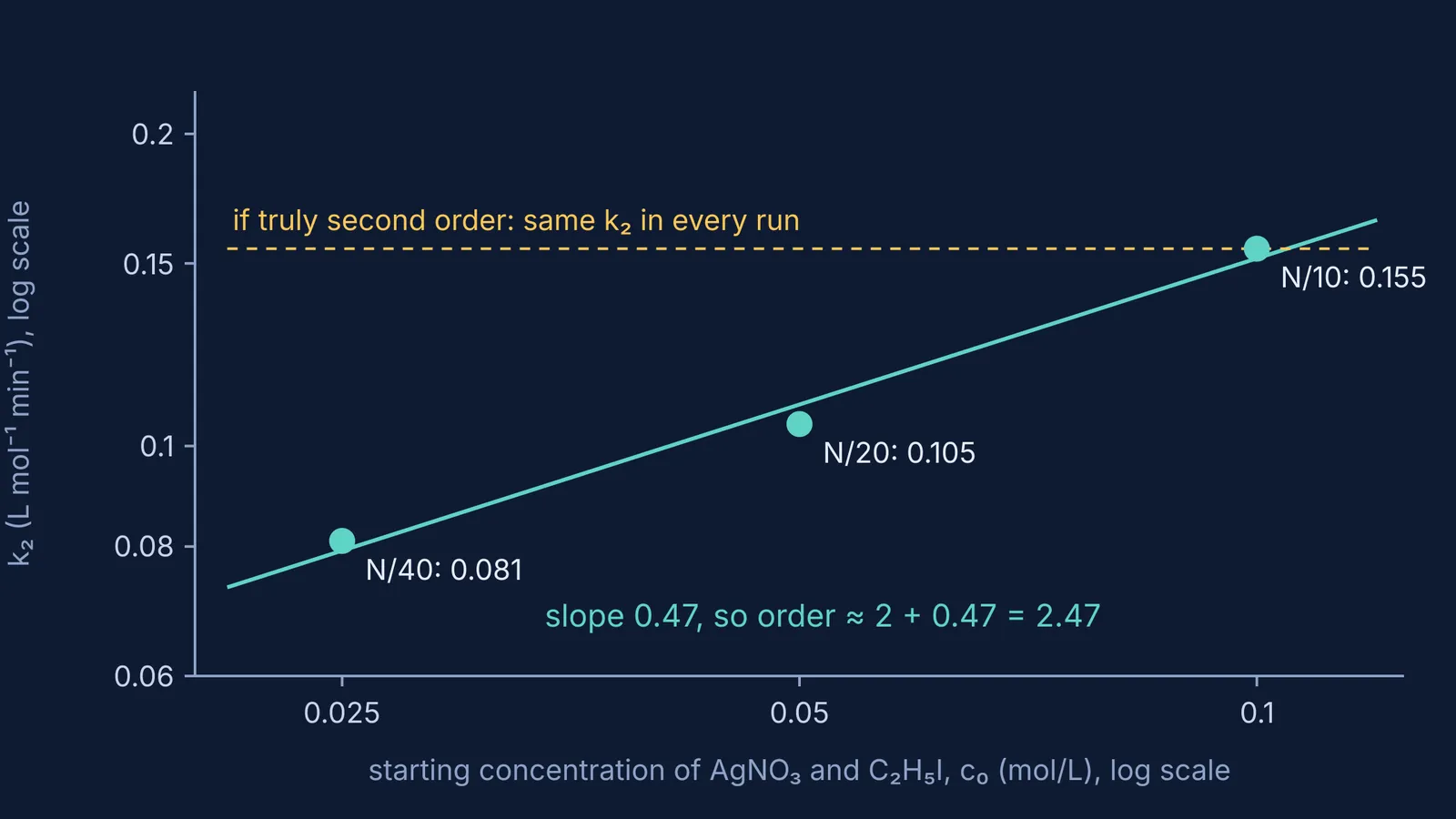
N/40 (Table IX): k = 0.00081
The paper's verdict: the bimolecular equation "holds good for each experiment (although in the case of the N/10-reaction there is a decided drop), but the velocity-coefficient varies with the initial concentrations of the reactants."
Worked example: find the order from how k changes with c₀
Step 1. Check the within-run constant. For second order with equal starting concentrations, k₂ = (1/c − 1/c₀) ÷ t. In Table VII, c₀ = 10 and c = 7.94 at 15 min, so k₂ = (0.12594 − 0.1) ÷ 15 = 0.00173. Repeating for 36, 66, 88 and 115 min gives 0.00165, 0.00155, 0.00146 and 0.00137, matching the printed row (which has 0.00164 for the second point). The 21% fall is the "decided drop".
Step 2. Convert units. Their concentration unit is 0.01 mol L⁻¹, so k in L mol⁻¹ min⁻¹ is 100 times theirs: 0.155, 0.105 and 0.081 at c₀ = 0.1, 0.05 and 0.025 mol L⁻¹.
Step 3. Use a log–log plot. Suppose the real law is −dc/dt = kₙcⁿ. Forcing a second-order fit gives k₂ ≈ kₙc^(n−2), so k₂ ∝ c₀^(n−2). The slope of ln k₂ against ln c₀ is ln(0.155 ÷ 0.081) ÷ ln(0.1 ÷ 0.025) = 0.649 ÷ 1.386 = 0.47. So n ≈ 2 + 0.47 = 2.47. Taken in pairs, the runs give 2.56 (N/10 against N/20) and 2.37 (N/20 against N/40).
Step 4. Cross-check with half-lives. For second order, t½ = 1/(k₂c₀): 1 ÷ (0.155 × 0.1) = 64.5 min, then 190 min and 494 min. The tables agree: c = 4.95 at 66 min in the N/10 run and 2.47 at 196 min in the N/20 run. A true second-order reaction would double its half-life each time c₀ halves (64.5, 129, 258 min). Here it nearly triples, then rises 2.6-fold. Using t½ ∝ c₀^(1−n), n = 1 + ln(494 ÷ 64.5) ÷ ln 4 = 2.47 again. The general rule is in half-life and initial concentration for any reaction order.
Step 5. Compare. 2.47 is our number from whole-run means in acetonitrile; the paper's 2.8 came from the first 10% in alcohol. Both say "more than 2".
Why does silver pull the iodide off?
In alcohol or water–alcohol, only about 30% of the "theoretical" ethyl nitrate formed. They wrote the products as two simultaneous reactions, plus a third in watery solvents:
A: AgNO₃ + C₂H₅I → AgI + C₂H₅ONO₂
B: AgNO₃ + C₂H₅I + C₂H₅OH → AgI + (C₂H₅)₂O + HNO₃
C: AgNO₃ + C₂H₅I + H₂O → AgI + C₂H₅OH + HNO₃
Check B: C 4 and 4, H 11 and 11, O 4 and 4, N, Ag and I 1 each. With silver lactate, acid formed stayed at 66 to 70% of the silver used up throughout a run. A constant product ratio is the sign of parallel reactions of the same order, so k(B) ÷ k(A) ≈ 70 ÷ 30 ≈ 2.3 at every moment.
They quoted Wegscheider and Fränkel's picture, C₂H₅–I···Ag–NO₃: silver's pull on iodine weakens the C–I bond, and the ethyl group is then taken by nitrate or by a solvent molecule. Donnan and Potts tested one definite version, that undissociated AgNO₃ is the reacting species: −dc/dt = k(1 − α)c², where α is the degree of dissociation. As a solution gets more dilute, α rises and (1 − α) falls, so a fitted k₂ drops. That is an order above 2 without any extra molecule colliding.
In today's terms this is silver-assisted ionisation. Ethyl is primary, so a free ethyl cation is unlikely. Ag⁺ pulls the iodide while the solvent, in huge excess, attacks the carbon. So solvent products win, and the reaction sits between textbook SN1 and SN2. Those labels came decades later; Donnan and Potts did not use them. The everyday version is the alcoholic AgNO₃ test for organic halides.
With iodoform (CHI₃) the same paper found an order "between 3 and 4, and nearer 4 than 3", with acid equal to 85% of the silver nitrate. For a cleaner third-order case, see Arthur Noyes' 1895 tin(II) and iron(III) reaction.
Where does this show up in JEE and NEET?
Class 12 Chemical Kinetics: order is found by experiment, not from the equation; k has no c₀ dependence; fractional orders; half-life against c₀.
JEE Advanced: comparing k across runs, and parallel reactions, where the product ratio equals the ratio of rate constants.
Class 12 Haloalkanes: Ag⁺ helping the halide leave, and why primary halides react slowly with alcoholic AgNO₃.
If you can follow a log–log order calculation but freeze on a new data table, the Fermi Problem Library has a step-by-step solver that explains the reasoning.
Quick checklist
A steady k inside one run does not prove the order.
Compare k between runs at different c₀; a true k stays put.
Slope of ln k₂ against ln c₀ = n − 2; here about 0.47, so n ≈ 2.5.
Ag⁺ pulls on iodine; ethanol in excess captures most of the ethyl group, giving ether and acid.