

On this page
Add a few drops of an organic halide to alcoholic silver nitrate and one of three things happens. A white precipitate appears at once, a precipitate creeps in over a few minutes or only after warming, or the solution stays clear however long you wait. Which one you see tells you what kind of carbon the halogen is attached to. This is why the test turns up in practicals and in "how will you distinguish" questions. Here is the ladder of reactivity, the reason behind it, and a worked identification problem.
What is the alcoholic silver nitrate test?
You dissolve the organic halide in ethanol and add a solution of AgNO₃ in ethanol. If the carbon–halogen bond breaks, the halide ion meets Ag⁺ and a silver halide precipitates. The colour tells you the halogen:
AgCl: white
AgBr: pale yellow (cream)
AgI: yellow
Organic fluorides give no precipitate. The C–F bond hardly ever breaks under these conditions, and AgF is soluble in any case.
This is not the same as the silver nitrate test for halide ions in water. That test, covered in how to distinguish chloride, bromide and iodide with silver nitrate, works on free X⁻ ions that are already in solution. In an organic halide the halogen is held by a covalent bond. The question here is how easily that bond breaks.
Why does the test use ethanol instead of water?
Haloalkanes and haloarenes do not dissolve in water, so in aqueous AgNO₃ the halide sits in a separate layer and almost nothing happens. Ethanol dissolves both the organic halide and enough AgNO₃ to bring Ag⁺ into contact with the C–X bond. Ethanol is also a polar solvent that can stabilise the ions formed when the bond breaks, which matters for the mechanism below.
Which organic halides give a precipitate, and how fast?
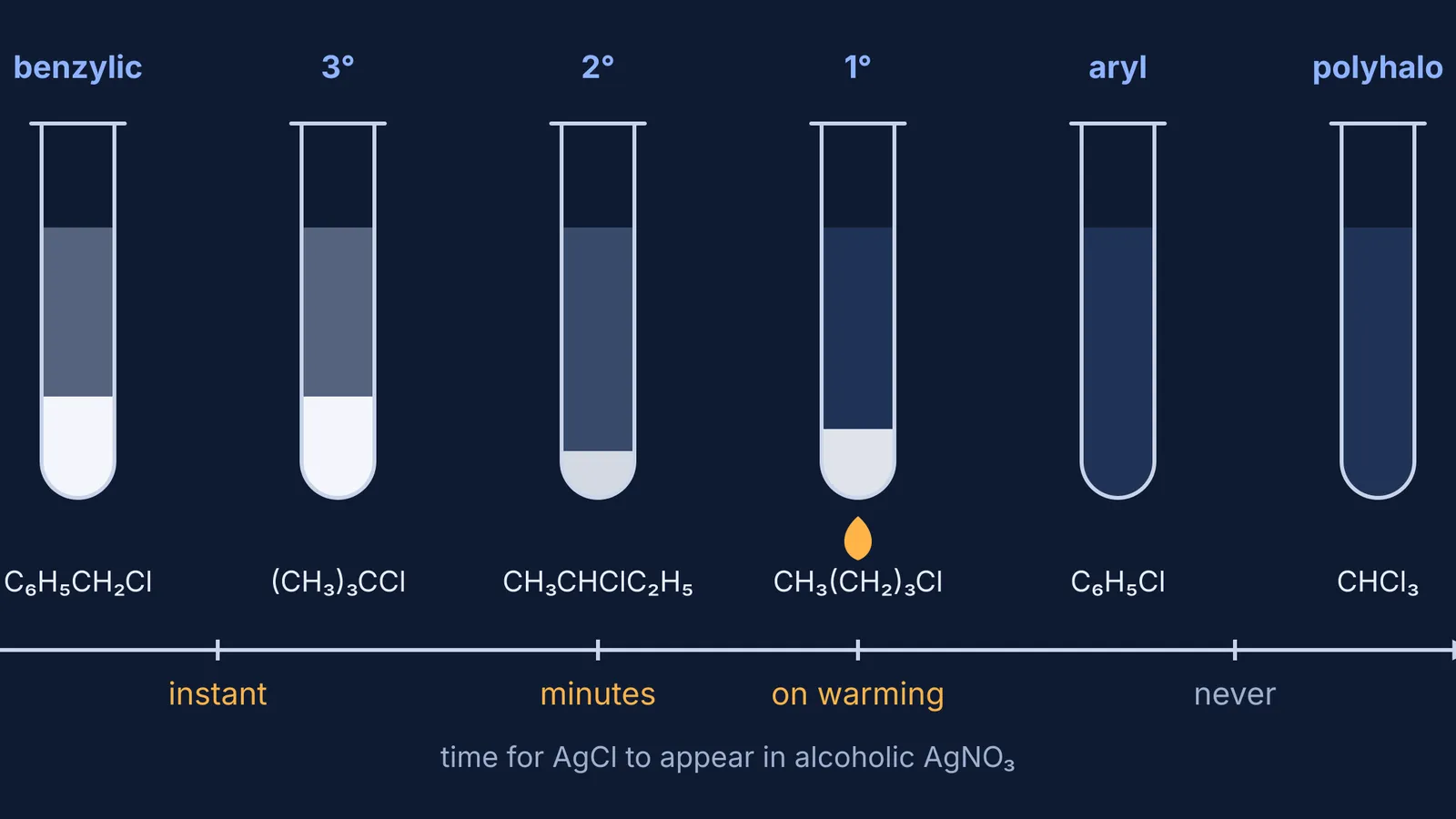
The usual order at room temperature, from fastest to no reaction, is:
Instant precipitate: benzyl halides (C₆H₅CH₂X), allyl halides (CH₂=CHCH₂X) and tertiary halides such as (CH₃)₃CCl.
Slow, over minutes: secondary halides such as 2-chlorobutane.
Only on warming: primary halides such as 1-chlorobutane.
No precipitate, even on warming: vinyl halides (CH₂=CHX), aryl halides such as chlorobenzene, and polyhalogen compounds such as CHCl₃ and CCl₄.
For the same carbon skeleton, iodides react faster than bromides, and bromides faster than chlorides. Exact times depend on concentration and temperature, so treat the categories above as a guide, not stopwatch values.
Why do benzyl, allyl and tertiary halides react instantly?
Ag⁺ has a strong attraction for halide ions. It pulls on the halogen and helps the C–X bond break, so the reaction behaves like an SN1 reaction:
R–X + Ag⁺ → R⁺ + AgX↓
R⁺ + C₂H₅OH → R–O–C₂H₅ + H⁺
Both steps balance in atoms and in charge (+1 on each side). The slow part is forming the carbocation, so the more stable the carbocation, the faster the precipitate appears. Tertiary cations are stabilised by three alkyl groups. Benzyl and allyl cations are stabilised by resonance, which spreads the positive charge over the ring or the double bond. That is why benzyl chloride, though it is a primary halide, reacts as fast as a tertiary one. The resonance picture is drawn out in why allylic and benzylic halides react fast by the SN1 route.
The simple "SN1 order" is slightly too neat for primary halides. A primary carbocation is too unstable to form on its own. Primary halides react only on warming, and then by a path in which Ag⁺ pulls on the halogen while a solvent molecule attacks the carbon at the same time. The result is the same: a slower reaction and a precipitate only after heating.
Why do iodides react faster than chlorides?
The C–X bond gets weaker down the group. In the methyl halides, approximate bond enthalpies are about 350 kJ mol⁻¹ for C–Cl, 290 kJ mol⁻¹ for C–Br and 235 kJ mol⁻¹ for C–I (tables differ slightly). A weaker bond breaks more easily, and the larger, more polarisable iodide is also the better leaving group. So for the same R group, R–I reacts fastest and R–Cl slowest.
Why do chlorobenzene, vinyl chloride and CHCl₃ give no precipitate?
Aryl and vinyl halides. The lone pair on the halogen is delocalised into the ring or the double bond, giving the C–X bond partial double bond character. The carbon is also sp² hybridised, which holds the bond more tightly. And the phenyl or vinyl cation that would form is very unstable, because its positive charge sits in an sp² orbital that cannot overlap with the π system. If the C–X bond does not break, no Ag⁺ meets a free halide ion. The four types of halide are compared in the difference between vinylic, allylic and benzylic halides.
CHCl₃ and CCl₄. A carbon carrying several chlorine atoms does not ionise under test conditions, and the crowded carbon resists attack from the back. Pure chloroform gives no precipitate with AgNO₃. That is why AgNO₃ is used to check stored chloroform for decomposition: chloroform that has partly oxidised in air and light contains phosgene and HCl, and the HCl gives a white precipitate.
Worked example: identify three chlorides
Three unlabelled bottles contain benzyl chloride, chlorobenzene and 1-chlorobutane. Each is tested with alcoholic AgNO₃. Bottle P gives a white precipitate immediately. Bottle Q gives nothing at room temperature but a white precipitate on warming. Bottle R gives no precipitate even after warming. Identify each.
Classify each compound. Benzyl chloride, C₆H₅CH₂Cl, is benzylic. 1-Chlorobutane, CH₃CH₂CH₂CH₂Cl, is a simple primary halide. Chlorobenzene, C₆H₅Cl, is an aryl halide.
Predict the behaviour. Benzylic: resonance-stabilised cation, instant precipitate. Primary: no stable cation, precipitate only on warming. Aryl: C–Cl bond does not break, no precipitate.
Match. P is benzyl chloride, Q is 1-chlorobutane and R is chlorobenzene.
The white colour confirms chlorine in P and Q.
Quantity check. If P contained 0.633 g of benzyl chloride (molar mass about 126.6 g mol⁻¹), that is 0.633 ÷ 126.6 ≈ 0.00500 mol. Each mole gives one mole of AgCl (143.3 g mol⁻¹), so the maximum mass of precipitate is 0.00500 × 143.3 ≈ 0.717 g.
If carbocation stability is the shaky part, the Concept Library covers it alongside SN1 and SN2, and the Fermi Problem Library has a step-by-step solver that explains the reasoning for distinguish-between questions like this one.
Quick checklist
Instant precipitate: benzyl, allyl and tertiary halides.
Slow: secondary. On warming: primary.
Never: vinyl, aryl, CHCl₃, CCl₄, and organic fluorides.
Faster for I than Br than Cl, because the C–X bond weakens down the group.
AgCl white, AgBr pale yellow, AgI yellow.
Ethanol is needed because haloalkanes do not dissolve in water.
No precipitate is not proof of no halogen; use Lassaigne's test for that.


