

On this page
In organic chemistry questions on JEE Main and NEET-UG, recognizing where a halogen atom attaches to a carbon skeleton is a reliable shortcut to predicting reaction pathways. Moving a chlorine atom from a double-bonded carbon to the adjacent saturated carbon transforms an unreactive compound into one of the fastest electrophiles in the laboratory.
Understanding these behaviors starts with distinguishing whether the halogen binds directly to an unsaturated carbon or to an adjacent saturated one.
Where does the halogen sit in each halide type?
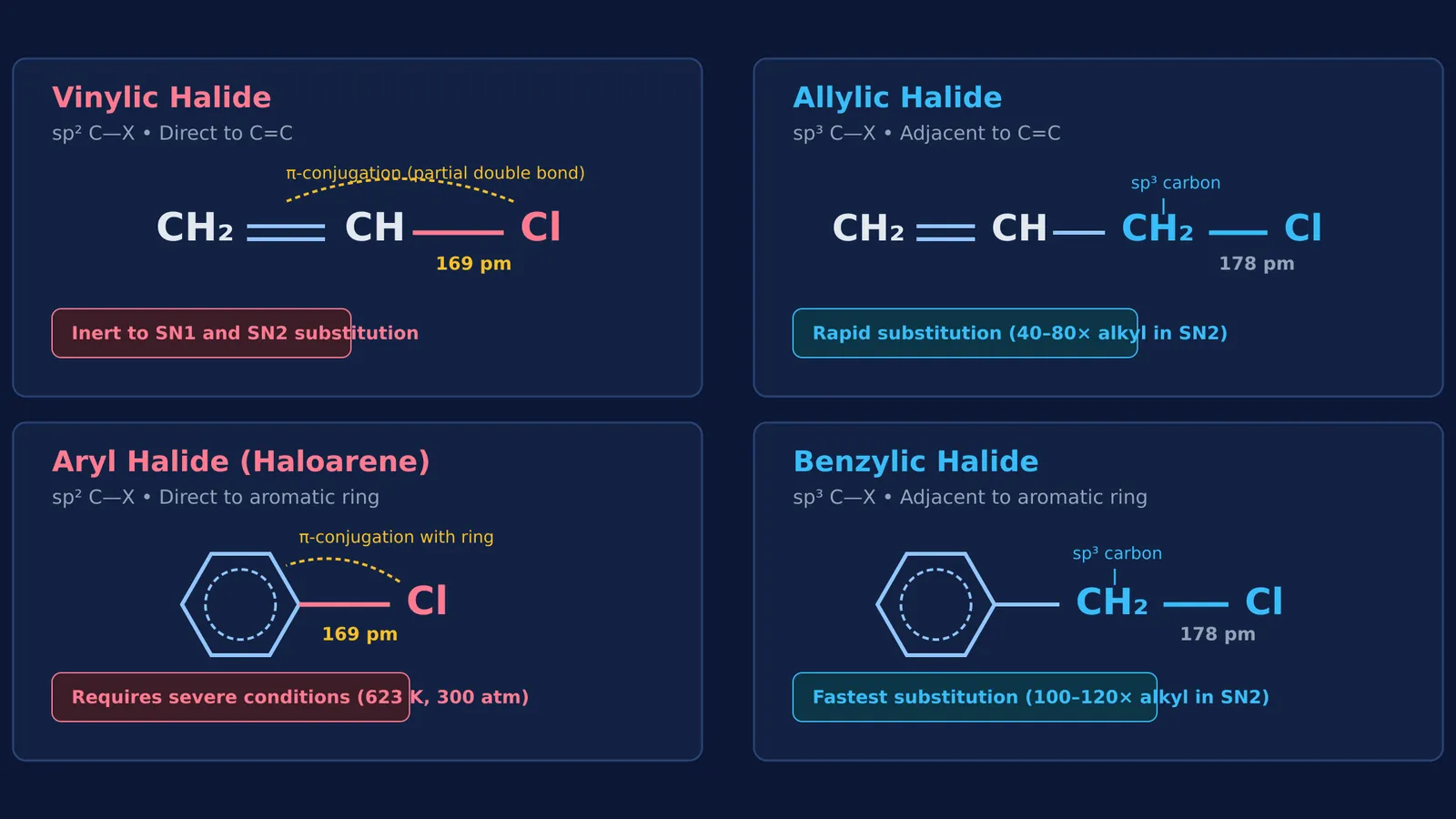
The classification of organohalogen compounds depends strictly on the hybridization and environment of the carbon atom directly bonded to the halogen (C—X), as defined in NCERT Class 12 Chemistry Unit 6:
Vinylic halides: The halogen atom is bonded directly to an sp² hybridized carbon atom of an aliphatic carbon-carbon double bond (such as chloroethene, CH₂=CH—Cl).
Aryl halides (haloarenes): The halogen atom is bonded directly to an sp² hybridized carbon atom of an aromatic ring (such as chlorobenzene, C₆H₅—Cl).
Allylic halides: The halogen atom is bonded to an sp³ hybridized carbon atom positioned directly adjacent to a carbon-carbon double bond (such as 3-chloroprop-1-ene, CH₂=CH—CH₂—Cl).
Benzylic halides: The halogen atom is bonded to an sp³ hybridized carbon atom directly attached to an aromatic ring (such as benzyl chloride, C₆H₅—CH₂—Cl).
Simple alkyl halides: The halogen atom is bonded to an sp³ hybridized carbon in an aliphatic chain with no adjacent π systems (such as 1-chloropropane, CH₃—CH₂—CH₂—Cl).
You can classify any unfamiliar organic halide using a three-step diagnostic test:
Identify the carbon atom directly bonded to the halogen.
Determine its hybridization: if it participates directly in a double bond or aromatic ring, it is sp² (vinylic or aryl).
If it is single-bonded (sp³), look at its immediate neighbor: an adjacent carbon-carbon double bond makes it allylic, an adjacent aromatic ring makes it benzylic, and saturated carbons make it a standard alkyl halide.
Why do vinylic and aryl halides resist nucleophilic substitution?
Vinylic and aryl halides resist ordinary nucleophilic substitution by both SN1 and SN2 pathways. Under conditions where an alkyl halide readily converts to an alcohol or ether, vinyl chloride and chlorobenzene remain unchanged. Four physical factors explain this resistance:
First, resonance delocalization provides partial double-bond character. The lone pairs of electrons on the halogen atom interact with the unhybridized p-orbitals of the adjacent π system. According to measurements reported in NCERT Class 12 Chemistry, this delocalization shortens the carbon-chlorine bond from 177 pm in chloromethane to 169 pm in chlorobenzene. A shorter bond possesses a higher bond dissociation enthalpy and resists heterolytic cleavage.
Second, the sp² hybridized carbon has 33% s-character compared to 25% in an sp³ carbon. Because s-orbitals are closer to the nucleus, an sp² carbon is more electronegative, holding the C—X bonding electrons tightly and diminishing carbon's electrophilic character.
Third, an SN1 pathway requires forming an unstable carbocation. Spontaneous ionization would produce a vinyl or phenyl cation. In both ions, the positive charge occupies an sp² hybrid orbital that lies in the plane of the molecule—exactly perpendicular to the π electron framework—preventing any resonance stabilization.
Fourth, backside attack in an SN2 mechanism is geometrically blocked. In an aryl halide, a nucleophile cannot approach through the interior of the aromatic ring, and in vinyl halides, the nucleophile is repelled by the high electron density of the π cloud.
Forcing nucleophilic aromatic substitution requires severe conditions. In the classic Dow process, converting chlorobenzene to sodium phenoxide demands heating with aqueous sodium hydroxide to 623 K (350 °C) under 300 atmospheres. In their foundational review of aromatic substitution, Bunnett and Zahler showed that substitution proceeds under mild conditions only when strong electron-withdrawing groups (such as nitro groups) occupy ortho or para positions. For details, read our guide on why haloarenes resist nucleophilic substitution.
Why do allylic and benzylic halides react exceptionally fast?
While vinylic and aryl halides resist substitution, allylic and benzylic halides occupy the opposite end of the reactivity spectrum. They undergo both unimolecular (SN1) and bimolecular (SN2) substitutions faster than ordinary alkyl halides.
In SN1 reactions, ionization produces a stable carbocation intermediate. When an allylic halide loses its leaving group, the resulting allyl cation delocalizes positive charge across two terminal carbon atoms across two equivalent resonance contributors. In benzylic halides, charge delocalizes into the ortho and para positions of the benzene ring across four resonance structures. For details on these hybrids, see why allylic and benzylic halides react fast by the SN1 route.
In SN2 reactions, allylic and benzylic substrates are equally formidable. In his classic kinetic compilation in Chemical Reviews, Streitwieser showed that primary allyl halides react approximately 40 to 80 times faster, and benzyl halides react roughly 100 to 120 times faster, than primary propyl halides when displaced by iodide in acetone.
This SN2 speed occurs because of transition state stabilization. As the incoming nucleophile approaches and the halogen departs, the central carbon adopts a planar, sp²-like geometry. Its partially filled p-orbital overlaps with the adjacent π orbital of the alkene or benzene ring. This conjugative overlap disperses developing charge across the π system, lowering the activation barrier. To see how substrate structure dictates mechanism choice, review SN1 vs SN2 in haloalkanes.
How to solve classification and reactivity exam problems?
Competitive exams frequently ask you to rank a series of isomers by their substitution rates. Consider four representative organochlorine compounds:
Compound A: 1-chlorobut-2-ene (CH₃—CH=CH—CH₂—Cl)
Compound B: 2-chlorobut-2-ene (CH₃—CH=C(Cl)—CH₃)
Compound C: 1-chlorobutane (CH₃—CH₂—CH₂—CH₂—Cl)
Compound D: (chloromethyl)benzene (C₆H₅—CH₂—Cl)
To rank them by nucleophilic substitution reactivity:
First, classify each carbon center: Compound B has chlorine attached directly to a C=C double bond (vinylic, sp²), making it unreactive under standard conditions. Compound C is a saturated primary alkyl chloride (sp³). Compound A is a primary allylic chloride (sp³ adjacent to C=C). Compound D is a primary benzylic chloride (sp³ adjacent to phenyl).
Next, apply the orbital rules:
For SN1 reactivity: Benzylic (D) > Allylic (A) >> Primary Alkyl (C) >> Vinylic (B). Compounds D and A form resonance-stabilized carbocations; C forms an unstable primary cation; B does not ionize.
For SN2 reactivity: Benzylic (D) > Allylic (A) > Primary Alkyl (C) >> Vinylic (B). Both D and A benefit from transition state π overlap; C reacts normally with modest steric hindrance; B experiences strong electrostatic and orbital repulsion.
When working through complex reaction sequences, the Fermi Problem Library provides worked problems with a step-by-step solver that explains the reasoning rather than printing an answer. For students exploring how orbital geometry connects reaction mechanisms, the Fermi Concept Library covers every concept in physics, chemistry, biology, mathematics and computing, each with its own lesson and its place in the map.


