On this page
Section B rewards an exact number and punishes a near miss, so each question below ends with a check by a second method and the slip that most often produces a wrong answer.
How are JEE Main numerical value questions marked?
NTA's Information Bulletin for JEE (Main) 2027 says each Paper 1 subject has 20 Section A questions (MCQs) and 5 Section B questions answered as a numerical value. A correct Section B answer earns +4, a wrong one −1, a blank 0. You enter an integer on an on-screen numeric keypad, and the bulletin says the answer should be rounded off to the nearest integer.
The topic is Unit 1 of the mathematics Syllabus for JEE (Main) 2027: sets, union, intersection and complement, power set, types of relations, equivalence relations, one-one and onto functions, and composition. Shaky on the words? Read sets, relations and functions Class 11 key terms, explained simply first.
Easy: can you count sets and subsets?
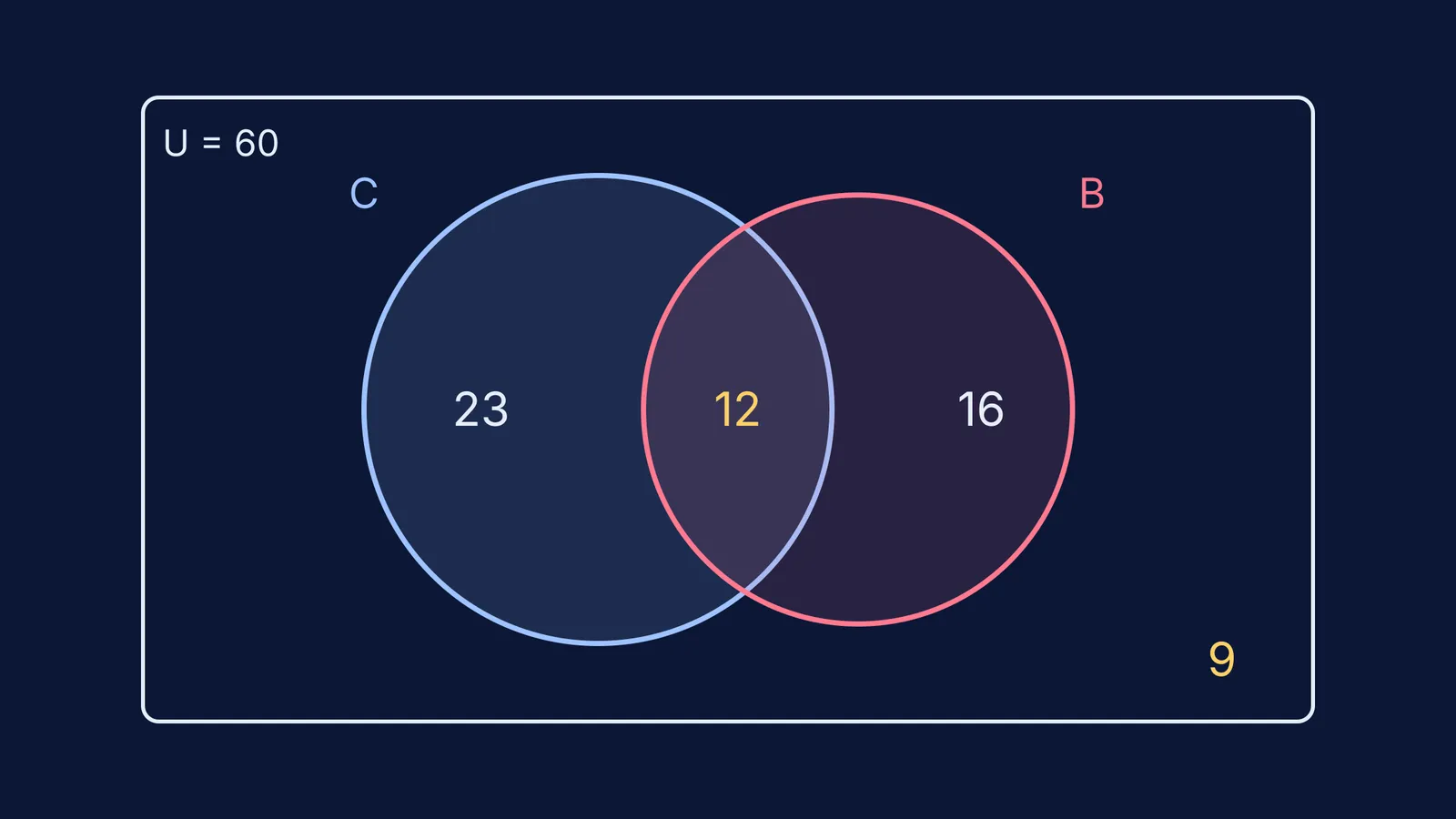
Q1 (easy). In a class of 60 students, 35 play chess, 28 play badminton and 12 play both. How many play neither?
Answer: 9. n(C ∪ B) = 35 + 28 − 12 = 51, so neither = 60 − 51 = 9.
Check: chess only 23, badminton only 16, both 12; 23 + 16 + 12 + 9 = 60. Slip: 51, the number who play at least one.
Q2 (easy). A = {1, 2, 3, 4, 5}. How many subsets of A contain at least one even number?
Answer: 24. All subsets: 2⁵ = 32. Subsets with no even number are subsets of {1, 3, 5}: 2³ = 8. Answer 32 − 8 = 24.
Check: a non-empty choice from {2, 4} (3 ways) times any subset of {1, 3, 5} (8 ways) = 24. Slip: 32, adding 16 subsets with 2 and 16 with 4, which counts those holding both twice.
Q3 (easy). How many reflexive relations are there on a set with 3 elements?
Answer: 64. A × A has 9 ordered pairs. The 3 pairs (a, a) must be in; each of the other 6 is in or out: 2⁶ = 64.
Check: total relations 2⁹ = 512, and each of the 2³ = 8 patterns on the diagonal gets the same 64, so 8 × 64 = 512. Slip: 512, forgetting the condition.
Medium: can you count relations and one-one maps?
Q4 (medium). How many equivalence relations are there on {1, 2, 3, 4}?
Answer: 15. An equivalence relation is the same as a partition into classes. Count by class sizes: {4} gives 1, {3, 1} gives 4, {2, 2} gives 3, {2, 1, 1} gives 6, {1, 1, 1, 1} gives 1. Total 15.
Check: element 4 shares its class with k of the other three, and the rest are split freely: 1 × 5 + 3 × 2 + 3 × 1 + 1 × 1 = 15. Slip: 12, missing the {2, 2} splits.
Q5 (medium). How many one-one functions f: {1, 2, 3} → {1, 2, 3, 4, 5} have f(1) ≠ 1?
Answer: 48. All one-one functions: 5 × 4 × 3 = 60. Those with f(1) = 1: 4 × 3 = 12. Answer 60 − 12 = 48.
Check: f(1) has 4 choices, f(2) then 4, f(3) then 3: 4 × 4 × 3 = 48. Slip: 100, from 5³ − 5², which drops the one-one condition.
Hard: can you handle onto and composition?
Q6 (hard). How many onto functions are there from a 4-element set to a 3-element set?
Answer: 36. Inclusion–exclusion on the outputs missed: 3⁴ − 3 × 2⁴ + 3 × 1⁴ = 81 − 48 + 3 = 36.
Check: exactly two inputs share an output. Choose that pair, C(4, 2) = 6, then match the three groups to three outputs, 3! = 6: 6 × 6 = 36. Slip: 24, from ⁴P₃, which counts one-one choices instead.
Q7 (hard). f(x) = (3x + 4)/(x − 3), x ≠ 3. Apply f to 4 a total of 2027 times. What number do you get?
Answer: 16. Simplify f(f(x)) = (13x)/(13) = x, so f is its own inverse. An odd number of applications equals one: f(4) = 16/1 = 16.
Check: f(16) = 52/13 = 4, so the values alternate 16, 4, 16. Slip: 4, getting the parity wrong.
Q8 (hard). How many functions f: {1, 2, 3, 4, 5} → {1, 2, 3, 4, 5} satisfy f(f(x)) = x for every x?
Answer: 26. Such an f only fixes points or swaps pairs. No swaps: 1. One swap: C(5, 2) = 10. Two swaps: 5 choices of fixed point × 3 ways to pair the other four = 15. Total 26.
Check: the counts for n = 1 to 5 follow I(n) = I(n − 1) + (n − 1) I(n − 2): 1, 2, 4, 10, 26. Slip: 11, forgetting the two-swap case.
How do you avoid the wrong number in sets, relations and functions?
Rewrite the condition in plain words before you count (Q4, Q6, Q8).
For at least one or not, count the complement (Q2, Q5).
With a self-inverse function, find the cycle and use parity (Q7).
Check with a second method. If the two disagree and time is short, a blank costs nothing; a wrong answer costs a mark.
Answer won't match? The Fermi Problem Library has worked problems with a step-by-step solver that explains the reasoning rather than printing an answer. For JEE Main and Advanced preparation, start at Fermi Test Prep.
Next, try permutations and combinations JEE Main numerical value questions or read how to count using a bijection.