On this page
Here are the key terms of NCERT Class 11 Mathematics Chapter 1, Sets, and Chapter 2, Relations and Functions (Reprint 2026-27), grouped by topic. For solved examples, see our Relations and Functions Class 11 guide.
Every term below is in the CBSE Mathematics syllabus for 2026-27; power sets and composition of functions are not in these reprints.
What is a set and how do you write one?
Set: a well-defined collection: you can always decide whether an object belongs. Counter-example: "the five best writers of India".
Element (∈, ∉): an object in a set. Example: 3 ∈ {2, 3, 5}, 4 ∉ {2, 3, 5}.
Roster form: elements listed in braces, each once, in any order. Example: SCHOOL gives {S, C, H, O, L}.
Set-builder form: {x : property}, read "the set of all x such that". Example: {x : x ∈ N, 3 < x < 10} = {4, 5, ..., 9}.
Empty set (φ or { }): a set with no elements. Example: natural numbers between 1 and 2. Don't confuse with: {0}, a singleton set with one element.
Finite and infinite sets: finite if empty or with a definite number of elements, else infinite; n(S) counts distinct elements. Example: n({1, 2, 2, 3}) = 3; N is infinite.
Equal sets: exactly the same elements. Example: {1, 2, 3} = {3, 3, 1, 2}.
What is the difference between a subset and an element?
Subset (A ⊂ B): every element of A is in B; A ⊂ A and φ ⊂ A always. Don't confuse with: ∈. For A = {1} and B = {{1}, 2}, A ∈ B but A ⊄ B, since 1 ∉ B.
Proper subset and superset: A ⊂ B with A ≠ B; B is then a superset of A. Example: {1, 2} and {1, 2, 3}.
Universal set (U): the basic set containing every set under discussion; for integers, U can be R.
Open interval (a, b): for a < b, the reals strictly between a and b. Example: 5 ∉ (−3, 5).
Closed interval [a, b]: the reals from a to b, ends included; [a, b) and (a, b] include one end. Example: [−3, 5) = {x : −3 ≤ x < 5}, length b − a = 8.
How do union, intersection, difference and complement work?
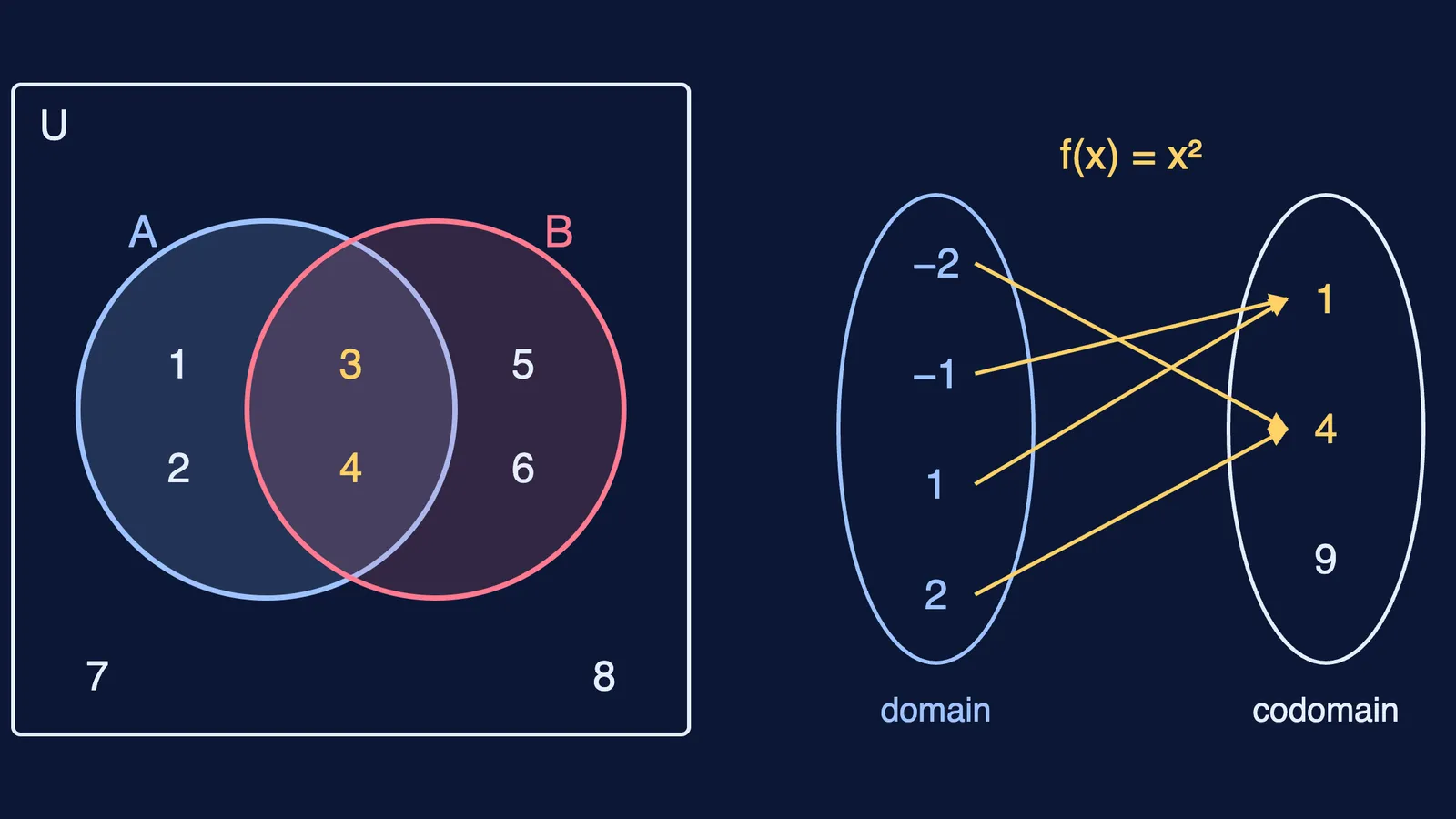
Take U = {1, ..., 8}, A = {1, 2, 3, 4}, B = {3, 4, 5, 6}, as in the diagram.
Union (A ∪ B): elements in A or B or both. Example: {1, 2, 3, 4, 5, 6}.
Intersection (A ∩ B): elements in both. Example: {3, 4}. If A ∩ B = φ, the sets are disjoint, like A and {7, 8}.
Difference (A − B): elements of A not in B. Example: A − B = {1, 2}. Don't confuse with: B − A = {5, 6}.
Complement (A′): elements of U not in A, so A′ = U − A = {5, 6, 7, 8}. Laws: A ∪ A′ = U, A ∩ A′ = φ, (A′)′ = A.
De Morgan's laws: (A ∪ B)′ = A′ ∩ B′ and (A ∩ B)′ = A′ ∪ B′. Example: (A ∪ B)′ = A′ ∩ B′ = {7, 8}.
What are ordered pairs, Cartesian products and relations?
Ordered pair (a, b): two elements in a fixed order; (a, b) = (x, y) only if a = x and b = y. Example: (x − 1, 4) = (2, y) gives x = 3, y = 4.
Cartesian product (A × B): all pairs (a, b) with a ∈ A, b ∈ B; n(A × B) = n(A) × n(B). Don't confuse with: B × A; (1, 3) ≠ (3, 1).
Relation: a subset of A × B chosen by a rule; in (x, y), y is the image of x. Two 3-element sets give 2^9 = 512 relations.
Domain, range, codomain: first elements, second elements, and the whole of B; range ⊂ codomain. Example: on A = {1, 2, 3, 4}, y = x + 1 gives {(1, 2), (2, 3), (3, 4)}: domain {1, 2, 3}, range {2, 3, 4}, codomain A.
When is a relation a function?
Function (f : A → B): a relation where every element of A has exactly one image in B. Counter-example: the relation above, where 4 has no image.
Image and preimage: if f(a) = b, b is the image of a, and a a preimage of b. Example: f(x) = x² sends both −2 and 2 to 4, which is allowed.
Range of a function: the set of images, inside the codomain. Example: f(x) = 2x on N has range the even natural numbers.
Real valued and real functions: range in R; a real function also has its domain in R.
Identity and constant functions: f(x) = x and f(x) = c, range {c}.
Polynomial function: a₀ + a₁x + ... + aₙxⁿ, n a non-negative integer, real coefficients. Counter-example: √x + 1.
Rational function: f(x)/g(x) for polynomials with g(x) ≠ 0. Example: 1/x, domain and range R − {0}.
Modulus function: |x| = x for x ≥ 0, −x for x < 0. Example: |−3| = 3.
Signum function: 1 for x > 0, 0 at 0, −1 for x < 0.
Greatest integer function [x]: the greatest integer ≤ x. Example: [2.7] = 2, [−0.5] = −1. Don't confuse with: rounding, giving 3.
Algebra of real functions: for f, g : X → R, (f + g)(x) = f(x) + g(x), and likewise f − g, αf and fg; (f/g)(x) needs g(x) ≠ 0.
How to learn these terms
Put numbers in a Venn diagram and read ∪, ∩, − and ′ off it.
Write your own example for each "Don't confuse with" pair.
Draw an arrow diagram before calling a relation a function.
Sketch the modulus, signum and greatest integer graphs from memory, then compare.
Revise the Sets Class 11 guide, then try the relations and functions assertion-reason questions. If a definition feels slippery, the Fermi Concept Library gives every concept in mathematics its own lesson and its place in the map.