On this page
These ten items are for practice. Every statement was checked against the NCERT chapter Relations and Functions (Reprint 2026-27), and every number recomputed in Python.
How do you answer assertion-reason questions?
Mark each statement true or false on its own. Only if both are true, ask: does R directly prove A? Assertion-reason keys:
(A) Both A and R are true and R is the correct explanation of A.
(B) Both A and R are true but R is NOT the correct explanation of A.
(C) A is true but R is false.
(D) A is false but R is true.
Statement-pair keys:
(A) Both statements are correct.
(B) Both statements are incorrect.
(C) Statement I is correct, Statement II is incorrect.
(D) Statement I is incorrect, Statement II is correct.
All items stay inside Relations and Functions in the CBSE 2026-27 Class XI Maths syllabus. Composition of functions is left out.
Assertion-reason questions on relations and functions
Q1 (easy). Assertion (A): If n(A) = 3 and n(B) = 4, then A × B has 12 elements. Reason (R): If n(A) = p and n(B) = q, then n(A × B) = pq.
Answer: (A). R is the rule that gives A: 3 × 4 = 12.
Trap: adding 3 + 4.
Q2 (easy). Assertion (A): If A = {1, 2} and B = {3}, then A × B = B × A. Reason (R): For finite sets, A × B and B × A have equally many elements.
Answer: (D). A is false: A × B holds (1, 3), B × A holds (3, 1), and these ordered pairs differ. R is true: both sets have 2 elements.
Trap: equal size is not equal sets.
Q3 (medium). Assertion (A): There are 64 relations from A = {1, 2, 3} to B = {a, b}. Reason (R): The number of relations from A to B equals n(A) × n(B).
Answer: (C). A is true: every relation is a subset of A × B, which has 6 pairs, so there are 2⁶ = 64. R is false: n(A) × n(B) = 6 counts pairs, not relations.
Trap: stopping at 6.
Q4 (medium). Assertion (A): The relation {(1, 2), (1, 3), (2, 3)} from {1, 2} to {2, 3} is a function. Reason (R): A relation from A to B is a function if every element of A has one and only one image in B.
Answer: (D). R is the NCERT definition, so it is true. A is false: 1 has two images, 2 and 3.
Trap: checking that each element has an image, not exactly one.
Q5 (hard). Assertion (A): The range of the signum function is {−1, 0, 1}. Reason (R): The domain of the signum function is R.
Answer: (B). Both are true per NCERT, but the domain does not decide the range: the identity function also has domain R and range R. The range comes from the rule, which outputs only 1, 0 or −1.
Trap: marking (A) because both lines are true.
Q6 (hard). Assertion (A): For f(x) = x − 2 and g(x) = x² − 4, the domain of f/g is R − {−2, 2}. Reason (R): (f/g)(x) = 1/(x + 2) for every real x except −2.
Answer: (C). A is true: f/g needs g(x) ≠ 0, and x² − 4 = 0 at x = ±2. R is false at x = 2: f/g gives 0/0 there, though 1/(x + 2) gives 1/4.
Trap: cancelling first, then reading the domain.
Statement I and Statement II questions with answers
Q7 (easy). Statement I: If (2x − 1, y + 3) = (5, 1), then x = 3 and y = −2. Statement II: If A = {0, 1} and B = {2, 3, 4}, then A × A × B has 12 ordered triplets.
Answer: (A). Equal ordered pairs give 2x − 1 = 5 and y + 3 = 1. A × A × B has 2 × 2 × 3 = 12 triplets.
Trap: adding 2 + 2 + 3.
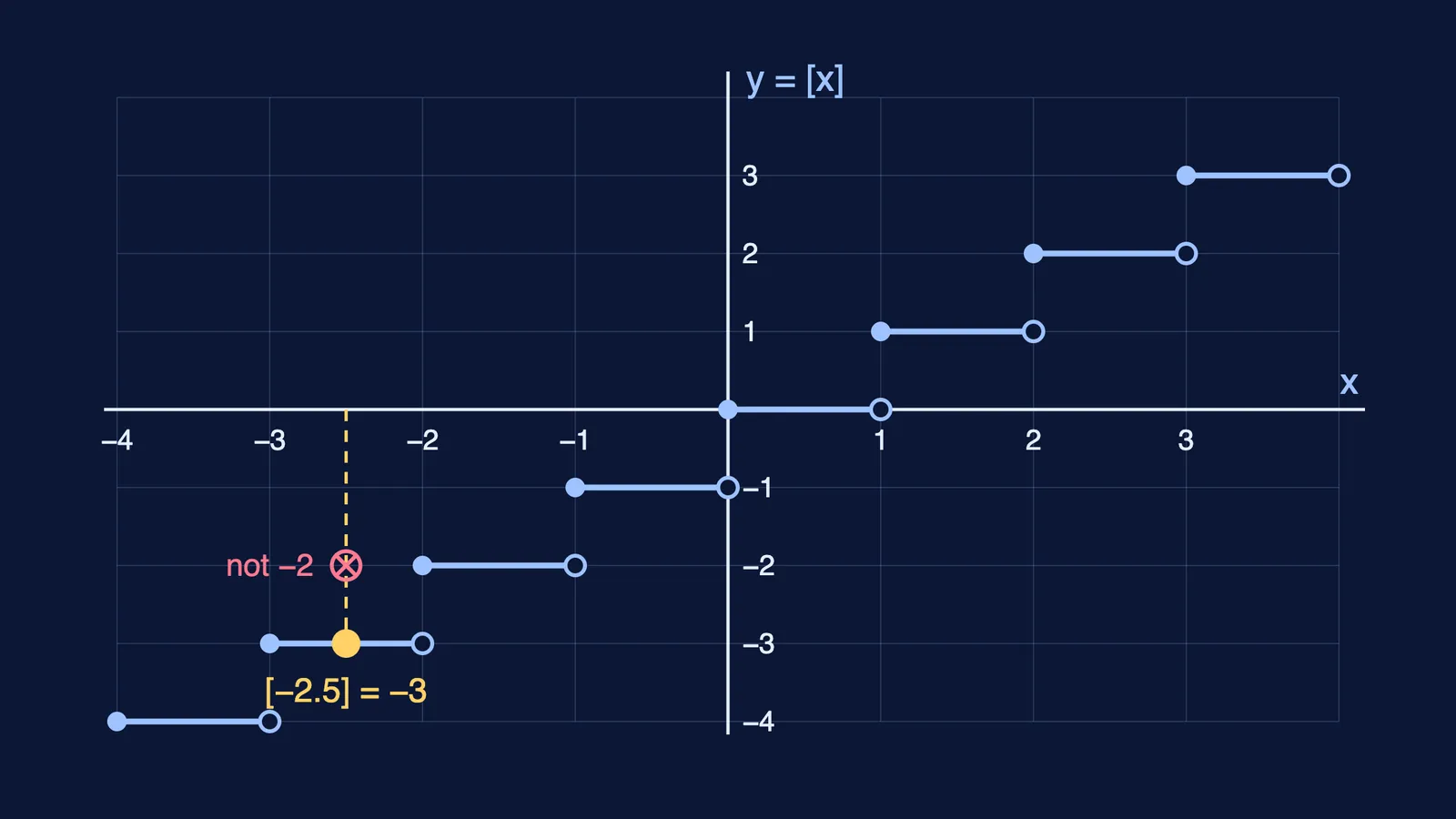
Q8 (medium). Statement I: [−2.5] = −2, where [x] is the greatest integer function. Statement II: The range of the greatest integer function f : R → R is the set of integers Z.
Answer: (D). [x] is the greatest integer less than or equal to x; −2 is greater than −2.5, so [−2.5] = −3. II is correct: every value is an integer, and [n] = n reaches each one.
Trap: chopping the decimal off.
Q9 (medium). Statement I: The range of f(x) = 1/x, x ≠ 0, is R. Statement II: The domain of f(x) = (x + 3)/(x² − 9) is R − {3}.
Answer: (B). I is wrong: 1/x is never 0, so the range is R − {0}. II is wrong: x² − 9 = 0 at x = ±3, so the domain is R − {−3, 3}.
Trap: keeping only the positive root.
Q10 (hard). Statement I: If the linear function f(x) = mx + c has f(0) = 3 and f(2) = −1, then f(x) = −2x + 3. Statement II: The range of f(x) = √(x − 1) is the set of all real numbers greater than or equal to 1.
Answer: (C). In I, c = f(0) = 3 and 2m + 3 = −1, so m = −2. In II, x ≥ 1 describes the domain; the range is all real numbers y ≥ 0, since √(x − 1) = 0 at x = 1.
Trap: swapping domain and range for square-root functions.
How should you use this set?
Attempt all ten in 12 minutes, marking T or F beside each statement first.
For each miss, note what you misjudged: A, R, or the link.
Redo Q3, Q6 and Q10 without the explanations.
Turn one trap into your own pair and swap it with a friend.
If the greatest integer or signum graph still feels hazy, the Fermi Concept Library gives every concept in mathematics its own lesson and its place in the map.
For the full chapter, read our Relations and Functions Class 11 guide; for the method, our assertion-reason strategy guide; and for the previous chapter, Sets Class 11 with solved examples.