On this page
Eight original JEE Main numerical-value questions, easy to hard. Each has a worked solution, the integer answer, a second-method check and a common wrong answer.
How are JEE Main numerical value questions marked?
NTA's Information Bulletin for JEE (Main) 2027 says each Paper 1 subject has 20 Section A questions (MCQs) and 5 Section B questions answered as a numerical value. A correct Section B answer earns +4, a wrong one −1, a blank 0. You type an integer on an on-screen keypad, rounded off to the nearest integer.
The topic is Unit 4 of the mathematics Syllabus for JEE (Main) 2027: the fundamental principle of counting, permutations, combinations, P(n, r) and C(n, r). Counting answers are whole numbers, so the danger is counting the wrong thing. Formulas: see permutations and combinations Class 11 formulas with examples.
Easy: can you count without overcounting?
Q1 (easy). How many arrangements are there of all the letters of SUCCESS?
Answer: 420. Seven letters, S three times and C twice: 7!/(3!×2!) = 5040/12 = 420.
Check: labelling the repeats splits each arrangement into 12, and 420×12 = 5040 = 7!. Slip: 5040, treating the S's and C's as different.
Q2 (easy). How many 4-digit numbers with all digits different are divisible by 5?
Answer: 952. Ending in 0: 9×8×7 = 504. Ending in 5, the first digit cannot be 0 or 5: 8×8×7 = 448. Total 952.
Check: ending in 5 is 9×8×7 = 504 strings minus 8×7 = 56 starting with 0, which is 448. Slip: 1008, letting 0 lead.
Q3 (easy). A committee of 5 is chosen from 6 boys and 4 girls. In how many ways can it include at least 2 girls?
Answer: 186. Complement: C(10,5) = 252, minus C(6,5) = 6 with no girl and 4×C(6,4) = 60 with one girl.
Check: directly, 6×20 + 4×15 + 1×6 = 186. Slip: 336, from C(4,2)×C(8,3), which counts each 3-girl committee three times and each 4-girl one six times.
Medium: where do the restrictions bite?
Q4 (medium). Six friends sit at a round table. In how many ways can they sit if Asha and Ravi must not be neighbours?
Answer: 72. Round-table arrangements: (6−1)! = 120. Glued together, Asha and Ravi give 4!×2 = 48. Answer 120 − 48 = 72.
Check: fix Asha's seat; Ravi has 3 allowed seats and the rest fill 4! ways: 3×24 = 72. Slip: 480, the answer for a row.
Q5 (medium). How many non-negative integer solutions does x + y + z + w = 10 have if x ≥ 1 and y ≥ 2?
Answer: 120. Put x = a + 1, y = b + 2. Then a + b + z + w = 7, all ≥ 0, and stars and bars gives C(10,3) = 120.
Check: if a + b = k (k + 1 ways), z + w = 7 − k (8 − k ways); summing over k = 0 to 7 gives 8 + 14 + 18 + 20 + 20 + 18 + 14 + 8 = 120. Slip: 286, which is C(13,3) and ignores both conditions.
Hard: can you subtract cleanly?
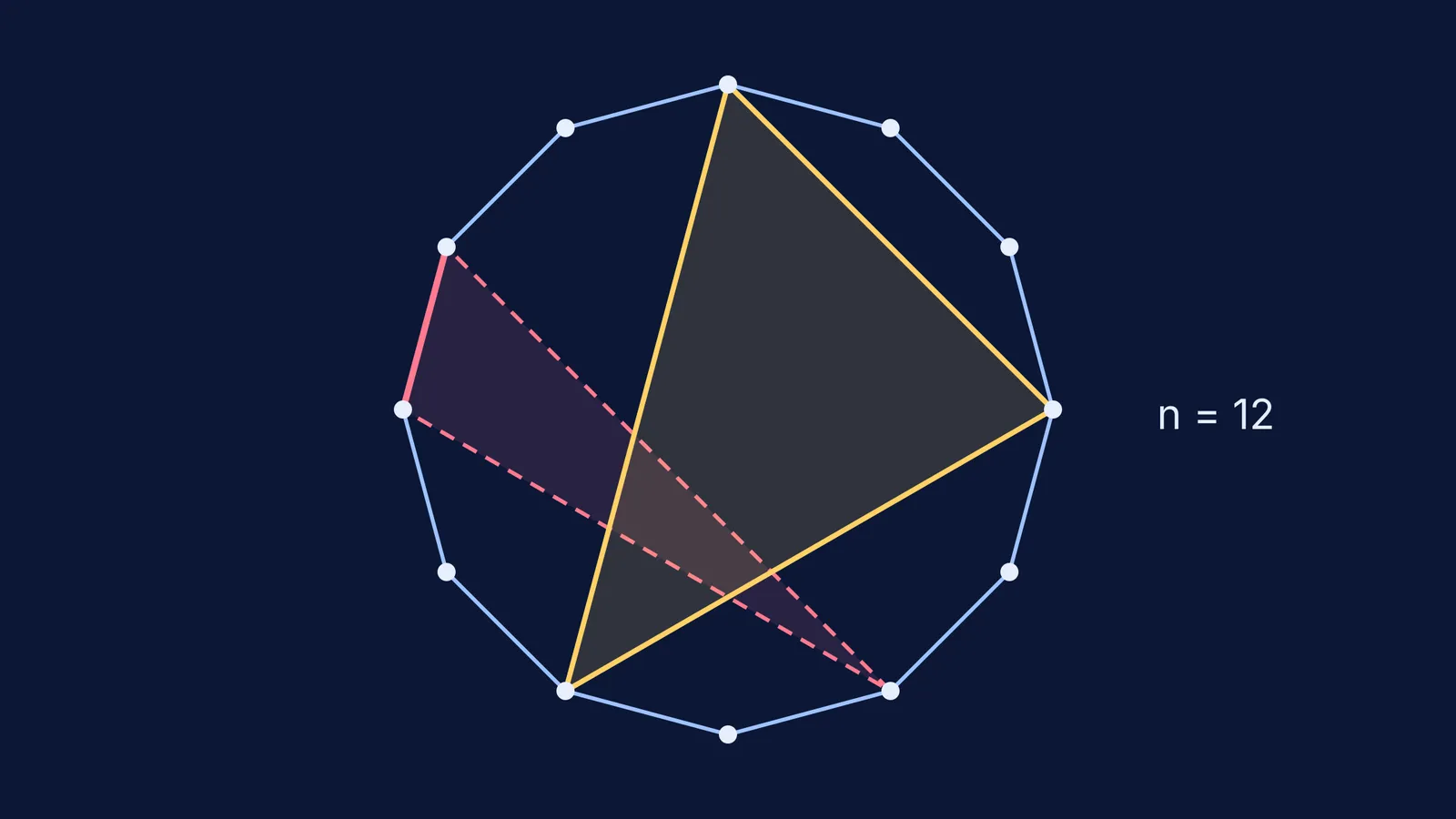
Q6 (hard). How many triangles have their vertices among those of a regular 12-gon but share no side with it?
Answer: 112. All triangles: C(12,3) = 220. Exactly one shared side: 12 sides × 8 third vertices (not the ends or their neighbours) = 96. Two shared sides: 12. Answer 220 − 96 − 12 = 112.
Check: n(n−4)(n−5)/6 = 12×8×7/6 = 112. Slip: 100, from 220 − 12×10, which counts two-side triangles twice.
Q7 (hard). Five letters go at random into five addressed envelopes, one each. In how many ways do exactly 2 reach the right envelope?
Answer: 20. Choose the 2 correct letters: C(5,2) = 10. The other 3 must all be wrong, a derangement with D₃ = 2, so 10×2 = 20.
Check: for A, B, C only BCA and CAB put none in place. Slip: 60, from 10×3!, which lets more letters land correctly.
Q8 (hard). Six different books go to three children so that each gets at least one. In how many ways?
Answer: 540. Without the condition: 3⁶ = 729. Inclusion–exclusion: 729 − 3×2⁶ + 3×1⁶ = 729 − 192 + 3 = 540.
Check: by group sizes, (4,1,1) gives 90, (3,2,1) gives 360, (2,2,2) gives 90. Slip: 10, from C(5,2), the formula for identical objects.
How do you avoid the wrong number in permutations and combinations?
Ask whether order matters before choosing P or C.
Ask whether the objects are identical or different (Q1, Q8).
For at least, not together and none in place, count the complement (Q3, Q4, Q7).
Check with a second method. If they disagree and time is short, a blank costs nothing; a wrong answer costs a mark.
Answer won't match? The Fermi Problem Library has worked problems with a step-by-step solver that explains the reasoning rather than printing an answer. For JEE Main and Advanced preparation, start at Fermi Test Prep.
Next, read how to count using a bijection or try Binomial Theorem: 8 JEE Main practice questions with solutions.