On this page
Every formula below comes from Chapter 6, Permutations and Combinations, of the NCERT Class 11 Mathematics textbook (Reprint 2026-27), and the topics match the chapter entry in the CBSE Class XI Mathematics syllabus for 2026-27: fundamental principle of counting, factorial n, and the formulae for ⁿPᵣ and ⁿCᵣ and their connections. Circular arrangements do not appear in the current NCERT chapter, so they are not on this sheet.
Symbols used throughout: n is the number of objects you have, r is how many you take, and both are whole numbers with 0 ≤ r ≤ n unless a line says otherwise. ⁿPᵣ counts arrangements (order matters) and ⁿCᵣ counts selections (order does not).
What is the fundamental principle of counting?
NCERT states it as: if an event can occur in m different ways, following which another event can occur in n different ways, the events in that order can occur in m × n ways (NCERT section 6.2).
Two events in succession: m × n ways.
Three events in succession: m × n × p ways, and so on for any finite number of events.
Factorial: n! = 1 × 2 × 3 × ... × n, for a natural number n.
Zero factorial: 0! = 1 (a definition, not a calculation).
Recursive form: n! = n × (n − 1)!, for n ≥ 1.
Worked example: a canteen meal is one of 4 sandwiches, then one of 3 drinks, then one of 2 fruits, so there are 4 × 3 × 2 = 24 meals. Factorials cancel: 9!/7! = 9 × 8 = 72, without working out either factorial.
Watch for: multiplying counts that are alternatives rather than steps. Multiply only when you do one thing and then another; (2n)! is not 2 × n!, and 0! is 1, not 0. Our explainer on why 0 factorial equals 1 shows three checks that agree.
How do you find ⁿPᵣ for different objects?
These are Theorems 1 and 2 and section 6.3.3 of the NCERT chapter.
No repetition: ⁿPᵣ = n(n − 1)(n − 2) ... (n − r + 1) = n!/(n − r)!, for 0 ≤ r ≤ n.
All n objects arranged: ⁿPₙ = n!.
Nothing arranged: ⁿP₀ = 1.
Repetition allowed (each of the r places can take any of the n objects): nʳ.
Worked example: how many 4-digit codes can you make from the digits 1 to 7? With no digit repeated, ⁷P₄ = 7 × 6 × 5 × 4 = 840. If digits may repeat, each place has 7 choices, so 7⁴ = 2,401.
Watch for: using ⁿPᵣ when repetition is allowed, or nʳ when it is not. Look for "without repetition" or "may repeat" first; ⁿPᵣ also needs r ≤ n.
How do you count arrangements when some objects are alike?
From Theorems 3 and 4 of the NCERT chapter:
n objects, p of them alike and the rest all different: n!/p!.
n objects with p₁ alike of one kind, p₂ alike of a second kind, ..., pₖ alike of a kth kind, and the rest different: n!/(p₁! p₂! ... pₖ!).
Condition: these count arrangements of all n objects at a time, in a row.
Worked example: the letters of TATTOO are 6 letters with T three times, O twice and A once. The number of different arrangements is 6!/(3! × 2!) = 720/12 = 60.
Watch for: taking n as the number of different letters instead of the total. Here n = 6, not 3. Divide by a factorial for every letter that repeats, and by nothing extra for letters that appear once.
What is the formula for ⁿCᵣ, and how is it linked to ⁿPᵣ?
From Theorem 5, its Remarks and Theorem 6 in NCERT section 6.4:
Selections: ⁿCᵣ = n!/(r! (n − r)!), for 0 ≤ r ≤ n.
Link to arrangements: ⁿPᵣ = ⁿCᵣ × r!, for 0 < r ≤ n (each selection of r objects can be ordered in r! ways).
End values: ⁿC₀ = 1 and ⁿCₙ = 1.
Complement rule: ⁿCₙ₋ᵣ = ⁿCᵣ (choosing r to keep is the same as choosing n − r to leave out).
Equal values: if ⁿCₖ = ⁿCₘ, then k = m or k + m = n.
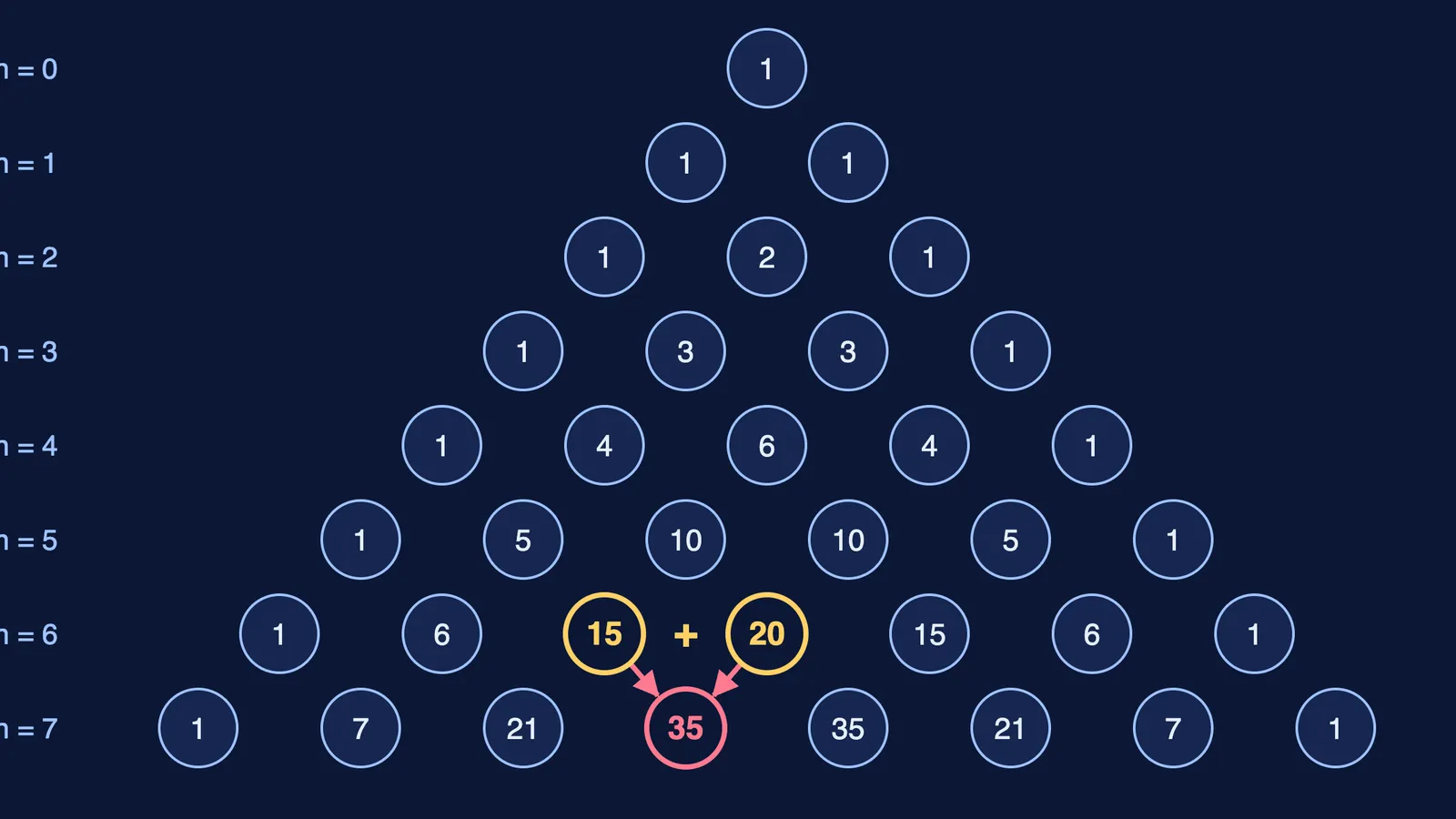
Pascal's rule: ⁿCᵣ + ⁿCᵣ₋₁ = ⁿ⁺¹Cᵣ, for 1 ≤ r ≤ n.
The hero diagram shows Pascal's rule in the triangle of ⁿCᵣ values: ⁶C₂ + ⁶C₃ = 15 + 20 = 35 = ⁷C₃.
Worked example: a committee of 3 boys and 2 girls is chosen from 7 boys and 5 girls. The two choices happen in succession, so the count is ⁷C₃ × ⁵C₂ = 35 × 10 = 350. Second example: if ⁿC₄ = ⁿC₉, then 4 ≠ 9, so n = 4 + 9 = 13 and ¹³C₂ = 78.
Watch for: using ⁿPᵣ for a committee or team, where order does not matter. For "at least" questions, split into cases (for example, exactly 2 girls plus exactly 3 girls) and add the cases; do not multiply them. If you keep picking the wrong method, the Fermi Problem Library has worked problems with a step-by-step solver that explains the reasoning rather than printing an answer.
How to revise this formula sheet
Derive ⁿPᵣ by filling r boxes (n choices, then n − 1, and so on), then divide by r! to get ⁿCᵣ.
Check every formula on small numbers you can list: ⁴C₂ = 6 (AB, AC, AD, BC, BD, CD) and ³P₂ = 6.
Use ⁿCᵣ = ⁿCₙ₋ᵣ to shorten work: ²⁰C₁₈ is ²⁰C₂ = 190.
Before any calculation, write one line: "order matters / does not; repetition allowed / not allowed; any alike objects?"
For the chapter explained topic by topic, read our Permutations and Combinations Class 11 guide, then test the theory with the permutations and combinations assertion-reason questions for Class 11.