On this page
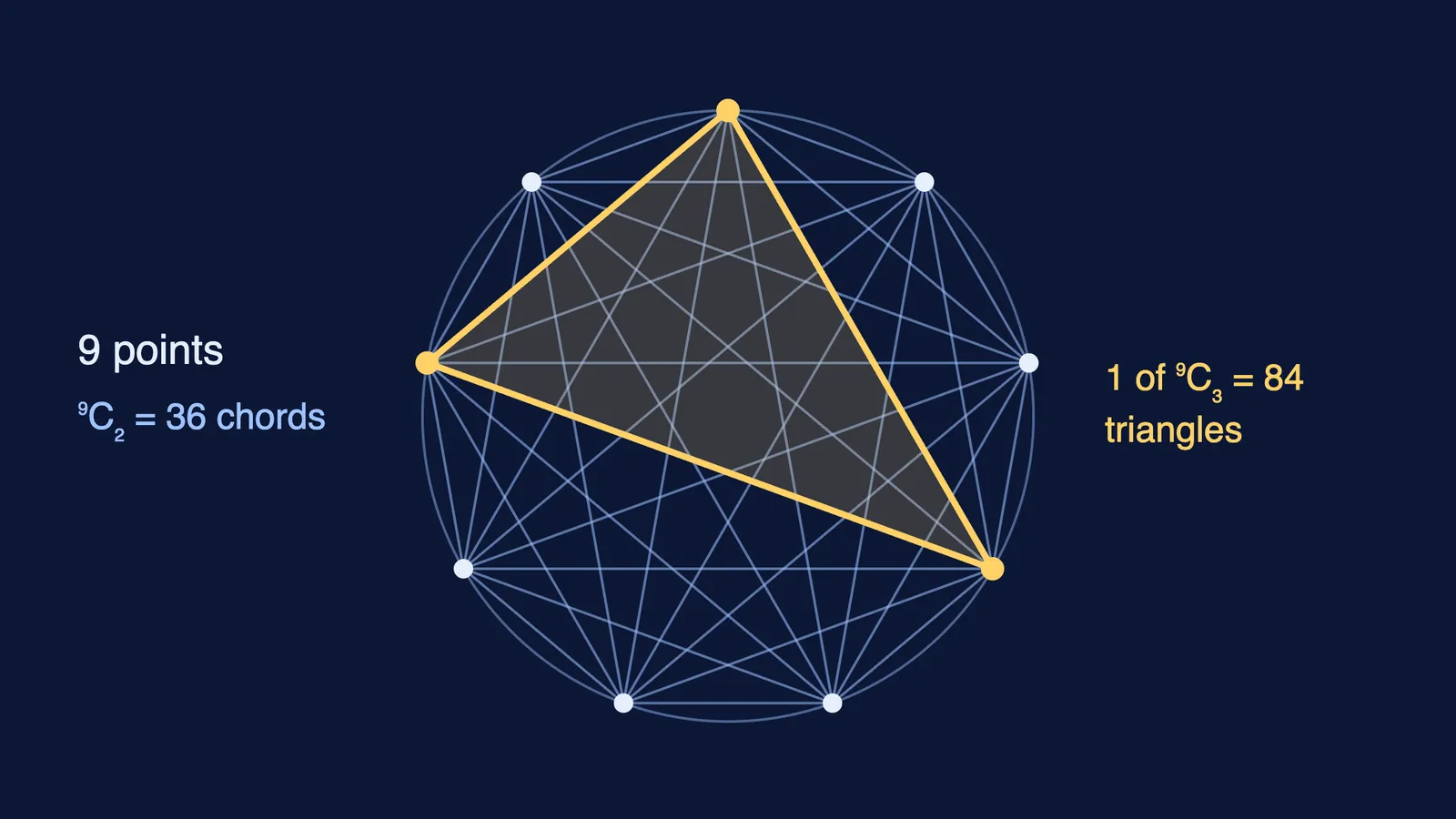
Every statement stays inside the NCERT Permutations and Combinations chapter (Reprint 2026-27); we checked every count in Python. Q8 uses the points drawn above.
How do you answer assertion-reason questions on permutations and combinations?
Permutations and Combinations is chapter 3 of Unit II (Algebra) in the CBSE 2026-27 Class XI Mathematics syllabus. Treat this set as practice.
Judge A, judge R, then read "A, because R". Most traps here are one of three: order that should not count, repeats not divided out, or a forbidden case (a leading zero) not removed. More in our assertion-reason question strategy.
Assertion-reason keys:
(A) Both A and R are true and R is the correct explanation of A.
(B) Both A and R are true but R is NOT the correct explanation of A.
(C) A is true but R is false.
(D) A is false but R is true.
Statement I / Statement II keys:
(A) Both statements are correct.
(B) Both statements are incorrect.
(C) Statement I is correct, Statement II is incorrect.
(D) Statement I is incorrect, Statement II is correct.
Permutations and combinations assertion-reason questions with answers
Q1 (easy). Assertion (A): Using the letters of MAGNETS without repetition, 840 four-letter arrangements (with or without meaning) can be made. Reason (R): The number of permutations of n different objects taken r at a time, without repetition, is n!/(n − r)!.
Answer: (A). MAGNETS has 7 different letters, so 7P4 = 7 × 6 × 5 × 4 = 840. R is the formula that gives it.
Trap: using 7^4, which allows repeated letters.
Q2 (easy). Assertion (A): 10C3 = 10C7. Reason (R): 10P3 = 10P7.
Answer: (C). Both combinations equal 120, because choosing 3 objects is the same as rejecting 7. R is false: 10P3 = 720 but 10P7 = 604800.
Trap: carrying a combination rule over to permutations.
Q3 (medium). Assertion (A): The letters of LEVEL can be arranged in 30 different ways. Reason (R): Two arrangements that differ only by swapping the two L's are counted as different arrangements.
Answer: (C). With two L's and two E's, the count is 5!/(2! 2!) = 30. R is false: swapping identical letters gives the same word, which is why we divide by 2! for each pair.
Trap: answering 5! = 120.
Q4 (medium). Assertion (A): Using the digits 0, 2, 4, 6, 8 without repetition, 5P3 = 60 three-digit numbers can be formed. Reason (R): A three-digit number cannot have 0 in the hundreds place.
Answer: (D). 5P3 = 60 includes strings like 024. Removing the 4P2 = 12 that start with 0 leaves 48, so A is false; R is true.
Trap: forgetting to subtract the leading-zero cases.
Q5 (hard). Assertion (A): In 144 of the arrangements of all the letters of ORANGE, the three vowels O, A, E are together. Reason (R): In 576 of the arrangements of ORANGE, the three vowels are not all together.
Answer: (B). Treat OAE as one block: 4! × 3! = 144. R is also true (720 − 144 = 576), but it is worked out from A, not a reason for it.
Trap: picking (A) because the two numbers are connected.
Q6 (hard). Assertion (A): If 20Cr = 20C(r + 6), then r = 7. Reason (R): If nCa = nCb and a ≠ b, then n = a + b.
Answer: (A). Since r ≠ r + 6, R gives 20 = r + (r + 6), so r = 7, and R explains A.
Trap: setting r = r + 6, finding no solution and calling A false.
Statement I and Statement II questions on permutations and combinations
Q7 (easy). Statement I: Choosing a captain and a vice-captain from 11 players is a combination problem. Statement II: Choosing 2 of the 11 players to sit out a match can be done in 55 ways.
Answer: (D). Different roles mean order matters: 11P2 = 110, a permutation. Sitting out has no roles, so 11C2 = 55.
Trap: seeing "choose" and reaching for nCr.
Q8 (medium). Nine points lie on a circle. Statement I: These points give more triangles (vertices among the points) than chords. Statement II: 9P3 = 504 triangles have their vertices among these points.
Answer: (C). A chord is an unordered pair: 9C2 = 36. A triangle is an unordered set of 3 points: 9C3 = 84, which is more than 36. 9P3 counts each triangle 3! = 6 times.
Trap: letting the order of naming vertices create new triangles.
Q9 (medium). A committee of 3 is chosen from 6 boys and 4 girls. Statement I: The number of committees with at least one girl is 4 × 9C2 = 144. Statement II: The number of committees with no girl is 6P3 = 120.
Answer: (B). "One girl, then any two" double counts. The right count is 10C3 − 6C3 = 120 − 20 = 100, and the all-boy count is 6C3 = 20.
Trap: fixing "the" girl first and double counting.
Q10 (hard). Statement I: Of the 4-digit PINs made from the digits 0 to 9 with repetition allowed, 4960 have at least one repeated digit. Statement II: In 40 of the arrangements of all the letters of BANANA, the two N's are not next to each other.
Answer: (A). I: 10^4 − 10P4 = 10000 − 5040 = 4960 (a PIN may start with 0). II: BANANA gives 6!/(3! 2!) = 60 arrangements; with NN as one block, 5!/3! = 20; so 60 − 20 = 40.
Trap: counting "at least one repeat" case by case instead of using the complement.
How should you use this set?
Cover the answers and do all ten in one sitting.
For each item, note: order or not, repeats or not, forbidden cases or not.
For every miss, write the trap in your own words and redo it the next day.
Check Q8 by hand with 4 points on a circle.
If the same counting slip keeps coming back, Fermi's AI tutor works out what you already know and builds a plan for the session, so you practise the step you are actually missing.
For formulas and solved examples, read our Permutations and Combinations Class 11 guide, then move on to our Binomial Theorem Class 11 guide.