On this page
Section B gives you no options to eliminate: you type a number, and it matches the key or it does not. Trigonometry suits this, because its answers are often clean integers hiding behind one identity. Try each question before reading the solution.
How are JEE Main numerical value questions marked?
According to NTA's JEE (Main) 2026 Information Bulletin, Paper 1 has 20 multiple-choice questions (Section A) and 5 numerical value questions (Section B) in each of Mathematics, Physics and Chemistry.
In Section B, a correct answer earns four marks (+4), an incorrect answer costs one mark (−1), and an unanswered question scores zero, per the same NTA bulletin, which also says to round the answer off to the nearest integer. So a guess is not free; a blank costs nothing.
Trigonometry numerical value questions 1 to 4: easy to medium
Q1. If sin θ + cos θ = 7/5 for an acute angle θ, find 50 sin θ cos θ.
Square both sides: 1 + 2 sin θ cos θ = 49/25, so sin θ cos θ = 12/25 and 50 sin θ cos θ = 24. Answer: 24. Check: sin θ = 3/5, cos θ = 4/5 fits both. Common slip: forgetting that sin²θ + cos²θ = 1 sits inside the square, which gives 49.
Q2. Find the maximum value of 12 sin x − 5 cos x + 3.
The expression a sin x + b cos x always lies between −√(a² + b²) and √(a² + b²). Here √(144 + 25) = 13, so the maximum is 13 + 3 = 16. Answer: 16. Check: 13 is the largest a sine wave of amplitude 13 can reach. Common slip: adding the coefficients, 12 + 5 + 3 = 20.
Q3. How many solutions does sin 2x = cos x have in [0, 2π]?
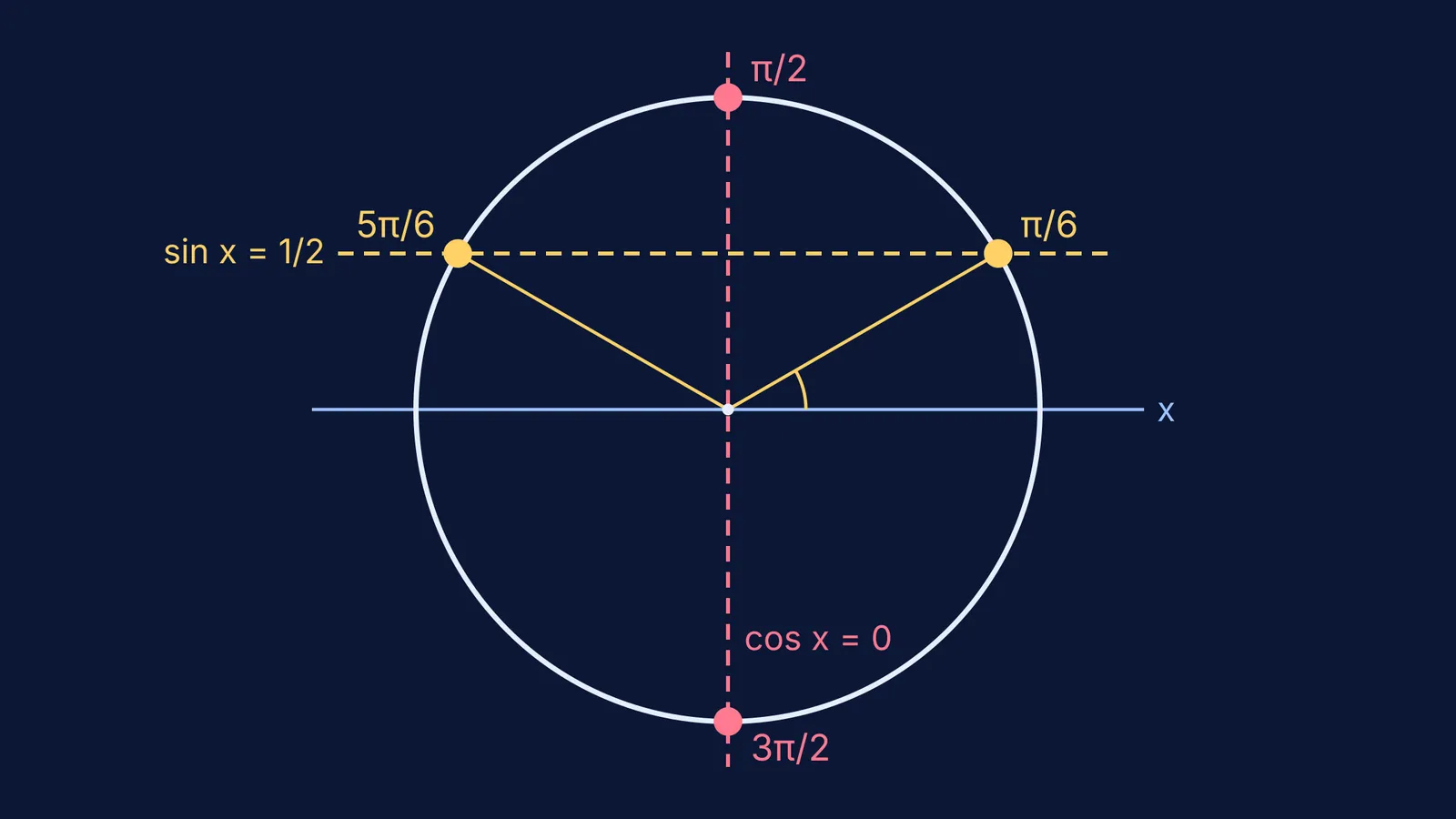
Write 2 sin x cos x − cos x = 0, so cos x (2 sin x − 1) = 0. cos x = 0 gives π/2 and 3π/2; sin x = 1/2 gives π/6 and 5π/6. Answer: 4. Check: mark the four angles on a unit circle, as in the diagram at the top. Common slip: dividing by cos x, which throws away two roots and gives 2.
Q4. If tan⁻¹1 + tan⁻¹2 + tan⁻¹3 = kπ/4, find k.
tan⁻¹1 = π/4. Because 2 × 3 > 1, tan⁻¹2 + tan⁻¹3 = π + tan⁻¹((2 + 3)/(1 − 6)) = π − π/4 = 3π/4. The total is π, so k = 4. Answer: 4. Check: three angles in [π/4, π/2) cannot sum to 0. Common slip: using the addition formula without adding π when xy > 1, which gives 0.
Trigonometry numerical value questions 5 to 8: medium to hard
Q5. Find the value of −64 cos(π/7) cos(2π/7) cos(4π/7).
Use cos A cos 2A cos 4A = sin 8A / (8 sin A). With A = π/7, sin(8π/7) = −sin(π/7), so the product is −1/8 and the expression equals 8. Answer: 8. Check: only cos(4π/7) is negative, so the product is negative. Common slip: missing that sign and typing −8.
Q6. If (1 + tan 1°)(1 + tan 2°) ... (1 + tan 44°) = 2ⁿ, find n.
When A + B = 45°, tan(A + B) = 1 gives tan A + tan B = 1 − tan A tan B, so (1 + tan A)(1 + tan B) = 2. Pair 1° with 44°, up to 22° with 23°: 22 pairs. Answer: 22. Check: A = 0°, B = 45° gives (1)(2) = 2. Common slip: letting the product run to 45° and writing 23.
Q7. Find the minimum value of 9 sec²x + 16 cosec²x for 0 < x < π/2.
Rewrite it as 25 + 9 tan²x + 16 cot²x. By AM ≥ GM, 9 tan²x + 16 cot²x ≥ 2√144 = 24, so the minimum is 49, reached when tan²x = 4/3. Answer: 49. Check: the shortcut (a + b)² gives (3 + 4)² = 49. Common slip: dropping the constant 25 and answering 24.
Q8. Find 2(sin²1° + sin²2° + ... + sin²89°).
Pair sin²k° with sin²(90 − k)° = cos²k°; each pair sums to 1. The pairs for k = 1 to 44 give 44, and sin²45° adds 1/2, so the bracket is 44.5 and twice it is 89. Answer: 89. Check: by the same symmetry, the 89 terms average exactly 1/2. Common slip: counting 45 pairs and typing 90.
How should you practise these trigonometry questions?
Do all eight in one timed sitting, without notes.
Mark yourself the Section B way: +4, −1 or 0.
For each wrong number, write which step failed and which check would have caught it.
Redo only those questions a week later.
For more, see our trigonometry JEE Main practice questions with worked solutions, the chapter plan in how to prepare trigonometry for JEE Main, and the same format in conic sections numerical value questions.
When the mistake is in the method, the Fermi Problem Library has a step-by-step solver that explains the reasoning. For JEE Main and Advanced preparation, start at Fermi Test Prep.