On this page
The JEE Main 2027 syllabus published by the NTA gives trigonometry one line, as Mathematics Unit 14: "Trigonometrical identities and trigonometrical functions, inverse trigonometrical functions their properties." Heights and distances are not named there, so this set stays with identities, function behaviour and inverse functions. Try each on paper first; under each solution we explain a tempting wrong option and why it fails.
How do you solve JEE Main questions on trigonometric identities, range and period?
Q1. If tan θ = 3/4 and θ lies in the third quadrant, then sin θ + cos θ equals: (a) 7/5 (b) −7/5 (c) 1/5 (d) −1/5
Solution. In the third quadrant sine and cosine are both negative, so sin θ = −3/5 and cos θ = −4/5. Answer: (b) −7/5.
Trap and check. Option (a) is the triangle with the signs left off. Check: (−3/5)² + (−4/5)² = 1, and (−3/5) ÷ (−4/5) = 3/4.
Q2. sin²75° − sin²15° equals: (a) 3/4 (b) √3/2 (c) 1/2 (d) 1
Solution. Use sin²A − sin²B = sin(A + B) sin(A − B). Here that is sin 90° × sin 60° = √3/2. Answer: (b).
Trap and check. Option (a) treats it as sin²60°. Check: 0.933 − 0.067 = 0.866 ≈ √3/2.
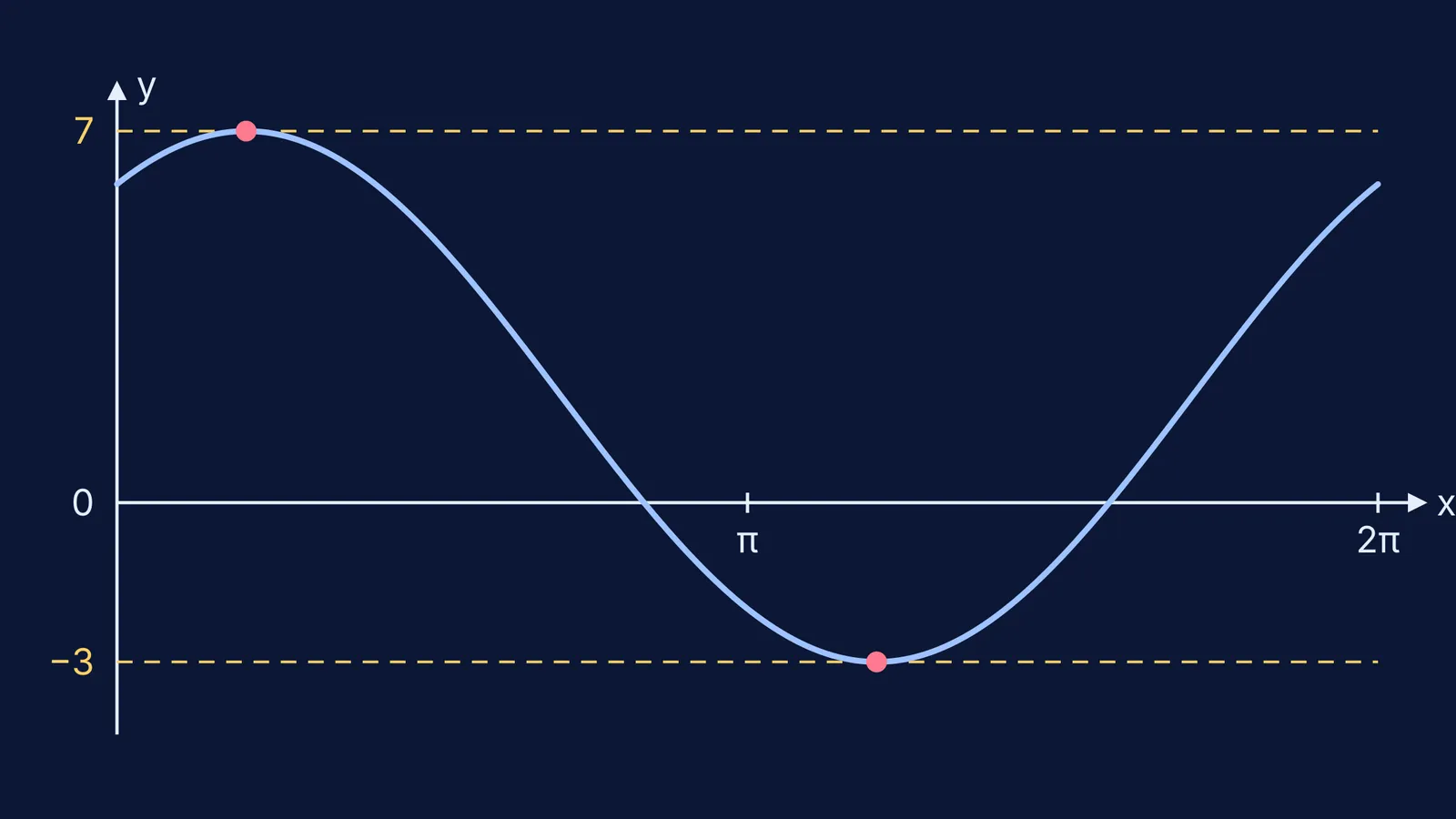
Q3. The range of f(x) = 3 sin x + 4 cos x + 2 is: (a) [−5, 9] (b) [−3, 7] (c) [−1, 5] (d) [−7, 7]
Solution. Since √(3² + 4²) = 5, 3 sin x + 4 cos x = 5 sin(x + α), which runs from −5 to 5. So f runs from −3 to 7. Answer: (b).
Trap and check. Option (a) adds 3 and 4, as if sine and cosine peaked together. Check: at tan x = 3/4 (first quadrant), f = 9/5 + 16/5 + 2 = 7.
Q4. The fundamental period of f(x) = |sin x| + |cos x| is: (a) π/4 (b) π/2 (c) π (d) 2π
Solution. f(x + π/2) = |cos x| + |−sin x| = f(x), so π/2 is a period. On [0, π/2], f(x) = √2 sin(x + π/4) equals 1 only at the ends, so no smaller period works. Answer: (b).
Trap and check. Option (c) is the period of each term alone; the sum can repeat sooner. Check: f(0) = 1, f(π/4) = √2, f(π/2) = 1.
How do you solve JEE Main questions on inverse trigonometric functions?
Q5. cos 20° cos 40° cos 80° equals: (a) 1/4 (b) 1/8 (c) −1/8 (d) √3/8
Solution. Call the product P and multiply by 8 sin 20°. Using 2 sin A cos A = sin 2A three times gives 8 sin 20° × P = sin 160° = sin 20°, so P = 1/8. Answer: (b).
Trap and check. Option (c) treats sin 160° as −sin 20°, but sine is positive in the second quadrant. Check: 0.940 × 0.766 × 0.174 ≈ 0.125.
Q6. sin⁻¹(sin 3), with 3 in radians, equals: (a) 3 (b) π − 3 (c) 3 − π (d) π/2 − 3
Solution. The principal range of sin⁻¹ is [−π/2, π/2], and 3 is outside it. Since sin 3 = sin(π − 3) and π − 3 ≈ 0.142 lies inside the range, the answer is (b).
Trap and check. Option (a) assumes sin⁻¹ and sin always cancel. Check: sin 3 > 0 because 3 < π, which rules out the negative (c) and (d).
Q7. tan⁻¹2 + tan⁻¹3 equals: (a) π/4 (b) −π/4 (c) 3π/4 (d) π/2
Solution. The formula gives tangent (2 + 3)/(1 − 6) = −1. Each angle lies between π/4 and π/2, so the sum lies between π/2 and π, where tangent −1 means 3π/4. Answer: (c).
Trap and check. Option (b) forgets the correction for xy > 1. Check: 1.107 + 1.249 = 2.356 ≈ 3π/4.
Q8. The sum of tan⁻¹(1/(1 + k + k²)) for k = 1 to 10 equals: (a) π/4 (b) tan⁻¹11 (c) tan⁻¹(5/6) (d) tan⁻¹(10/11)
Solution. Write 1/(1 + k + k²) = ((k + 1) − k)/(1 + (k + 1)k). Each term is then tan⁻¹(k + 1) − tan⁻¹k, and the sum telescopes to tan⁻¹11 − tan⁻¹1 = tan⁻¹((11 − 1)/(1 + 11)) = tan⁻¹(5/6). Answer: (c).
Trap and check. Option (a) is the sum to infinity; (b) forgets the lower end. Check the first term: tan⁻¹2 − tan⁻¹1 has tangent 1/3, which matches k = 1.
How should you use this practice set in revision?
The set is only useful if you write the mistakes down.
Do all eight without notes, writing "sure" or "guess" by each answer.
Mark each as right and sure, right but guessed, or wrong.
For every guess or miss, name the trap in one line, such as "dropped the quadrant sign".
Redo only those the next day, and again at the end of the week, without the solutions.
Change one number (try tan θ = 5/12 in the fourth quadrant) and solve the new version.
If the misses cluster on one idea, go back to theory: our guide on how to prepare trigonometry for JEE Main covers the core results. For more like Questions 6 to 8, try eight JEE Main questions on inverse trigonometric functions; when this set feels easy, move to the JEE Advanced trigonometry practice set.
When a solution step still does not make sense, the Fermi Problem Library has worked problems with a step-by-step solver that explains the reasoning rather than printing an answer. And when you are ready to put trigonometry alongside the other units, Fermi Test Prep is where we bring JEE Main and Advanced preparation together.