On this page
Eight new JEE Advanced-style trigonometry questions, easy to hard: three single-correct, three with one or more correct options, two numerical. Every option was checked in Python with SymPy.
Which trigonometry topics can JEE Advanced test?
The official JEE (Advanced) 2026 syllabus lists trigonometric functions with their periodicity and graphs, addition and subtraction formulae, multiple and sub-multiple angle formulae, general solutions of trigonometric equations, and inverse trigonometric functions (principal value only). It notes the 2026 syllabus is unchanged from 2025.
For method, read our guide on how to prepare trigonometry for JEE Advanced.
How should you use this set?
Cover the solutions. Allow 3 minutes per easy question, 6 per hard one.
In one-or-more-correct questions, judge each option on its own.
Log every miss with its trap and redo it three days later.
Our post on JEE Advanced question types explains the formats. If a step is unclear, the Fermi Problem Library has a step-by-step solver that explains the reasoning rather than printing an answer.
Easy: periods and products
Q1 (easy, single correct). The fundamental period of f(x) = |sin 3x| + cos² 2x is
(A) π/6
(B) π
(C) 2π
(D) π/3
Answer: (B). |sin 3x| repeats every π/3 and cos² 2x = (1 + cos 4x)/2 every π/2, so the period is their least common multiple, π. Trap: (C) forgets that the modulus and the square halve the periods.
Q2 (easy, single correct). The value of 16 sin 18° sin 42° sin 78° is
(A) √5 + 1
(B) √5 − 1
(C) (√5 + 1)/4
(D) 2√3
Answer: (A). With θ = 18°, use sin θ sin(60° − θ) sin(60° + θ) = (1/4) sin 3θ. The expression is 4 sin 54° = 4 cos 36° = √5 + 1. Trap: (B) uses sin 18° instead of sin 54°.
Medium: equations, identities and half angles
Q3 (medium, numerical value). Find the number of solutions of sin 7x + sin 3x = √3 sin 5x in [0, π].
Answer: 8. Sum-to-product gives sin 5x (2 cos 2x − √3) = 0. sin 5x = 0 gives x = kπ/5, k = 0 to 5: six roots. cos 2x = √3/2 gives π/12 and 11π/12, neither a multiple of π/5. Total 8. Trap: dividing by sin 5x leaves 2.
Q4 (medium, one or more correct). Let f(x) = sin⁶x + cos⁶x + (3/2) sin²x cos²x. Which are true?
(A) The fundamental period of f is π.
(B) The minimum value of f is 5/8.
(C) f(x) = 29/32 has exactly four solutions in [0, π].
(D) f(π/12) = 7/8.
Answer: (B), (C). Since sin⁶x + cos⁶x = 1 − 3 sin²x cos²x, f = 1 − (3/8) sin² 2x = 13/16 + (3/16) cos 4x. The period is π/2, so (A) is false; the range is [5/8, 1], so (B) is true. f = 29/32 means cos 4x = 1/2, giving 4x = π/3, 5π/3, 7π/3, 11π/3: (C) is true. f(π/12) = 29/32, so (D) is false. Trap: (A); π is a period, but not the smallest.
Q5 (medium, single correct). If cos x = −3/5 and π < x < 3π/2, then tan(x/2) + tan(x/4) equals
(A) (√5 − 3)/2
(B) (√5 + 3)/2
(C) −(√5 + 3)/2
(D) (√5 − 5)/2
Answer: (A). x/2 lies between π/2 and 3π/4, so tan²(x/2) = (1 − cos x)/(1 + cos x) = 4 gives tan(x/2) = −2. For t = tan(x/4), with x/4 between π/4 and 3π/8, t > 1, and 2t/(1 − t²) = −2 gives t = (1 + √5)/2. The sum is (√5 − 3)/2. Trap: (B) takes tan(x/2) = +2, ignoring the quadrant.
Hard: inverse functions, graphs and parameters
Q6 (hard, one or more correct). Let f(x) = sin⁻¹(2x/(1 + x²)) + 2 tan⁻¹ x. Which are true?
(A) f(x) = π for every x ≥ 1.
(B) f(−√3) = −4π/3.
(C) f is differentiable at x = 1.
(D) f(x) = π/2 has exactly one real solution.
Answer: (A), (D). With x = tan θ, the first term is sin⁻¹(sin 2θ), equal to 2θ only when |x| ≤ 1, so f = 4 tan⁻¹ x on [−1, 1], f = π for x > 1 and f = −π for x < −1. (A) is true; (B) is false, since f(−√3) = −π. (C) is false: the slope is 2 from the left and 0 from the right. (D) is true: the only root is tan(π/8) = √2 − 1. Trap: (B) uses 4 tan⁻¹ x outside [−1, 1].
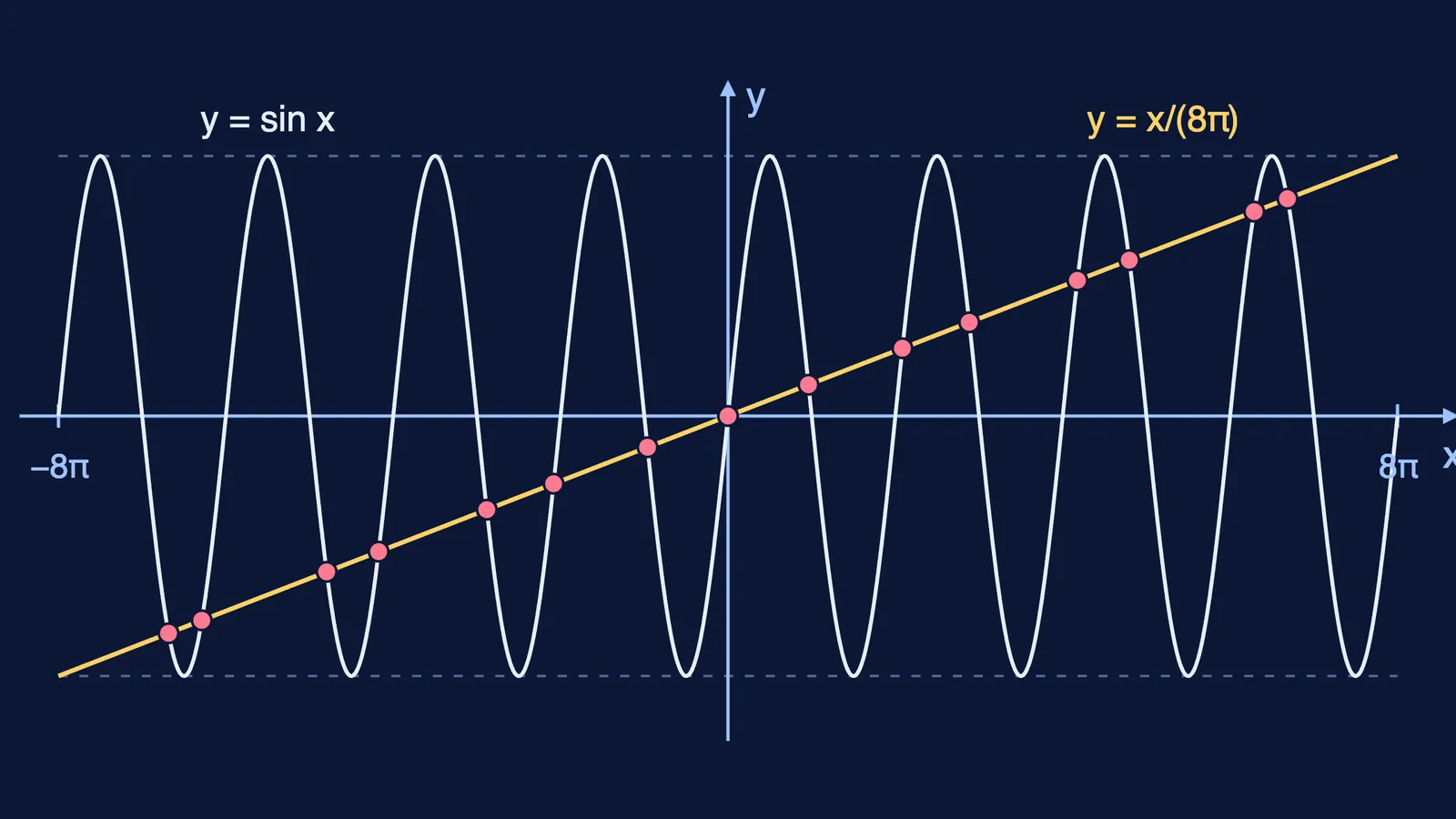
Q7 (hard, numerical value). Find the number of real solutions of 8π sin x = x.
Answer: 15. Compare y = sin x with y = x/(8π), drawn at the top; every solution has |x| ≤ 8π. For x > 0 the line lies between 0 and 1, so it crosses each positive arch on (2kπ, 2kπ + π) twice for k = 1, 2, 3, and once on (0, π), because its slope at 0 is below 1. That is 7 positive roots, 7 negative ones and x = 0. Trap: 14, forgetting x = 0.
Q8 (hard, one or more correct). For cos 2x + 4 cos x = k, which are true?
(A) It has a real solution if and only if −5 ≤ k ≤ 5.
(B) For k = −3, it has exactly one solution in [0, 2π].
(C) For k = 1, its general solution is x = 2nπ ± cos⁻¹(√2 − 1), n an integer.
(D) For k = 4, it has exactly four solutions in [0, 2π].
Answer: (B), (C). With c = cos x, 2c² + 4c − 1 = k, and on [−1, 1] the left side rises from −3 to 5: (A) is false. k = −3 forces c = −1, so x = π only: (B) is true. k = 1 gives c = √2 − 1 (the other root is below −1): (C) is true. k = 4 gives one c, about 0.87, so two solutions: (D) is false. Trap: (A) adds separate minima that never occur together.
Missed two or more? Work through our trigonometric identities and equations practice plan, then retry.