On this page
Advanced-level trigonometry problems often mix equations with many roots, inverse-function graphs and maxima. This guide covers counting roots, reading principal values and checking answers.
What does the JEE Advanced trigonometry syllabus include?
The official JEE (Advanced) 2026 syllabus lists, under Trigonometry: "Trigonometric functions, their periodicity and graphs, addition and subtraction formulae, formulae involving multiple and sub-multiple angles, general solution of trigonometric equations." It adds a second line: "Inverse trigonometric functions (principal value only) and their elementary properties." It notes the 2026 syllabus is unchanged from 2025.
The 2027 syllabus is not published yet (as of 19 November 2026). The JEE (Advanced) 2027 home page says the exam will be held on 23 May 2027 (Sunday), organised by IIT Delhi, and the eligibility page requires being among the top 2,50,000 candidates in the B.E./B.Tech. paper of JEE (Main) 2027.
Those two entries are the whole Trigonometry list. It does not mention properties of triangles, the sine rule or the cosine rule.
How is Advanced trigonometry different from JEE Main?
The JEE (Main) 2027 syllabus covers the unit in one line: trigonometrical identities and functions, and inverse trigonometrical functions with their properties. The Advanced list names items that line does not spell out: periodicity and graphs, multiple and sub-multiple angle formulae, and the general solution of trigonometric equations. After our inverse trigonometric functions guide for JEE Main, expect more depth and longer multi-step problems.
JEE (Advanced) 2026 had two compulsory papers of three hours each, according to the 2026 Information Brochure. Question types and marking are announced in each year's paper; our post on JEE Advanced question types explains the formats.
How do you solve trigonometric equations without losing roots?
Worked example 1. How many x in [0, 3π] satisfy sin 5x − sin x = cos 3x?
Use the sum-to-product formula: sin 5x − sin x = 2 cos 3x sin 2x.
Do not divide by cos 3x. Write cos 3x (2 sin 2x − 1) = 0.
cos 3x = 0 gives x = π/6 + kπ/3. In [0, 3π], k runs from 0 to 8: nine roots.
sin 2x = 1/2 gives x = π/12 + nπ or 5π/12 + nπ, with n = 0, 1, 2: six roots.
Check overlap: none of the six makes cos 3x zero. Answer: 15.
Stuck on why a root went missing? The Fermi Problem Library has worked problems with a step-by-step solver that explains the reasoning rather than printing an answer.
How do principal values trap you in multiple-correct questions?
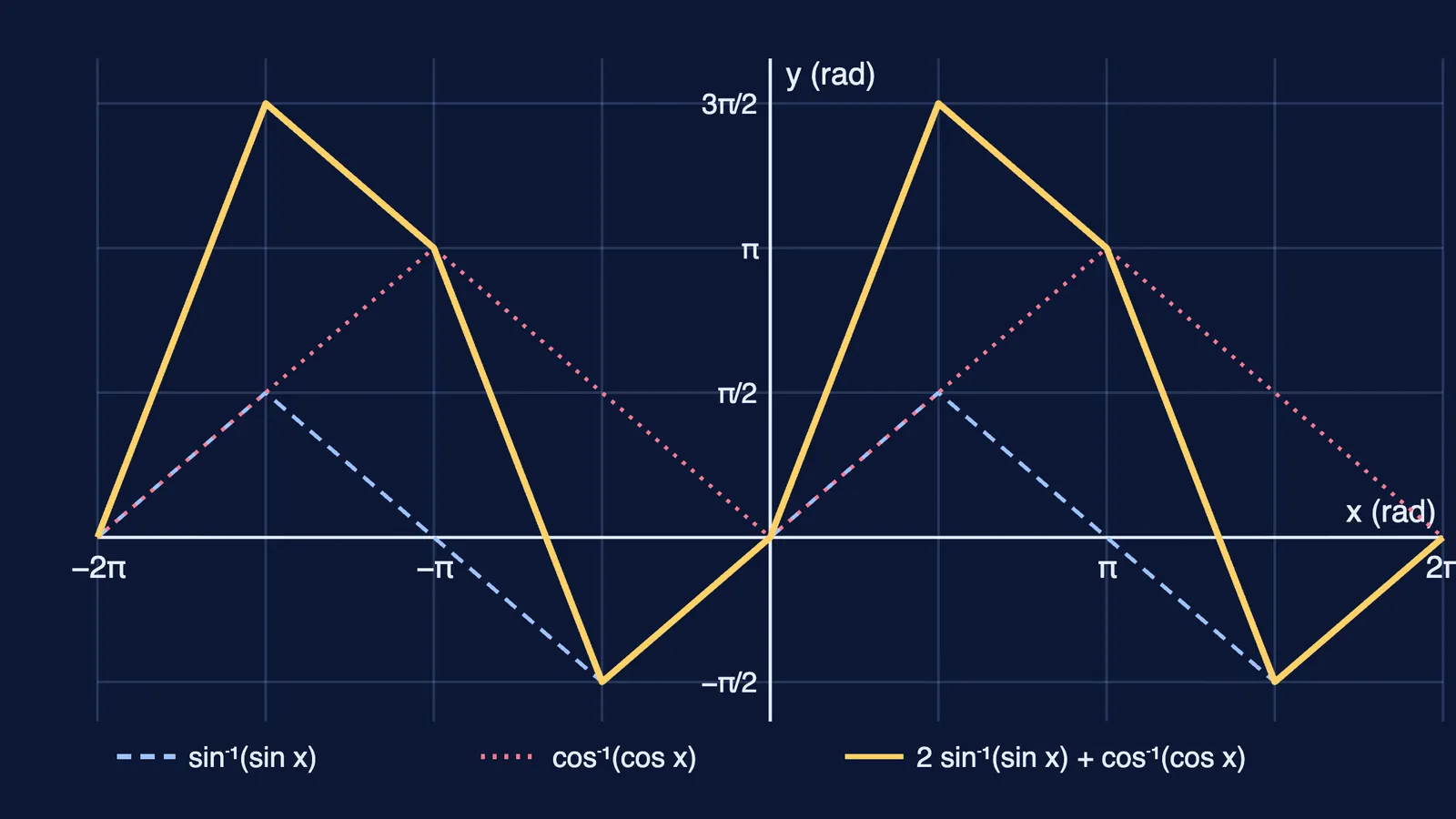
Worked example 2. Let f(x) = 2 sin⁻¹(sin x) + cos⁻¹(cos x). Which are true? (A) The maximum of f is 3π/2. (B) f(5) = 2π − 5. (C) f(x) = π has exactly three solutions in [0, 2π]. (D) f is not differentiable at x = π.
Work piece by piece on [0, 2π], using the principal ranges [−π/2, π/2] and [0, π]:
0 to π/2: f = 3x
π/2 to π: f = 2π − x
π to 3π/2: f = 4π − 3x
3π/2 to 2π: f = x − 2π
f has period 2π, so (A) is true: the peak is 3π/2 at x = π/2. Since 5 lies between 3π/2 and 2π, f(5) = 5 − 2π, so (B) is false. f = π only at x = π/3 and x = π, so (C) is false. At x = π the slope jumps from −1 to −3, so (D) is true. Answer: A and D.
How do you check an answer with limiting cases?
Worked example 3. Find the minimum of y = (3 − 2 cos x)/sin x for 0 < x < π.
Use the sub-multiple angle t = tan(x/2), so cos x = (1 − t²)/(1 + t²) and sin x = 2t/(1 + t²). Then y = (1 + 5t²)/(2t) = 1/(2t) + 5t/2. By AM-GM, y ≥ √5, with equality at t = 1/√5, where cos x = 2/3.
Check: as x approaches 0 or π, y grows without bound, so an interior minimum makes sense. Substituting cos x = 2/3, sin x = √5/3 gives y = √5, about 2.24.
What should a four-week practice plan look like?
Week 1: sketch sin, cos, tan and composites like sin⁻¹(sin x) from memory.
Week 2: multiple and sub-multiple angles, including tan(x/2).
Week 3: general solutions in odd intervals like [0, 3π].
Week 4: mixed sets with calculus and inequalities; review every error.
Try these original questions:
How many x in [0, 2π] satisfy cos 2x + cos 4x = 0? Answer: 6 (cos x = 0 adds no new roots).
Find sin⁻¹(sin 4) + cos⁻¹(cos 4). Answer: 3π − 8.
Find the maximum of 3 sin x + 4 cos(x + π/3). Answer: √(25 − 12√3), about 2.05.
Start with graphs this week, and log every root you lose and why.