On this page
In JEE Main statistics, marks are usually lost to slips, not missing ideas. These eight original questions run from easy to hard; each has a worked solution, the tempting wrong option and a quick check.
What does the JEE Main statistics syllabus cover?
NTA's Syllabus for JEE (Main) 2027 places statistics in Mathematics Unit 13, "Statistics and Probability". The statistics part lists measures of dispersion; mean, median and mode of grouped and ungrouped data; and standard deviation, variance and mean deviation for grouped and ungrouped data. Probability, the unit's other half, is not covered here. For a study plan, read our guide to preparing statistics for JEE Main.
Questions 1 to 4: can you handle ungrouped data?
1. A missing value, then the median and mode
The observations 4, 7, x, 10, 12, 7 have mean 8. Their median and mode are: (A) 7.5 and 7 (B) 8 and 7 (C) 7 and 7 (D) 7.5 and 8.
Solution: the sum must be 6 × 8 = 48, and 40 + x = 48 gives x = 8. Sorted, the data read 4, 7, 7, 8, 10, 12, so the median is (7 + 8)/2 = 7.5 and the mode is 7. Answer (A). The tempting (B) takes x as the median because it sits mid-list; sort first. Check: 4 + 7 + 8 + 10 + 12 + 7 = 48.
2. Variance of five even numbers
The variance of 2, 4, 6, 8, 10 is: (A) 8 (B) 10 (C) 2√2 (D) 40.
Solution: the mean is 6, the deviations are −4, −2, 0, 2, 4, and their squares add to 40, so the variance is 40/5 = 8. Answer (A). (B) divides by n − 1; (C) is the standard deviation; (D) forgets to divide. Check with the shortcut: the squares add to 220, and 220/5 − 6² = 44 − 36 = 8.
3. Scaling and shifting the data
Ten observations have mean 20 and standard deviation 4. Each is multiplied by 3 and then 5 is subtracted. The new mean and variance are: (A) 55 and 144 (B) 55 and 139 (C) 55 and 48 (D) 60 and 144.
Solution: the mean follows the same rule, 3 × 20 − 5 = 55. Subtracting 5 shifts values and mean together, so deviations only scale by 3: standard deviation 12, variance 144. Answer (A). (C) multiplies the variance by 3, not 3² = 9; (B) also subtracts 5 from it. Check: 16 and 24 (mean 20, deviation 4) become 43 and 67 (mean 55, deviation 12).
4. Mean deviation about the median
The mean deviation about the median of 6, 2, 9, 14, 5, 11, 8 is: (A) 3 (B) 43/7 (C) 7/2 (D) 148/49.
Solution: sorted, the data read 2, 5, 6, 8, 9, 11, 14, so the median is 8. The absolute deviations are 6, 3, 2, 0, 1, 3, 6, which add to 21, and 21/7 = 3. Answer (A). (B) takes 14, the middle entry of the unsorted list, as the median; (C) divides by 6; (D) is the mean deviation about the mean, 55/7. Check: mean deviation is smallest about the median, and 3 is just below 148/49 ≈ 3.02.
Questions 5 to 8: what changes with grouped data?
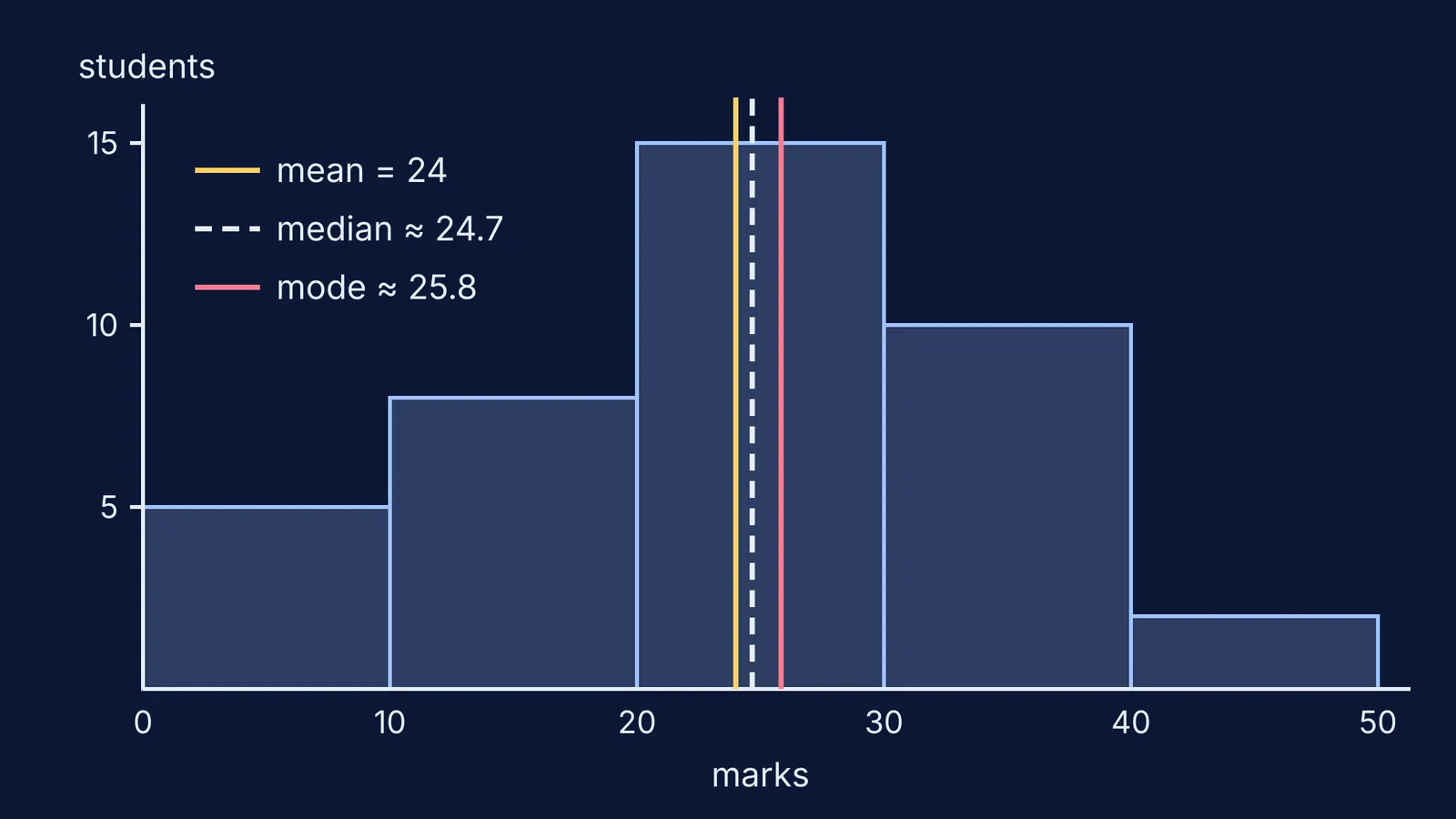
Questions 5 and 6 use the marks of 40 students in a 50-mark test:
0–10 marks: 5 students
10–20 marks: 8 students
20–30 marks: 15 students
30–40 marks: 10 students
40–50 marks: 2 students
5. Median of grouped data
The median mark is: (A) 74/3 (B) 24 (C) 44/3 (D) 76/3.
Solution: N/2 = 20. The cumulative frequencies are 5, 13, 28, 38, 40, so the 20th student falls in 20–30. With l = 20, cf = 13 (before the class), f = 15 and h = 10, the median is 20 + (20 − 13)/15 × 10 = 74/3 ≈ 24.7. Answer (A). (C) uses 28, the cumulative frequency including the median class. (B) is the mean, 960/40 = 24. Check: the median must lie inside its own class, and 44/3 ≈ 14.7 does not.
6. Mode of grouped data
The mode is: (A) 25 (B) 155/6 (C) 26 (D) 24.
Solution: the modal class is 20–30, with f1 = 15, f0 = 8 before it and f2 = 10 after it. Mode = l + (f1 − f0)/(2f1 − f0 − f2) × h = 20 + 7/12 × 10 = 155/6 ≈ 25.8. Answer (B). (A) is only the midpoint of the modal class. (C) is the empirical rule, mode ≈ 3 median − 2 mean = 26: a check, not the formula. Check: 25.8 is close to 26.
7. Correcting a wrongly recorded value
Ten observations have mean 10 and variance 4. One value was recorded as 15 instead of 5. The correct variance is: (A) 3 (B) 4 (C) 23 (D) 5.
Solution: Σx = 100 and Σx² = n(σ² + mean²) = 10 × 104 = 1040. Correcting gives Σx = 90 and Σx² = 1040 − 225 + 25 = 840. The new mean is 9, and the variance is 840/10 − 9² = 84 − 81 = 3. Answer (A). (C) updates the mean but not Σx²; (B) ignores the correction. Check: removing 15, far from the mean, should shrink the variance, and 3 is below 4.
8. Two unknown values (numerical answer)
The observations 2, 4, 10, a and b have mean 6 and variance 8. Find |a − b|.
Solution: the sum is 30, so a + b = 14. The sum of squares is 5(8 + 36) = 220, so a² + b² = 220 − 120 = 100. Then 2ab = 14² − 100 = 96, and (a − b)² = 100 − 96 = 4, giving |a − b| = 2. Answer: 2 (a and b are 6 and 8). Check: 2, 4, 6, 8, 10 have squared deviations 16, 4, 0, 4, 16, which average to 8. Dividing by n − 1 instead gives (a − b)² = −12, an instant sign the convention was wrong.
How should you use this practice set in revision?
Attempt all eight in one timed sitting, marking any you guessed.
For every miss, name the trap: unsorted data, n − 1, the wrong cumulative frequency or a forgotten correction.
Three days later, redo the misses with numbers you choose, running the quick check each time.
Keep one page with five tools: grouped median, grouped mode, Σx²/n − mean², the scale-and-shift rule and corrected sums.
If a method still feels shaky, the Fermi Problem Library has a step-by-step solver that explains the reasoning rather than printing an answer. For the rest of the syllabus, use Fermi Test Prep for JEE Main and Advanced preparation, and try our complex numbers and quadratic equations practice set in the same format.