On this page
Statement and match-the-list questions test whether you can judge each fact on its own, not just reach one number. Here are 8 original coordinate geometry items, easy to hard, solved one statement or one pair at a time.
What do these coordinate geometry questions cover?
All sit inside Unit 10, Co-ordinate Geometry, of NTA's Syllabus for JEE (Main) - 2027: straight lines, the centroid, orthocentre and circumcentre of a triangle, circles, and conic sections in standard forms. The matching NCERT Class 11 chapters are Straight Lines and Conic Sections.
Can you solve these Statement I and Statement II questions?
Options for Q1, Q3 and Q4: (1) Both correct (2) Both incorrect (3) I correct, II incorrect (4) I incorrect, II correct
Q1 (easy). Statement I: The distance between 3x + 4y = 5 and 6x + 8y + 15 = 0 is 2. Statement II: The lines x + 2y = 3 and 2x − y = 1 are perpendicular.
Answer: (4). I: halve the second line to 3x + 4y + 7.5 = 0; the distance is |−5 − 7.5|/5 = 2.5, so I is incorrect. II: the slopes −1/2 and 2 multiply to −1, so II is correct.
Trap: (1). Using |15 − 5|/5 = 2 ignores both the sign and the factor of 2.
Q2 (medium, multi-statement). A triangle has vertices A(0, 0), B(6, 0), C(0, 8). Which are correct? A. The orthocentre is A. B. The circumcentre is (3, 4). C. The centroid is (3, 8/3). D. The distance of A from BC is 4.8. E. The area is 48.
(1) A, B and D only (2) A, B, C and D only (3) A, B, D and E only (4) B, C and E only
Answer: (1). The right angle is at A, so the altitudes meet there (A true) and the circumcentre is the midpoint of the hypotenuse BC (B true). C false: the centroid is (2, 8/3). D true: BC is 4x + 3y = 24, so the distance is 24/5. E false: ½ × 6 × 8 = 24.
Trap: (3), dropping the ½ in the area.
Q3 (medium). For the circle x² + y² − 4x + 6y − 12 = 0: Statement I: The line 3x − 4y + 7 = 0 touches it. Statement II: The point (5, 1) lies inside it.
Answer: (3). Centre (2, −3), radius √(4 + 9 + 12) = 5. I: the distance from the centre is |6 + 12 + 7|/5 = 5, equal to the radius, so it touches. II: (5 − 2)² + (1 + 3)² = 25, so the point is on the circle, not inside.
Trap: (2). Reading the centre as (−2, 3) makes the line cut the circle and puts the point outside.
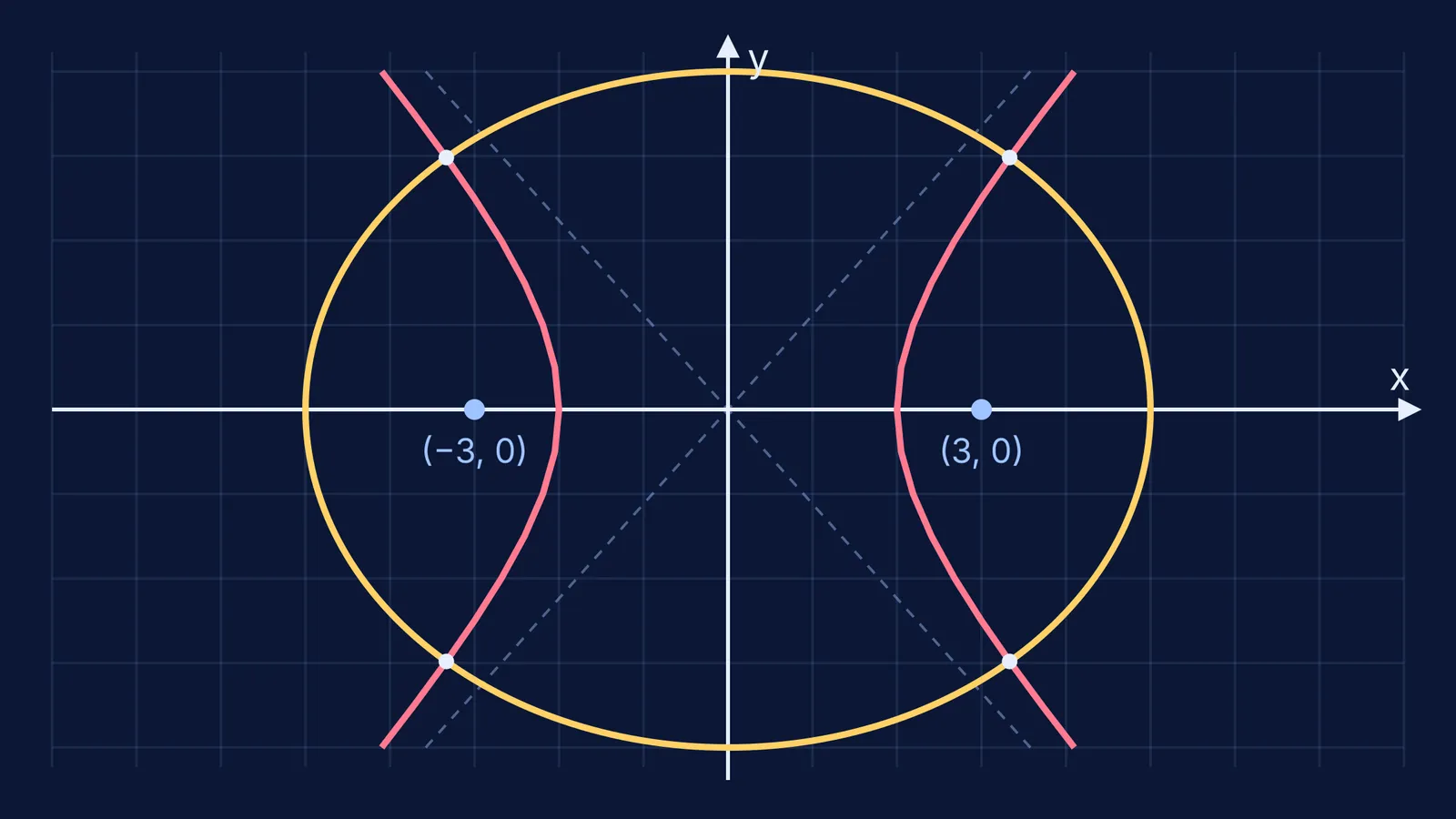
Q4 (hard). Statement I: The ellipse x²/25 + y²/16 = 1 and the hyperbola x²/4 − y²/5 = 1 have the same foci. Statement II: The product of their eccentricities is 1.
Answer: (3). Ellipse: c² = 25 − 16 = 9. Hyperbola: c² = 4 + 5 = 9. Both have foci (±3, 0), so I is correct. II: e = 3/5 and 3/2, product 9/10, so II is incorrect.
Trap: (1). Shared foci mean a shared c, not reciprocal eccentricities.
Can you solve these List-I and List-II matching questions?
Q5 (easy). For the parabola x² = −16y, match each quantity with its value.
List-I: A. Length of the latus rectum. B. Vertex to directrix. C. Focus to directrix. D. Distance of the point (−16, −16) from the focus.
List-II: I. 4 II. 8 III. 16 IV. 20
(1) A-III, B-I, C-II, D-IV (2) A-II, B-I, C-III, D-IV (3) A-III, B-II, C-I, D-IV (4) A-III, B-I, C-IV, D-II
Answer: (1). Here 4a = 16, so a = 4. A: 4a = 16. B: a = 4. C: 2a = 8. D: the point is on the curve (256 = 256), so its focal distance equals its distance from the directrix y = 4, which is 20.
Trap: (3), swapping the vertex-to-directrix and focus-to-directrix distances.
Q6 (medium). Match each quantity with its value.
List-I: A. Distance of (1, 2) from 3x + 4y + 4 = 0. B. The k for which x + y = 2, 2x − y = 1 and kx + 2y = 6 are concurrent. C. Area of the triangle 3x + 4y = 12 makes with the axes. D. Distance between 3x + 4y − 5 = 0 and 6x + 8y + 10 = 0.
List-II: I. 2 II. 3 III. 4 IV. 6
(1) A-II, B-III, C-IV, D-I (2) A-I, B-III, C-IV, D-II (3) A-II, B-IV, C-III, D-I (4) A-III, B-II, C-IV, D-I
Answer: (1). A: |3 + 8 + 4|/5 = 3. B: the first two lines meet at (1, 1), so k + 2 = 6 and k = 4. C: intercepts 4 and 3 give ½ × 4 × 3 = 6. D: halve to 3x + 4y + 5 = 0; |−5 − 5|/5 = 2.
Trap: (2), the only code with D-II. Not halving in D gives |−5 − 10|/5 = 3; checking A (3, not 2) rules it out.
Q7 (medium). Each circle has centre (3, 4). Match it with its property.
List-I: A. x² + y² − 6x − 8y = 0 B. x² + y² − 6x − 8y + 16 = 0 C. x² + y² − 6x − 8y + 9 = 0 D. x² + y² − 6x − 8y + 25 = 0
List-II: I. Touches the x-axis II. Touches the y-axis III. Passes through the origin IV. Is a single point
(1) A-III, B-I, C-II, D-IV (2) A-III, B-II, C-I, D-IV (3) A-IV, B-II, C-I, D-III (4) A-III, B-II, C-IV, D-I
Answer: (2). With r² = 9 + 16 − c, the radii are 5, 3, 4 and 0. A: c = 0, so (0, 0) satisfies it. B: r = 3 equals the distance 3 to the y-axis. C: r = 4 equals the distance 4 to the x-axis. D: r = 0.
Trap: (1). A circle touches the x-axis when r equals the size of the centre's y-coordinate, not its x-coordinate.
Q8 (hard). Match each conic with its eccentricity.
List-I: A. x²/9 + y²/5 = 1 B. x²/16 − y²/9 = 1 C. y² = 8x D. 9x² − 16y² = −144
List-II: I. 2/3 II. 1 III. 5/4 IV. 5/3
(1) A-I, B-III, C-II, D-IV (2) A-I, B-IV, C-II, D-III (3) A-III, B-I, C-II, D-IV (4) A-I, B-III, C-IV, D-II
Answer: (1). A: e² = 1 − 5/9, so e = 2/3. B: e² = 1 + 9/16, so e = 5/4. C: every parabola has e = 1. D: dividing by −144 gives y²/9 − x²/16 = 1, the conjugate of B, with e² = 1 + 16/9 and e = 5/3.
Trap: (2), swapping B and D by reading the transverse axis along x in both.
How do you attack these formats quickly?
Mark each statement T or F on its own before you read the options.
Check the faster statement first; one F removes two of the four options.
Make the x and y coefficients equal before using the parallel-line distance formula.
Write a circle's centre and radius, or a conic's a, b, c and e, once before testing anything.
In a match grid, lock your surest pair and strike every code that disagrees.
If the same slip keeps returning (a sign in the centre, a missing ½), the Fermi Problem Library has a step-by-step solver that explains the reasoning rather than printing an answer. For your wider JEE plan, Fermi Test Prep is our JEE Main and Advanced preparation.
For numerical-answer practice on the same unit, try straight lines numerical value questions, circles numerical value questions and conic sections numerical value questions.