On this page
In Section B of JEE Main there are no options to rule out, so one dropped minus sign costs marks. Here are eight original Straight Lines questions in that format, easy to hard. Solve each before reading the solution.
How are JEE Main numerical value questions marked?
NTA's JEE (Main) 2027 Information Bulletin gives each Paper 1 subject 20 multiple-choice questions in Section A and 5 numerical value questions in Section B. A correct numerical answer earns 4 marks, a wrong one loses 1 mark, and a blank scores 0. You enter the answer with the mouse and a virtual numeric keypad, and the bulletin says it should be rounded off to the nearest integer.
In the JEE (Main) 2027 syllabus, Straight Lines covers forms of a line, intersection, angles, concurrency, distance of a point from a line, and a triangle's centroid, orthocentre and circumcentre.
Easy: can you get the basics right first time?
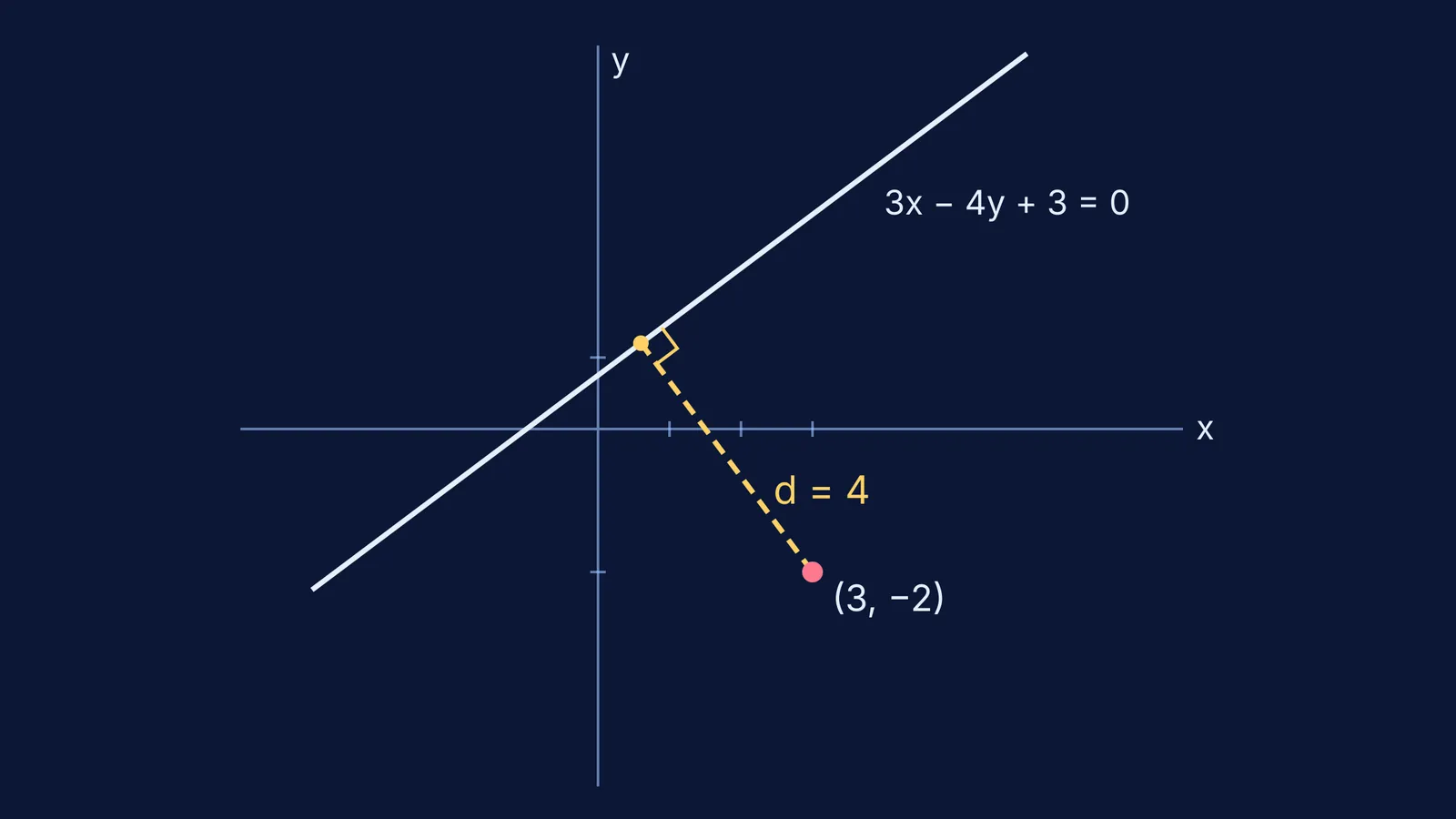
Q1. Find the perpendicular distance of the point (3, −2) from the line 3x − 4y + 3 = 0.
Solution: d = |3(3) − 4(−2) + 3| / √(3² + 4²) = 20/5. Answer: 4. Check: the foot of the perpendicular, (0.6, 1.2), lies on the line (1.8 − 4.8 + 3 = 0) and is √(2.4² + 3.2²) = 4 from the point. Common slip: writing −4(−2) as −8 gives 4/5 = 0.8, entered as 1.
Q2. The line through (1, 4) and (3, 0) meets the axes at A and B. Find the area of triangle OAB, where O is the origin.
Solution: the slope is (0 − 4)/(3 − 1) = −2, so y = −2x + 6. The intercepts are 3 and 6, and the area is ½ × 3 × 6. Answer: 9. Check: both given points satisfy y = −2x + 6. Common slip: leaving out the ½ and typing 18.
Q3. Find the distance between the parallel lines 3x − 4y + 7 = 0 and 6x − 8y − 16 = 0.
Solution: divide the second line by 2 to get 3x − 4y − 8 = 0. Then d = |7 − (−8)| / 5 = 15/5. Answer: 3. Check: (−1, 1) lies on the first line, and its distance from 6x − 8y − 16 = 0 is |−6 − 8 − 16| / 10 = 3. Common slip: using the formula before matching the coefficients gives 23/5 = 4.6, which rounds to 5.
Medium: what do concurrency, reflection and triangle-centre questions look like?
Q4. Find k if x + y − 5 = 0, 2x − y − 1 = 0 and kx + 2y − 14 = 0 are concurrent.
Solution: adding the first two lines gives 3x = 6, so they meet at (2, 3). Then 2k + 6 − 14 = 0. Answer: 4. Check: 4(2) + 2(3) = 14. Common slip: rewriting 2x − y − 1 = 0 as y = 1 − 2x, which gives the wrong meeting point.
Q5. The image of (1, 2) in the line x − y + 3 = 0 is (h, k). Find h² + k².
Solution: (h − 1)/1 = (k − 2)/(−1) = −2(1 − 2 + 3)/(1² + 1²) = −2, so h = −1 and k = 4. Answer: 17. Check: the midpoint (0, 3) lies on the line, and the segment direction (−2, 2) is perpendicular to the line direction (1, 1). Common slip: dropping the factor 2 gives the foot of the perpendicular, (0, 3), and the answer 9.
Q6. Triangle ABC has A(0, 0), B(6, 0) and C(2, 4). H is the orthocentre and O the circumcentre. Find the sum of the four coordinates of H and O.
Solution: the altitude from C is x = 2. BC has slope −1, so the altitude from A has slope 1, giving y = x and H = (2, 2). For O, the perpendicular bisector of AB is x = 3, and OA = OC gives 9 + y² = 1 + (y − 4)², so y = 1 and O = (3, 1). Answer: 8. Check: the centroid (8/3, 4/3) equals (H + 2O)/3, as the Euler line requires. Common slip: giving the altitude the slope of BC instead of its negative reciprocal.
Hard: how do bisector and family-of-lines questions trip you up?
Q7. The bisector of the angle between 3x − 4y + 6 = 0 and 5x + 12y − 13 = 0 that contains the origin is written px + y + q = 0. Find p.
Solution: first make both constants positive: 3x − 4y + 6 = 0 and −5x − 12y + 13 = 0. The bisector containing the origin takes the plus sign: (3x − 4y + 6)/5 = (−5x − 12y + 13)/13, which simplifies to 64x + 8y + 13 = 0, or 8x + y + 13/8 = 0. Answer: 8. Check: (0, −13/8) lies on it and is 2.5 from both lines. Common slip: skipping the sign step picks the other bisector, 14x − 112y + 143 = 0, where p = −1/8 rounds to 0.
Q8. For every real λ, the line (x + 2y − 5) + λ(2x − y) = 0 is drawn. Find the greatest distance of the point (5, 5) from any of these lines.
Solution: every line in the family passes through P(1, 2), where x + 2y − 5 = 0 meets 2x − y = 0. The distance from Q(5, 5) is greatest when the line is perpendicular to PQ, and then it equals PQ = √(4² + 3²). Answer: 5. Check: the family holds every line through P except 2x − y = 0, so the slope −4/3 line is included. Common slip: taking λ = 0 as the best case gives 10/√5 ≈ 4.47, entered as 4.
How should you practise these before the exam?
Solve all eight against a timer, without notes.
Run the check before you look at the answer.
For every miss, name the slip in one line (sign, missing factor, wrong bisector) and try a similar question the next day.
If the method itself is the problem, the Fermi Problem Library has a step-by-step solver that explains the reasoning. For the rest of your exam preparation, see Fermi Test Prep, our JEE Main and Advanced preparation.