On this page
Section B gives you no options to eliminate: you compute, you type, and the number is right or wrong. Many circle questions end in a clean number, such as a radius, a chord or a tangent length, which suits this format. Below are eight original questions, from warm-up to hard. Try each one before reading its solution.
How are JEE Main numerical value questions marked?
The rules are in the JEE (Main) 2026 Information Bulletin published by NTA. In Paper 1, each subject has 20 multiple-choice questions in Section A and 5 numerical value questions in Section B. A correct numerical answer earns +4, an incorrect one costs −1, and an unanswered one scores 0. You enter the answer on an on-screen keypad, rounded off to the nearest integer.
Which circle questions should you try first?
The key formula: for x² + y² + 2gx + 2fy + c = 0, the centre is (−g, −f) and the radius is √(g² + f² − c).
Q1. Find the radius of x² + y² − 6x + 8y − 11 = 0.
Here g = −3, f = 4, c = −11, so radius² = 9 + 16 + 11 = 36. Answer: 6. Check: the point (9, −4), 6 units right of the centre (3, −4), gives 81 + 16 − 54 − 32 − 11 = 0. Slip: writing g² + f² + c, which gives √14.
Q2. The line 3x + 4y = 15 cuts x² + y² = 25. Find the length of the chord.
The distance from (0, 0) to the line is 15/5 = 3, so half the chord is √(25 − 9) = 4. Answer: 8. Check: the line meets the circle at (5, 0) and (−1.4, 4.8), which are 8 apart. Slip: typing 4, the half-chord.
Q3. Find the length of the tangent from (7, 5) to x² + y² − 2x − 4y − 4 = 0.
Tangent length is √S₁, the left side with the point substituted: 49 + 25 − 14 − 20 − 4 = 36. Answer: 6. Check: centre (1, 2), radius 3, distance to the point √45, and 45 − 9 = 36. Slip: typing the distance to the centre.
Q4. A circle passes through (2, 1), (8, 1) and (2, 9). Find its radius.
Skip the three equations. From (2, 1) the other points lie 6 right and 8 up, a right angle, so the hypotenuse √(36 + 64) = 10 is a diameter. Answer: 5. Check: the centre (5, 5) is 5 from (2, 1). Slip: typing the diameter.
What do the harder circle numericals test?
Q5. How many common tangents do x² + y² − 4x − 6y − 12 = 0 and x² + y² + 6x + 18y + 26 = 0 have?
Centres (2, 3) and (−3, −9); radii 5 and 8. The distance between centres is √(25 + 144) = 13 = 5 + 8, so they touch externally. Answer: 3. Check the cases: d above r₁ + r₂ gives 4, equal gives 3, between |r₁ − r₂| and r₁ + r₂ gives 2. Slip: answering 4 without comparing d with r₁ + r₂.
Q6. The circles x² + y² − 4x + 2y − 5 = 0 and x² + y² + 2kx − 6y + 7 = 0 cut orthogonally. Find |k|.
Use 2g₁g₂ + 2f₁f₂ = c₁ + c₂: −4k − 6 = −5 + 7, so k = −2. Answer: 2. Check: centres (2, −1) and (2, 3) are 4 apart, and 16 = 10 + 6, the sum of the squared radii. Slip: dropping the 2s, which gives k = −2.5.
Q7. P moves on x² + y² − 6x − 8y + 21 = 0. Find the maximum value of x² + y² at P.
x² + y² is the squared distance from the origin O. The centre C(3, 4) has OC = 5 and the radius is 2, so the farthest point is 7 from O. Answer: 49. Check: that point is (4.2, 5.6), and 17.64 + 31.36 = 49. Slip: typing 7.
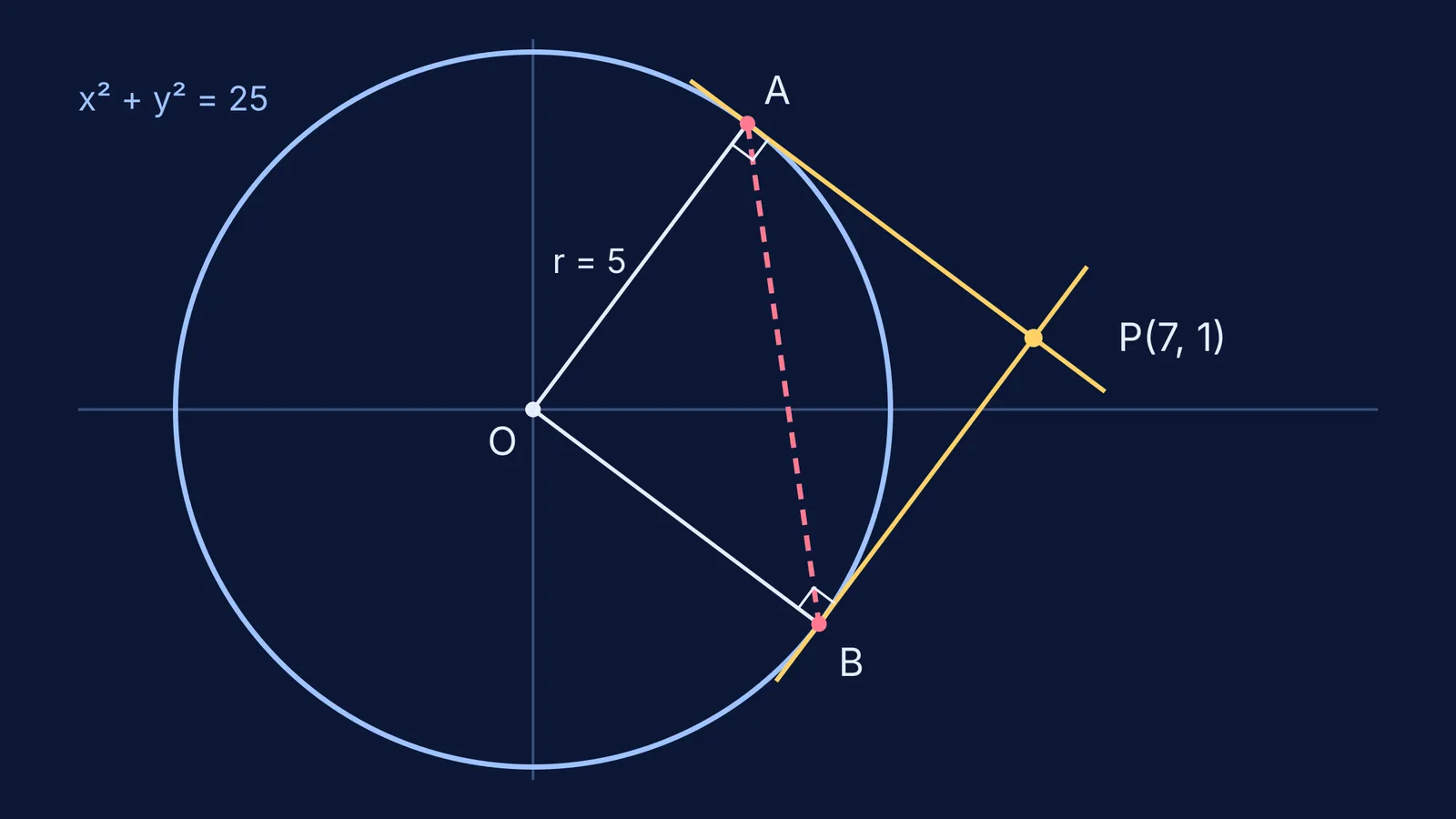
Q8. Tangents from P(7, 1) to x² + y² = 25 touch it at A and B. Find AB².
The chord of contact is 7x + y = 25, at distance 25/√50 from O, so (AB/2)² = 25 − 12.5 = 12.5. Answer: 50. Check: A(3, 4) and B(4, −3) give 1 + 49 = 50; the tangent length √(49 + 1 − 25) = 5 equals the radius, so OAPB is a square with diagonal AB. Slip: stopping at 12.5.
How should you practise circle numericals?
Write your answer before reading any solution.
Run a check every time: substitute a point, or use a second method.
Log each slip in one line, such as "forgot to square", and reread the log before a mock.
If a method feels shaky, the Fermi Problem Library has worked problems with a step-by-step solver that explains the reasoning rather than printing an answer. To plan the rest of your preparation, start at Fermi Test Prep for JEE Main and Advanced.