On this page
You know |A| = 5 for a 3×3 matrix. The question asks for |2A|, and the options are 10, 20, 40 and 80. Picking 10 means taking the 2 outside the bars as if a determinant behaved like an ordinary number. It doesn't, and the correct answer is 40.
Why is |kA| equal to kⁿ|A| and not k|A|?
One property does all the work. Multiplying a single row of an n×n matrix by a scalar k multiplies its determinant by k. That is Theorem 3.2.2 in Kuttler's A First Course in Linear Algebra on LibreTexts/03:_Determinants/3.02:_Properties_of_Determinants).
Now look at what kA really is. Writing kA multiplies every entry by k, so all n rows have been multiplied by k. You can pull one k out of the determinant for each row. Three rows give three ks, so for a 3×3 matrix |kA| = k × k × k × |A| = k³|A|.
In general, for an n×n matrix, det(kA) = kⁿ det(A), which the same LibreTexts chapter/03:_Determinants/3.02:_Properties_of_Determinants) states as Theorem 3.2.3.
Check it on a 2×2 you can work out by hand. Take A with rows (1, 2) and (3, 4), so |A| = 1×4 − 2×3 = −2. Then 2A has rows (2, 4) and (6, 8), and |2A| = 16 − 24 = −8. That is 2² × (−2), not 2 × (−2).
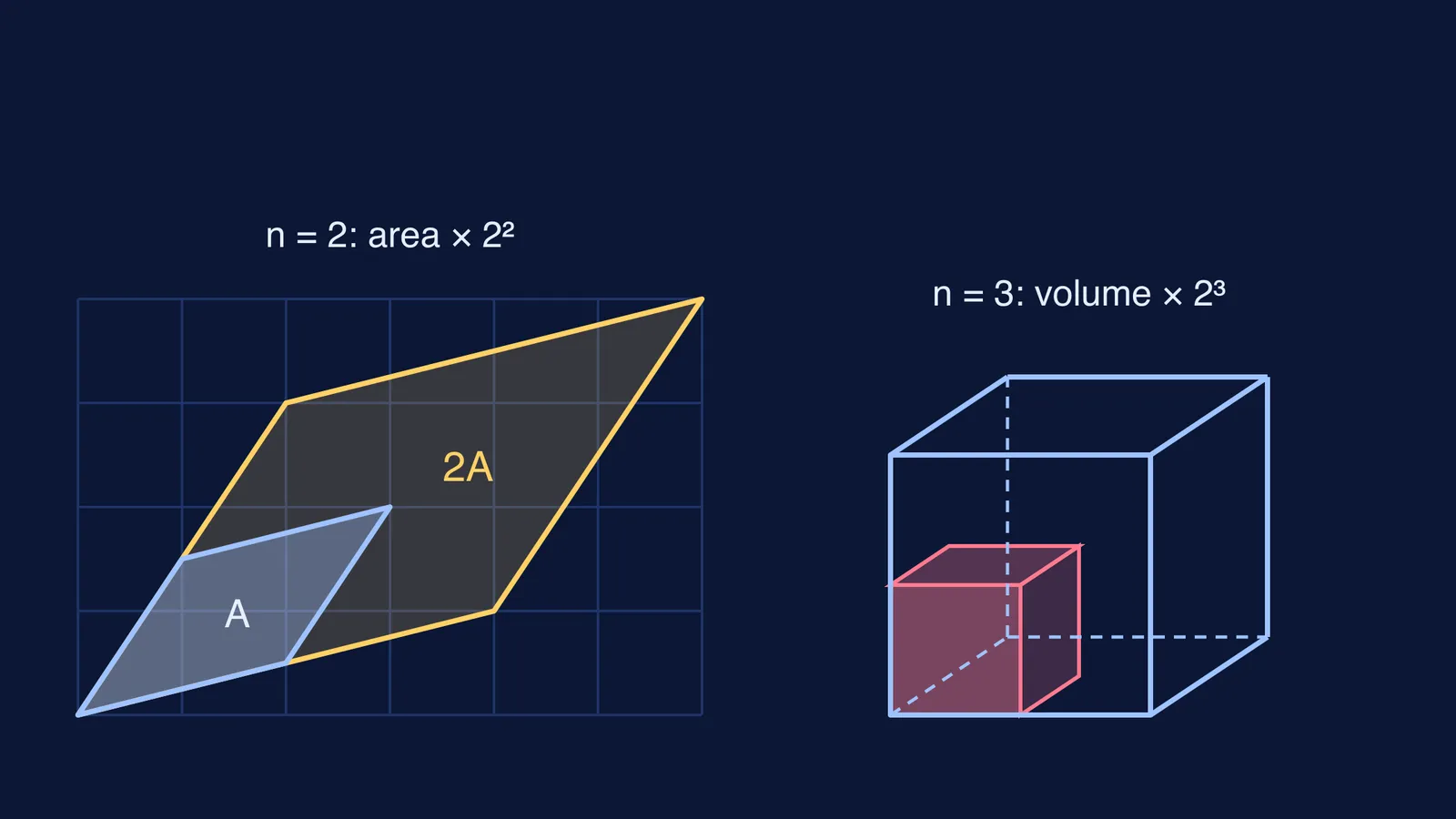
There's a picture behind the rule too. For a real matrix, the size of the determinant is the factor by which the transformation scales area or volume, and its sign records orientation (Wikipedia: Determinant). Double every side of a square and its area grows by 2². Double every side of a cube and its volume grows by 2³.
How do you solve |2A| and |adj 3A| questions?
You need two more facts. For an n×n matrix, |adj A| = |A|ⁿ⁻¹, and adj(kA) = kⁿ⁻¹ adj A (Wikipedia: Adjugate matrix). Both follow from A · adj A = |A| I, which is also where A⁻¹ = adj A / |A| comes from (Wikipedia: Determinant).
Here is a worked set. In every question A is 3×3 and |A| = 5, so n = 3.
|2A|: use kⁿ, so 2³ × 5 = 40. Trap answer: 10.
|−A|: here k = −1, so (−1)³ × 5 = −5. For a 2×2 or 4×4 matrix the sign would not change. Only an odd n flips it.
|adj A|: use |A|ⁿ⁻¹, so 5² = 25. Trap answers: 5 or 125.
|2 adj A|: adj A is also 3×3, so the 2 still comes out cubed: 2³ × 25 = 200. Trap answer: 50.
|adj(3A)|: first route, |3A| = 3³ × 5 = 135, so |adj(3A)| = 135² = 18,225. Second route, adj(3A) = 3² adj A = 9 adj A, so its determinant is 9³ × 25 = 729 × 25 = 18,225. When both routes agree, you know the answer is right. Trap answers: 75 or 225.
|A⁻¹|: since |AB| = |A||B| (Theorem 3.2.5 in the LibreTexts chapter/03:_Determinants/3.02:_Properties_of_Determinants)) and A A⁻¹ = I, |A⁻¹| = 1/5.
Where do the wrong options in these MCQs come from?
The trap answers come from two mix-ups:
Reading |kA| as k|A|. The two look alike on paper but mean different things. In |kA| the k multiplies the whole matrix. In k|A| it multiplies only the determinant.
Losing track of which matrix the scalar sits on. In |k adj A|, the power is the order of adj A, which is still n. In |adj(kA)|, handle kA first, then take the adjugate.
Use this routine for any question in this chapter:
Write down n before anything else.
Circle every scalar and ask whether it multiplies a matrix inside the bars.
Work from the inside out: the scalar on the matrix first, then the adjugate or inverse, then the outer determinant.
Check the sign whenever k is negative and n is odd.
How should you practise this?
Do ten of these questions in one sitting, mixing 2×2, 3×3 and 4×4 matrices, and say the power out loud before you calculate. Then work one out in full on a 2×2 or a diagonal matrix. That way the rule feels earned, not just memorised.
Want more mixed problems with every line of reasoning shown? The Fermi Problem Library has worked problems with a step-by-step solver that explains the reasoning rather than printing an answer. If the gap is in adjugates or cofactors themselves, the Fermi Concept Library covers every concept in physics, chemistry, biology, mathematics and computing, each with its own lesson.
The next time you see |2A| on a paper, write 2ⁿ first and fill in n after.