

On this page
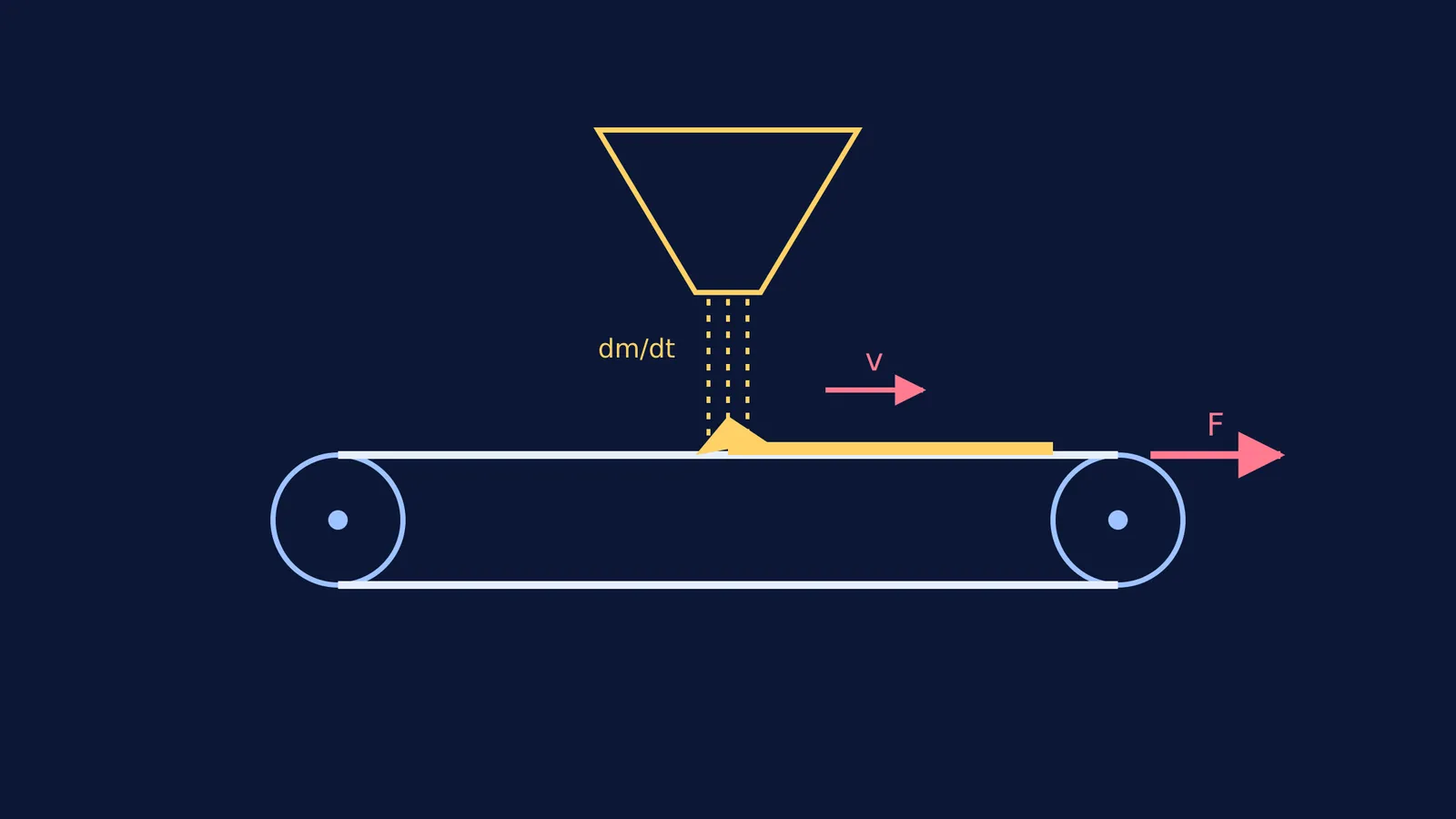
When sand drops vertically onto a moving surface, it has no horizontal momentum. To keep the belt moving at a steady speed, the motor must push hard enough to accelerate every new grain of sand from a standstill up to the belt's speed. This classic variable-mass system is a staple of JEE and NEET mechanics, but it also drives some of the largest engineering projects in the world.
For instance, the Dune Express in Texas and New Mexico is a 42-mile conveyor belt that transports up to 13 million tons of fracking sand annually, replacing thousands of truck journeys (Newsweek). Engineers sizing the motors for such massive industrial systems rely on the exact same fundamental physics equations that appear in high school exams. Understanding these principles helps us appreciate both the scale of modern engineering and the elegance of classical mechanics.
Here is how to calculate the force, power, and energy in this non-conservative system—and why exactly half the energy is always lost to the environment as heat.
What is the force needed to keep the conveyor belt moving as sand falls?
According to Newton's Second Law, force is defined as the rate of change of momentum (F = dp/dt). In introductory physics, we are mostly used to problems featuring a constant mass and a changing velocity (F = ma). However, on a continuous conveyor belt, the situation is entirely reversed: the velocity is constant, and the mass is constantly changing over time.
Because the conveyor belt moves at a constant horizontal velocity (v), there is absolutely no acceleration of the existing mass that is already sitting on the belt. The only change in horizontal momentum comes from adding new mass. You can find the required force by multiplying the belt's constant velocity by the rate at which sand is added:
F = v × dm/dt
F: The extra horizontal force the motor must apply to maintain a constant speed (measured in Newtons).
v: The constant horizontal velocity of the conveyor belt (measured in m/s).
dm/dt: The rate at which the mass of the sand drops onto the belt from the hopper (measured in kg/s).
If a hopper drops sand at a continuous rate of 5 kg/s onto a belt moving steadily at 2 m/s, the motor must apply an additional horizontal force of 10 N just to maintain that speed against the repeated impacts of the falling sand.
Why is the power supplied twice the kinetic energy gained?
This problem contains a famous "efficiency paradox" that frequently appears in competitive physics exams. The paradox emerges when you carefully compare the mechanical power supplied by the motor to the kinetic energy actually gained by the moving sand.
Power supplied by the motor: Mechanical power is defined as the driving force multiplied by the velocity (P = F × v). Substituting the force equation from above, the total power supplied by the motor becomes P = v² × dm/dt.
Rate of kinetic energy gain: The kinetic energy of any moving mass m is given by ½mv². Therefore, the rate at which the newly added sand gains kinetic energy is exactly half that of the motor's power output: dK/dt = ½v² × dm/dt.
The motor is clearly doing twice as much work as the kinetic energy gained by the sand (LibreTexts). So where exactly does the other half of the energy go?
It is entirely dissipated as heat. When the sand first hits the belt, it slips. It takes a brief fraction of a second for the kinetic friction between the rough sand and the rubber belt to accelerate the grains up to the belt's speed. During this slipping phase, exactly 50% of the energy is lost to thermal friction. Interestingly, this 50% loss happens regardless of how rough or smooth the belt surface is; a smoother belt simply means the sand slips for a longer distance before catching up, but the total energy dissipated remains exactly the same.
If you struggle with the subtle differences between force and energy in these non-conservative systems, the Fermi Concept Library has every concept in physics, chemistry, biology, mathematics and computing, each with its own lesson and its place in the map.
How do you solve variable-mass problems in exams?
In competitive entrance tests like JEE and NEET, conveyor belt questions are deliberately designed to trick you into using energy conservation instead of momentum. Because energy is lost, momentum is the only reliable tool.
Remember these three rules for variable-mass problems:
Never use ½mv² to find the force. If you incorrectly assume that power is just the derivative of kinetic energy, you will get an answer that is exactly half of the true force. Because energy is lost to heat, mechanical energy is not conserved here. (Read more on when to use energy conservation instead of Newton's laws).
Separate the axes. The sand's vertical velocity is halted by the normal force from the belt underneath it, which does absolutely no horizontal work. The horizontal force that accelerates the sand comes entirely from friction. Keep your x and y calculations completely separate.
Watch the signs. If sand is *falling off* a moving cart (like a leaking sandbag), it carries its horizontal momentum with it. In that case, dm/dt is negative, but since the sand leaves at the same horizontal speed v, the cart does not experience a change in velocity, and no extra force is needed to keep the cart moving. The force equation F = v(dm/dt) only applies when mass is being *added* or accelerated.
For a visual feel of how mass and velocity interact when objects stick together (which is effectively a perfectly inelastic collision in the horizontal plane), you can test the physical principles in an elastic vs inelastic collisions simulation.


