

On this page
If you drop a heavy uniform chain onto a weighing scale, you might expect the scale reading to just steadily climb to the total weight of the chain. But classical physics reveals a counterintuitive result.
When a chain falls steadily onto a horizontal surface, the scale reading at any given moment is exactly three times the static weight of the chain already resting on it (The Weight of a Falling Chain, 1951). This famous mechanics problem is a standard feature in competitive exams, as it tests a student's ability to combine static forces with the rate of change of momentum.
If you struggle to set up momentum flow problems, you are not alone. The Fermi Problem Library breaks down derivations like this step by step, so you can trace exactly where the variables come from.
Here is how the momentum flow works and why the force triples.
What is the force on a table by a chain falling on it?
Imagine a uniform chain of total mass M and total length L. You hold it vertically so that its bottom tip just grazes a scale on the table, and then you release it from rest.
As the chain falls, the scale records a force that consists of two separate parts:
The static weight of the chain that has already landed and is resting on the pan.
The dynamic impact force of the falling links slamming into the pan and coming to a sudden halt.
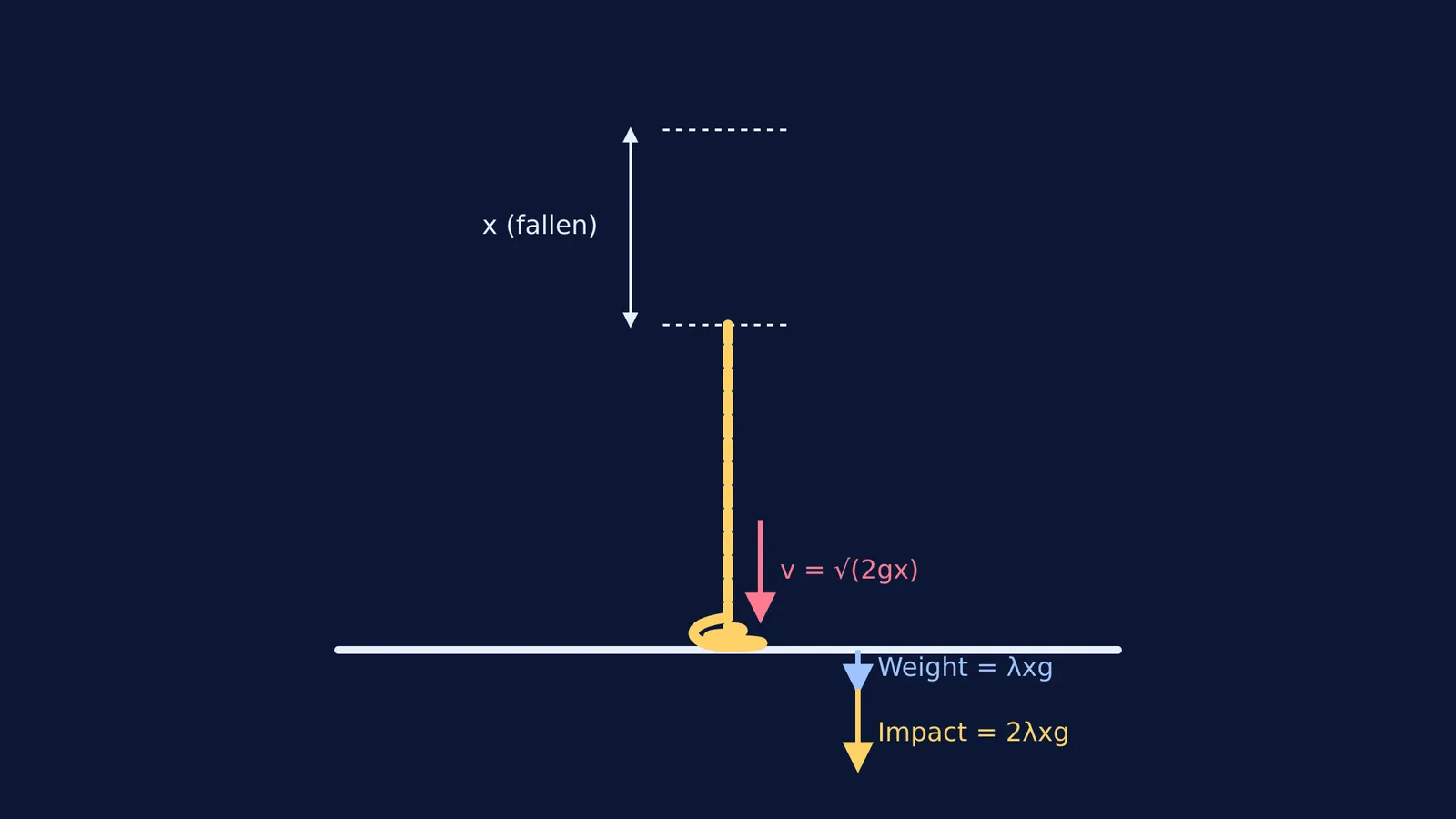
Let λ = M/L be the mass per unit length of the chain. After a time t, a length x of the chain has piled up on the table.
The static weight of this resting portion is simply its mass multiplied by gravity: W = λxg.
You might intuitively guess that the falling links just add a small bump to the reading. But calculating the momentum reveals that the impact force is 2λxg, which is double the static weight.
Why is the impact force exactly twice the weight?
To find the impact force, we look at the rate at which momentum is being destroyed by the table. Newton's second law states that force equals the rate of change of momentum (F = dp/dt).
First, we need the speed of the chain. Because the chain is in free fall, a link that has dropped a distance x reaches a velocity v = √(2gx).
In a tiny time interval dt, a small new length of chain dx hits the table. The mass of this small section is dm = λdx. Since v = dx/dt, we can write dm = λv dt.
The momentum this tiny mass carries just before it hits the table is dp = v dm. Substitute the mass to get dp = v(λv dt) = λv² dt.
Now, divide by dt to find the force: Impact force = dp/dt = λv².
Since the velocity squared is v² = 2gx, we substitute that in: Impact force = λ(2gx) = 2λxg.
This dynamic force alone is twice the weight of the fallen chain.
How does the total reading change over time?
When we add the static weight and the impact force together, we get the total force on the table: Total force = λxg + 2λxg = 3λxg.
This means the total force exerted by a falling chain on a scale is three times the weight of the chain already on the scale (Force exerted by a falling chain, 1998).
When the very last link of the chain hits the table, the length fallen is the total length L, so the peak force recorded by the scale is 3Mg. At the exact instant the chain finishes falling, the impact force vanishes, and the reading immediately drops to the true static weight Mg.
Do real chains fall faster than free fall?
While the 3Mg result is the standard textbook answer, real physics experiments show a fascinating twist. In a 2010 study, researchers found that real chains can fall faster than free fall because the links pull each other down as they fold (The weight of a falling chain, revisited, 2010).
As a chain hits the pile, the links do not simply stop in isolation. The geometry of the chain forces the links to tilt and press against the pile, which creates a downward tension on the segment still in the air. This causes the free-falling section to accelerate at greater than g, slightly altering the final impact force from the idealised equation.
For exam preparations, however, the ideal model is what you will be tested on. A good way to master these nuanced mechanics applications is to explore related scenarios, such as the Contact force between blocks pushed together on a smooth floor or the physics of A shell exploding midair: momentum, fragments and energy.
When you understand how momentum flows through a system, equations that look like magic tricks become straightforward accounting.


