

On this page
JEE problems often give a curve as a pair: x and y both written in terms of a third variable t. You do not need to eliminate t. You need one substitution and one careful decision about the limits.
What is the formula for area under a parametric curve?
For a curve x = f(t), y = g(t), the area between the curve and the x-axis is A = ∫ g(t) f′(t) dt, taken between the t values at the two ends, provided the curve is traced out exactly once as t moves between them (Paul's Online Math Notes, Lamar University).
The reason: dx = (dx/dt) dt, so ∫ y dx becomes ∫ y (dx/dt) dt. It is dx/dt, not dy/dt; mixing them up is a common slip.
How do you choose the t limits?
Use this four-step routine every time:
Find t at each end by solving f(t) = left end of x and f(t) = right end of x.
Check that the curve is traced once in between and y does not change sign. If it does, split the integral.
Integrate from the t at the left end to the t at the right end, even if the upper limit is the smaller one.
Check the sign. An area is positive.
How do you find the area under one arch of a cycloid?
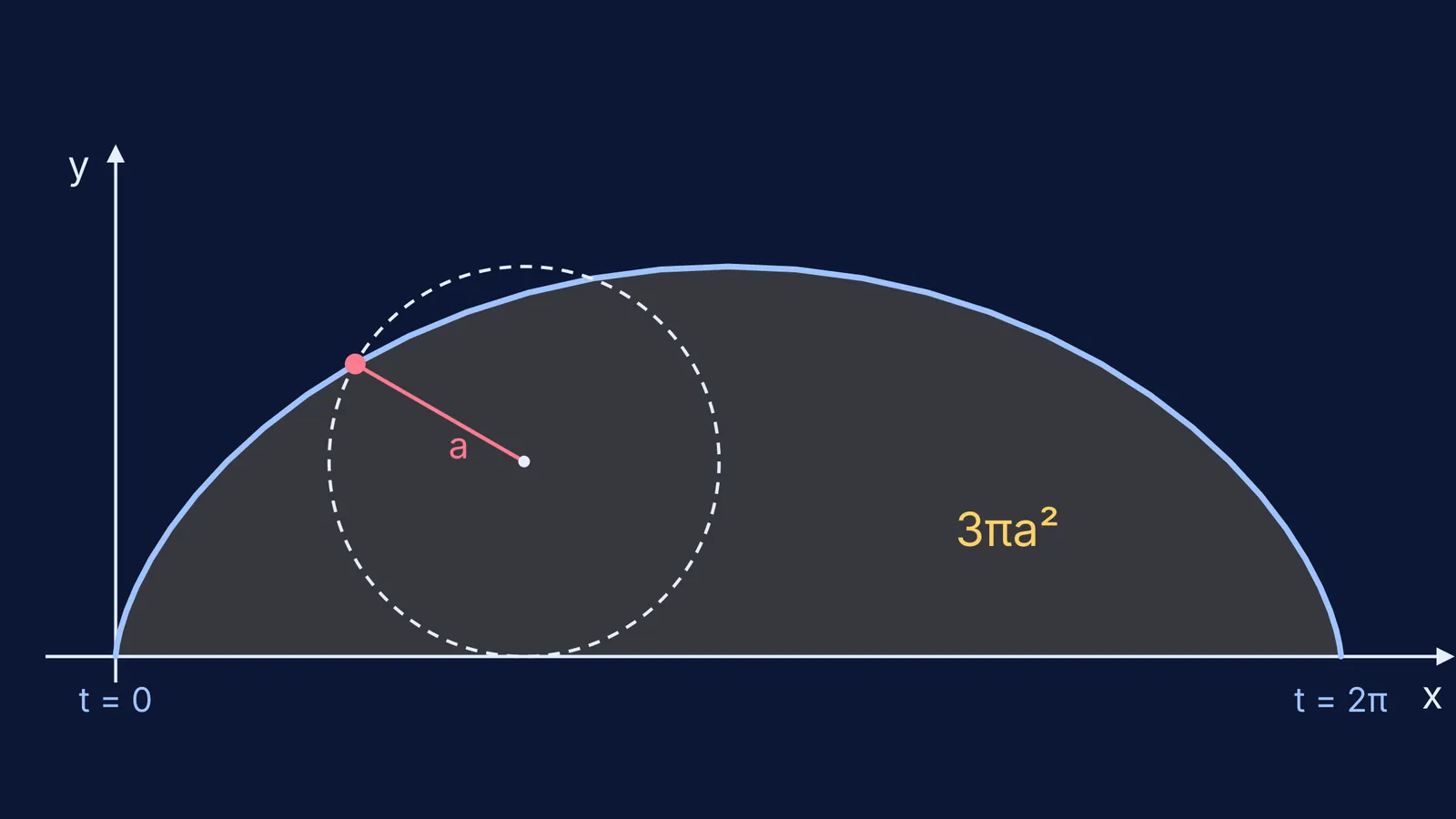
A cycloid is the path of a point on the rim of a circle of radius a rolling along the x-axis: x = a(t − sin t), y = a(1 − cos t), where t is the angle through which the circle has turned (Wikipedia: Cycloid).
Step 1, the limits. y = 0 when cos t = 1, so one arch runs from t = 0 to t = 2π (x from 0 to 2πa). Since dx/dt = a(1 − cos t) is never negative, x moves left to right, so the limits are 0 to 2π.
Step 2, the integral. A = ∫ a(1 − cos t) · a(1 − cos t) dt from 0 to 2π, which is a² ∫ (1 − 2 cos t + cos² t) dt.
Step 3, term by term over 0 to 2π:
∫ 1 dt = 2π
∫ cos t dt = 0, a full period
∫ cos² t dt = π, half of 2π
So A = a²(2π − 0 + π) = 3πa².
The area under one arch of a cycloid is 3πa², three times the area of the rolling circle (Wikipedia: Cycloid; Wolfram MathWorld: Cycloid). That 3 has a history: according to his student Torricelli, Galileo tried in 1599 to find the area by weighing metal cut-outs and got a ratio of roughly 3 to 1, and Roberval found the exact area in 1634 (Wikipedia: Cycloid).
If you find it hard to picture how the rolling circle traces the arch, Fermi's AI tutor can draw the figure on its board and check your understanding as it goes.
How do you find the area of an astroid?
The astroid is x = a cos³t, y = a sin³t, a four-cusped curve that fits inside a square of side 2a (Wikipedia: Astroid). It is a closed curve, symmetric about both axes, so find the area in the first quadrant and multiply by 4.
Step 1, the limits. In the first quadrant x runs from 0 (at t = π/2) to a (at t = 0), so you integrate from π/2 to 0: the upside-down case.
Step 2, the integral. dx/dt = −3a cos²t sin t, so the quarter area is ∫ a sin³t · (−3a cos²t sin t) dt from π/2 to 0. Flipping the limits cancels the minus sign: 3a² ∫ sin⁴t cos²t dt from 0 to π/2.
Step 3, Wallis' formula. ∫ sin⁴t cos²t dt from 0 to π/2 = (3 · 1 · 1)/(6 · 4 · 2) · π/2 = π/32. The quarter area is 3πa²/32.
Step 4, the whole curve: 4 × 3πa²/32 = 3πa²/8, which matches the area given in Wolfram MathWorld: Astroid.
Writing the limits as 0 to π/2 gives −3πa²/32: right size, wrong sign, which the sign check catches.
Which mistakes cost marks in parametric area questions?
Writing y (dy/dt) instead of y (dx/dt).
Keeping the x limits instead of converting them to t.
Running t over more than one trace, so part of the area is counted twice.
Integrating the whole curve when symmetry, a quarter and Wallis' formula would finish faster.
To practise, try the ellipse x = a cos t, y = b sin t; the four steps on one quadrant should give πab for the whole ellipse. Then work through these definite integrals and area questions for JEE Main, and keep the application of integrals formulas for Class 12 next to you while you do. For a longer plan, read how to prepare integral calculus for JEE Advanced.
If you keep choosing the wrong limits, the Fermi Problem Library has a step-by-step solver that explains the reasoning, so you can see where your setup went wrong.


