On this page
Almost every formula in this chapter comes from one idea: area is the sum of thin strips. The CBSE Mathematics syllabus for 2026-27 limits it to the area under simple curves, especially lines, circles, parabolas and ellipses in standard form only, and the NCERT chapter (Reprint 2026-27) builds the formulas with vertical and horizontal strips. Below is each formula with its condition, one worked example per group and the slip to watch for.
Not covered: the area between two curves (the 2026-27 NCERT chapter has no section or exercise on it), volumes of solids, and conics shifted or rotated out of standard form.
What is the formula for area under a curve?
Symbols: y = f(x) is the curve, x = a and x = b the boundary lines (b > a), A the area in square units.
Vertical strip: dA = y dx.
A = ∫ₐᵇ y dx = ∫ₐᵇ f(x) dx, when f(x) ≥ 0 on [a, b].
Curve below the x-axis (f(x) ≤ 0 on [a, b]): the integral is negative, so A = |∫ₐᵇ f(x) dx|.
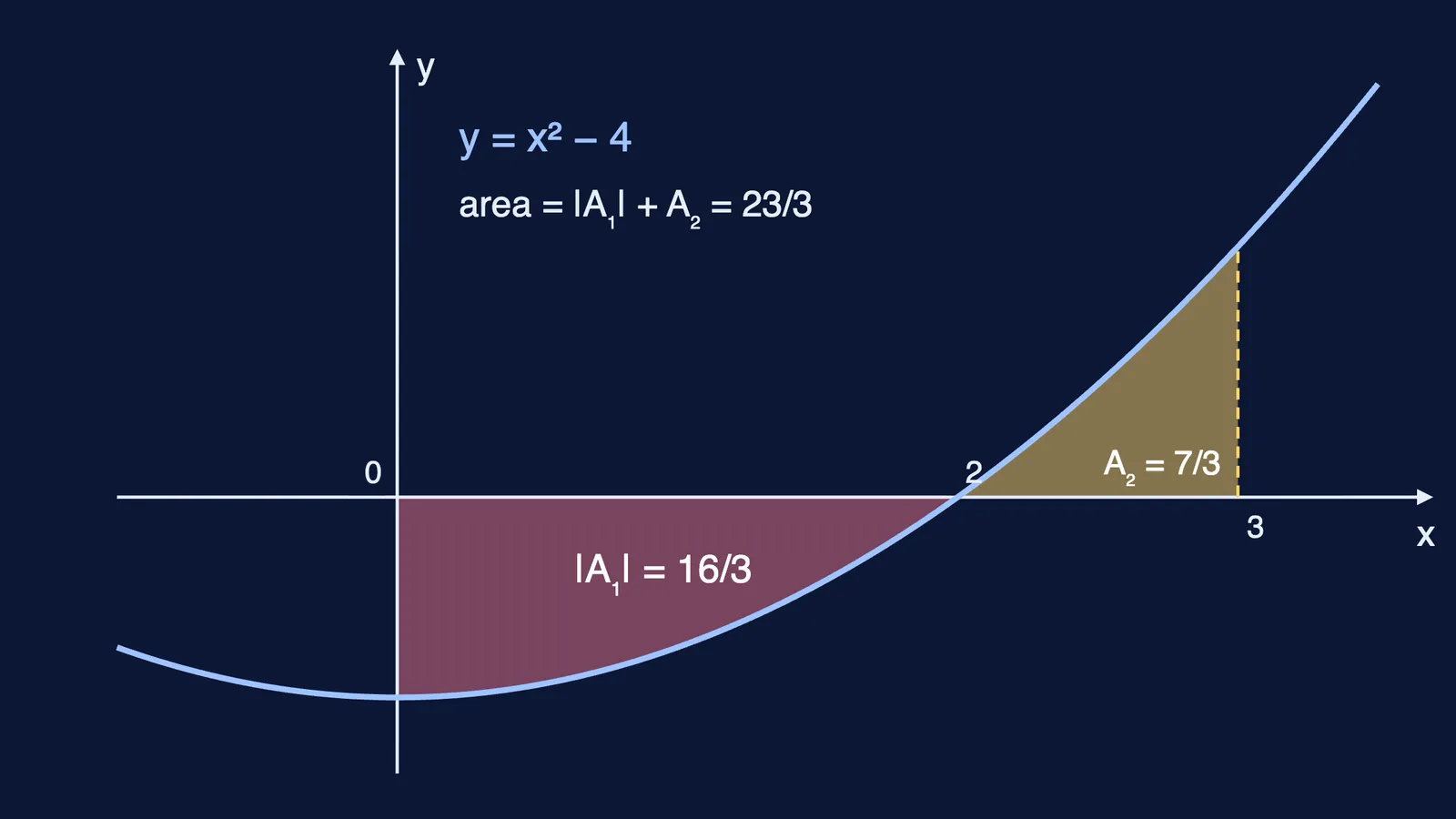
Curve crossing the x-axis at c in (a, b): A = |A₁| + A₂, with A₁ = ∫ₐᶜ f(x) dx (below the axis) and A₂ = ∫ᶜᵇ f(x) dx (above). In one line: A = ∫ₐᵇ |f(x)| dx.
Worked example: the area between y = x² − 4, the x-axis, x = 0 and x = 3. The curve cuts the axis at x = 2. A₁ = ∫₀² (x² − 4) dx = −16/3 and A₂ = ∫₂³ (x² − 4) dx = 7/3, so A = 16/3 + 7/3 = 23/3 square units.
Watch for: integrating straight from 0 to 3 gives −3, the net signed value, not the area. Find where the curve cuts the axis first.
How do you find area using horizontal strips?
Symbols: x = g(y) is the curve, y = c and y = d the boundary lines (d > c).
Horizontal strip: dA = x dy.
A = ∫ x dy = ∫ g(y) dy, taken from y = c to y = d, when g(y) ≥ 0 there. If the curve lies left of the y-axis, take the absolute value.
Worked example: the area bounded by y² = 9x, the y-axis, y = 0 and y = 6. Here x = y²/9, so A = ∫₀⁶ (y²/9) dy = 216/27 = 8 square units.
Watch for: the limits are y-values. Putting x = 0 to x = 4 (the x-coordinate at y = 6) into a dy integral mixes variables and gives a wrong answer.
What is the area of a circle, ellipse and parabola by integration?
Symbols: a, b, h are positive constants; for the ellipse, a and b are the semi-axes along x and y. All of these rest on one integral, valid for |x| ≤ a:
∫ √(a² − x²) dx = (x/2)√(a² − x²) + (a²/2) sin⁻¹(x/a) + C
Circle x² + y² = a²: area = 4 ∫₀ᵃ √(a² − x²) dx = πa²; the first-quadrant quarter is πa²/4.
Ellipse x²/a² + y²/b² = 1: y = (b/a)√(a² − x²) in the first quadrant, so area = 4 ∫₀ᵃ (b/a)√(a² − x²) dx = πab.
Parabola y² = 4ax with the line x = h, both halves: area = 2 ∫₀ʰ 2√(ax) dx = (8/3)√a · h^(3/2). The same holds for x² = 4ay with y = h.
Worked example: the area enclosed by 9x² + 25y² = 225. Dividing by 225 gives x²/25 + y²/9 = 1, so a = 5, b = 3 and the area is 15π square units. For y² = 12x (a = 3) cut off by x = 3, the area is (8/3)(√3)(3√3) = 24 square units.
Watch for: a and b are the square roots of the denominators. Using 25 and 9 here gives 225π. The factor 4 (or 2) from symmetry applies only when the region really is symmetric.
How to revise this formula sheet
Redraw each example from memory. The CBSE 2026-27 sample question paper asks for neat and clean figures wherever required, and the figure is where your limits come from.
Derive πa² and πab once from the key integral so you can rebuild them in the hall. The same paper does not allow calculators, so practise sin⁻¹(1) = π/2 and surds by hand.
For each region, choose vertical or horizontal strips first: pick the one that needs a single integral.
End every answer with "square units".
For how the chapter is examined and where step marks go, read our application of integrals Class 12 board exam guide; the integration methods it relies on are in Integrals Class 12 board exam: methods, step marks, traps. If a set-up keeps going wrong, the Fermi Problem Library has worked problems with a step-by-step solver that explains the reasoning rather than printing an answer.