On this page
Most probability you meet in school assumes draws that do not affect each other. The Pólya urn is the simplest model where they do: every draw makes its own colour more likely next time. That one change gives a surprising result. The share of red balls stops moving, but where it stops is itself random.
What is the Pólya urn model?
In the basic Pólya urn model, you start with some red and some blue balls, draw one uniformly at random, return it, and add one extra ball of the same colour. The model goes back to a 1923 paper by F. Eggenberger and George Pólya, Über die Statistik verketteter Vorgänge (roughly, on the statistics of chained events), in the journal ZAMM.
Compare it with the two urns you already know. Sampling with replacement leaves the urn unchanged, so nothing is reinforced. Sampling without replacement makes a colour you just saw less likely. The Pólya urn does the opposite: a colour you just saw becomes more likely.
A worked example: one red, one blue, three draws
Start with 1 red and 1 blue. What is the chance of exactly 2 reds in 3 draws? Work out each order. The urn holds 2, then 3, then 4 balls, so the denominators are always 2, 3, 4.
Red, red, blue: 1/2 × 2/3 × 1/4 = 1/12.
Red, blue, red: 1/2 × 1/3 × 2/4 = 1/12.
Blue, red, red: 1/2 × 1/3 × 2/4 = 1/12.
So the answer is 3/12 = 1/4. The three orders give the same product because the numerators are the same numbers rearranged. This property is called exchangeability: only how many reds you drew matters, not when. Check 0, 1 and 3 reds the same way and each also comes out at 1/4.
Why does the fraction of red settle to a random limit?
Suppose the urn has r red balls out of t. After one more draw the red fraction is (r+1)/(t+1) with probability r/t, and r/(t+1) otherwise. The expected new fraction is r(r+1)/(t(t+1)) + (t−r)r/(t(t+1)) = r/t. On average the fraction never drifts. A process like this is a martingale, and the Pólya urn fraction is a martingale that converges. If the step "expected value given the present" feels new, our post on the tower rule for conditional expectation builds it up.
Why does it settle? After t balls, one draw moves the fraction by less than 1/t, so late draws barely register. Early draws, made when the urn is small, do most of the steering. A lucky run of reds at the start tilts the urn, and later draws keep that tilt instead of undoing it.
Why is the limit uniform for one red and one blue?
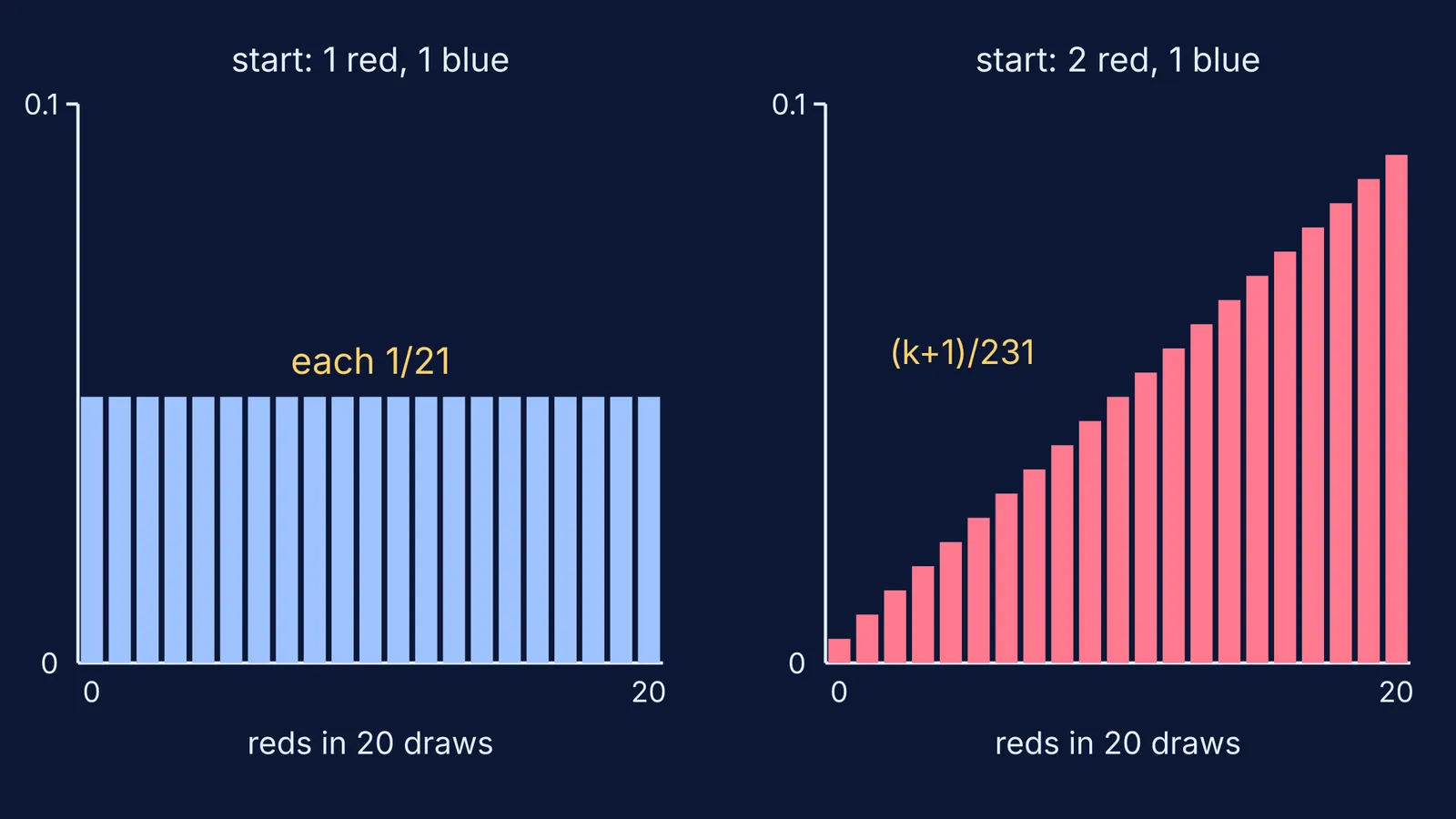
Starting from one ball of each colour, after n draws the urn is equally likely to hold any number of reds from 1 to n+1, each with probability 1/(n+1). The worked example above is the case n = 3. So the red fraction is spread evenly over the values 1/(n+2), 2/(n+2), up to (n+1)/(n+2). As n grows these fill the interval from 0 to 1 evenly, and the limit is uniform: ending near 10% red is exactly as likely as ending near 50%.
Other starts give a beta distribution instead. Start with 2 red and 1 blue and the limit has density 2x, so the chance the urn ends more than half red is 3/4.
Where do rich-get-richer effects show up?
The urn is a standard example of a self-reinforcing, rich-get-richer process. Robin Pemantle's survey of random processes with reinforcement covers generalised Pólya urns and discusses applications in statistics, biology and economics.
A related idea helps explain how large networks grow. Albert-László Barabási and Réka Albert's 1999 Science paper traced the scale-free, power-law spread of connections in many large networks to two mechanisms: networks keep adding new nodes, and new nodes attach preferentially to sites that are already well connected. The family resemblance to the urn is that an early lead tends to be reinforced rather than undone.
How do you solve Pólya urn questions in an exam?
Write the probability of one order as a product. The denominators rise by one each draw, whatever the colours.
Multiply by the number of orders, nCk, because every order has the same probability.
The chance that the m-th draw is red equals the starting red fraction. With 2 red and 3 blue, the 5th draw is red with probability 2/5, as is the 1st.
The expected red fraction after any number of draws equals the starting fraction.
The third point is the same idea as using symmetry in our guide to linearity of expectation with indicator variables. If urn questions trip you up, the Fermi Concept Library covers every concept in mathematics, each with its own lesson, and the Fermi Problem Library has a step-by-step solver that explains the reasoning, so you can see where a method went wrong. For where probability fits in your wider plan, read how to prepare probability and statistics for JEE Advanced.