On this page
In mathematics, a solid ball can be split into a handful of pieces that, moved only by rotations and slides, form two balls each identical to the first. It is a theorem, not a trick, and the reason it does not break physics teaches you what volume really means.
What is the Banach–Tarski paradox?
Stefan Banach and Alfred Tarski proved it in a 1924 paper in Fundamenta Mathematicae (the paper's DOI record). The Stanford Encyclopedia of Philosophy states it this way: any solid sphere "can be split into finitely many pieces which can be reassembled to form two solid spheres of the same size" (SEP, The Axiom of Choice). The same entry calls it the most spectacular of the strikingly counterintuitive consequences of the axiom of choice.
The pieces are not chunks like slices of cake; they are "infinite scatterings of points" (Wikipedia, Banach–Tarski paradox). Doubling a ball can be done with five pieces, and fewer than five will not suffice, a result due to Raphael M. Robinson (Wikipedia) in a 1947 paper (DOI record).
Why can't the pieces have a volume?
Volume obeys two rules: moving a shape rigidly does not change it, and a whole equals the sum of its non-overlapping parts. If every piece had a volume, the pieces would add up to V, one ball, before the move and 2V after it. That forces V = 0, which is false for a real ball.
So some of the pieces must be non-measurable sets: Lebesgue measure, the mathematician's precise notion of volume, is not defined for them (Wikipedia). Such sets were not new in 1924: Giuseppe Vitali found a non-measurable set of real numbers in 1905 (SEP).
What does the axiom of choice have to do with it?
Ernst Zermelo stated the axiom of choice in 1904, and one standard form reads: "Any collection of nonempty sets has a choice function" (SEP). In plain terms: given any family of non-empty boxes, even infinitely many with no rule for picking, you may take one item from each box.
The usual proof uses exactly that: it picks one starting point from each of infinitely many families of points, with no formula to say which. Some such choice cannot be avoided: the paradox is not a theorem of ZF, the usual axioms of set theory without choice, assuming those axioms are consistent (Wikipedia). In 1970 Robert Solovay published a model of set theory in which every set of real numbers is Lebesgue measurable (DOI record). Infinity can upset intuition in probability too; compare our piece on the St Petersburg paradox and its coin game worth infinity.
How does the free group trick work?
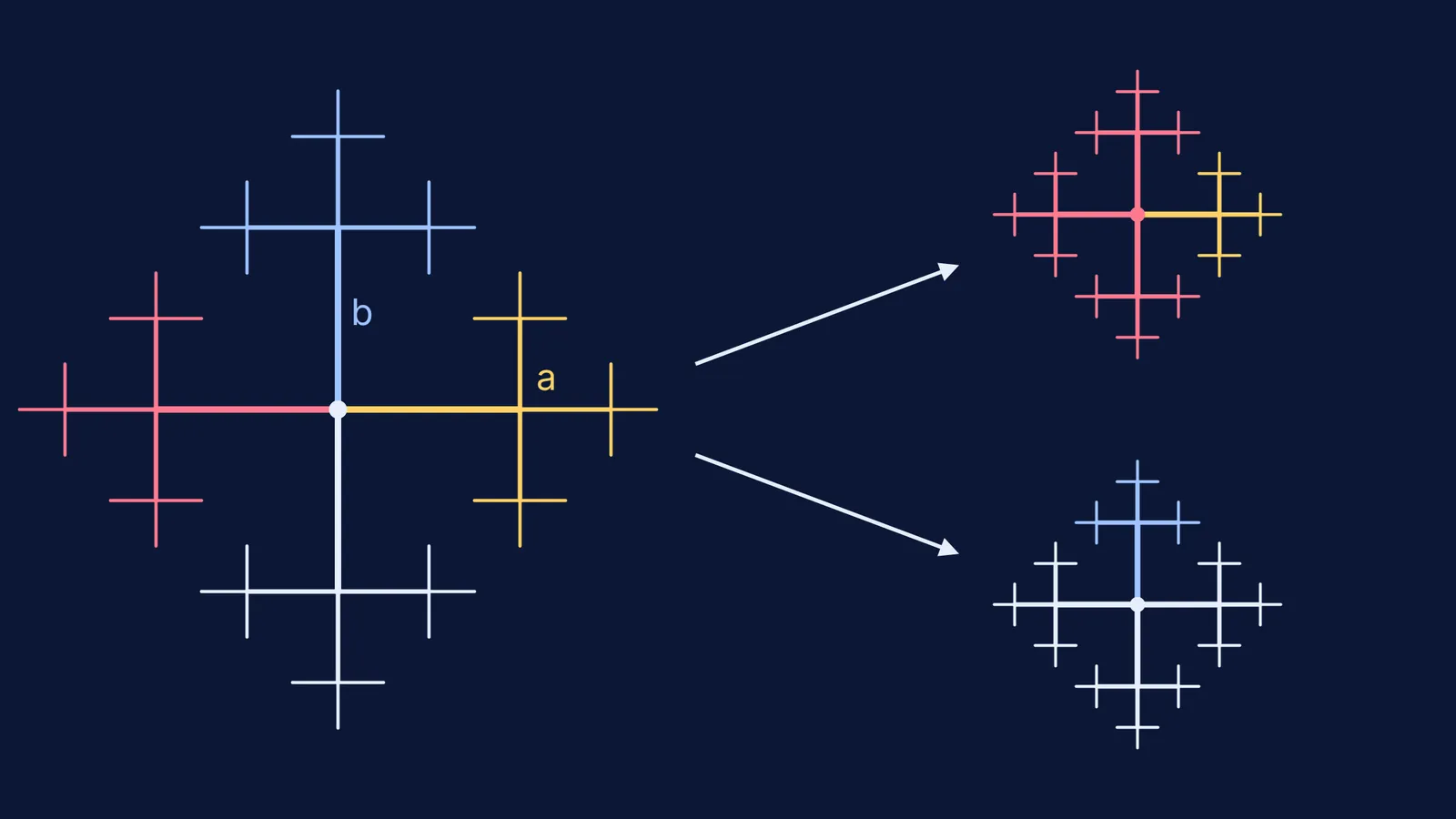
This is the heart of the proof, and it fits on paper. Take two letters, a and b, and their reverses a⁻¹ and b⁻¹. Write words with them, always cancelling a letter that sits next to its reverse, so a a⁻¹ b becomes just b. These words form the free group on two generators (Wikipedia).
Sort every word except the empty one into four piles by its first letter: S(a), S(a⁻¹), S(b), S(b⁻¹).
Take the pile S(a⁻¹) and put an a in front of every word. Then a·a⁻¹b becomes b, a·a⁻¹a⁻¹ becomes a⁻¹, and a·a⁻¹ becomes the empty word.
Check what you get: every word that does not start with a. Add the pile S(a) and you have the whole group again.
Do the same with S(b⁻¹) and S(b). Two piles made one full copy; the other two piles make a second.
Four piles of one group become two whole groups. To carry this to a ball, take two rotations, each by the angle arccos(1/3), one about the x axis and one about the z axis (Wikipedia). They behave like a and b. Each point of the sphere gets an orbit labelled by words, the axiom of choice picks one point per orbit, and the four piles of words become four pieces of the sphere. Further steps handle leftover points and the inside of the ball.
The strong form of the paradox is false in one and two dimensions. There the group of rigid motions is solvable, while in three dimensions it contains a free group with two generators (Wikipedia). If groups are new to you, start with our explainer on Lagrange's theorem and the order of a group.
How should you study a result like this?
Do the free-group check by hand for every reduced word of length two.
List the assumptions behind each obvious rule. Volume adding up is only promised for measurable sets.
Separate what is proved from what it is about: a theorem on point sets says nothing about copying gold.
Ask what breaks if you drop one axiom. Without some form of choice, the proof cannot pick its starting points.
If measure, groups or set theory feel shaky, the Fermi Concept Library covers every concept in mathematics, each with its own lesson and its place in the map, so you can see what this result rests on.