On this page
NCERT's chapter on chemical bonding fills the molecular orbitals of Be₂, finds a bond order of zero, and says the molecule "also does not exist". That is the answer you should write in the exam. It is also a prediction from a simple model, not a measurement. In 2009 a spectroscopy experiment showed that Be₂ is a real molecule held together by about 10 kJ/mol. This post shows how big that is, why simple MO theory misses it, and what to write when the question comes up.
What does NCERT say about Be₂?
In the NCERT Class 11 chapter on chemical bonding, section 4.8 defines bond order as half of (bonding electrons − antibonding electrons). It then states that a positive bond order means a stable molecule, while "a negative or zero bond order means an unstable molecule". After working through He₂, it adds that the Be₂ molecule, σ1s² σ*1s² σ2s² σ*2s², "also does not exist".
The counting is simple. Each Be atom has 4 electrons, so Be₂ has 8:
Bonding electrons: σ1s² and σ2s², so 4.
Antibonding electrons: σ*1s² and σ*2s², so 4.
Bond order = (4 − 4)/2 = 0.
If you count only valence electrons, you get σ2s² σ*2s² and (2 − 2)/2 = 0.
Is Be₂ really a bound molecule?
Yes. The first calculations predicted that two Be atoms simply repel each other. Better calculations from the late 1970s onwards said the molecule is weakly bound, as summarised by Lesiuk and co-workers in a 2018 paper. Experiments in the 1980s saw only a few vibrational levels, and their well-depth estimate of 790 ± 30 cm⁻¹ was too low.
In 2009, Merritt, Bondybey and Heaven recorded spectra that, in the words of their Science abstract, "sample all the bound vibrational levels" of Be₂'s ground state. The abstract notes more than 100 earlier theoretical studies giving "a wide range of bond lengths and dissociation energies", and ends: "After more than 70 years of research on this problem, the experimental data and theoretical models for the dimer are finally reconciled."
The abstract gives no numbers. The values below are the ones the 2018 arXiv paper quotes for the 2009 experiment, next to its own calculation:
Well depth, Dₑ (bottom of the energy curve to separated atoms): 929.7 ± 2.0 cm⁻¹ from experiment; 934.5 ± 2.5 cm⁻¹ calculated.
Dissociation energy, D₀ (from the lowest vibrational level): 806.53 cm⁻¹ from experiment; 808.0 cm⁻¹ calculated.
Bond length, Rₑ: 2.4536 Å (about 245 pm) from experiment; 2.4425 Å calculated.
Eleven vibrational levels were characterised in the experiment, and later theory found a twelfth, very weakly bound one. The authors of a 2011 review put it in one line: "The beryllium dimer has a formal bond order of zero, but the molecule is weakly bound."
Worked example: how strong is the Be–Be bond?
Spectroscopists report energies in wavenumbers (cm⁻¹). Convert to kJ/mol to compare with textbook bond enthalpies.
Find the conversion factor. Energy per mole = h × c × (wavenumber) × Nₐ. With h = 6.626 × 10⁻³⁴ J s, c = 2.998 × 10¹⁰ cm/s and Nₐ = 6.022 × 10²³ mol⁻¹, 1 cm⁻¹ = 11.96 J/mol = 0.01196 kJ/mol.
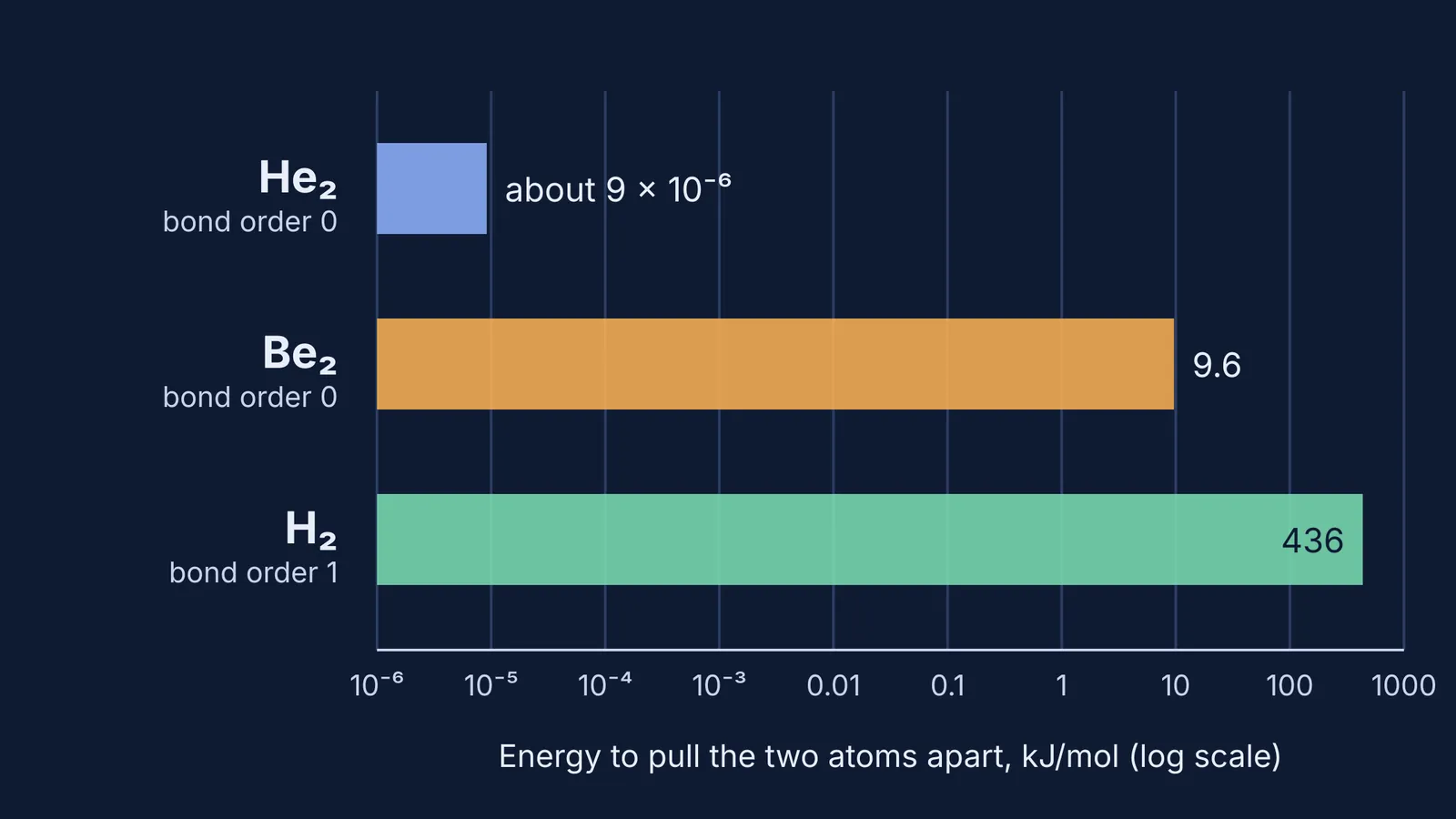
Convert the well depth. Dₑ = 929.7 × 0.01196 = 11.12 kJ/mol.
Convert the dissociation energy. D₀ = 806.53 × 0.01196 = 9.65 kJ/mol. The two differ by 123 cm⁻¹ (1.47 kJ/mol), which is the zero-point vibrational energy. Do not mix them up.
Compare with thermal energy. At 298 K, RT = 8.314 × 298.15 / 1000 = 2.48 kJ/mol. So D₀ ≈ 3.9 RT.
Compare with He₂. Grisenti and co-workers measured the binding energy of the helium dimer as 1.1 mK. Multiply by the Boltzmann constant and Nₐ: 1.1 × 10⁻³ K × 8.314 J/(mol K) = 9.1 × 10⁻³ J/mol = 9.1 × 10⁻⁶ kJ/mol. The ratio 9.65 / (9.1 × 10⁻⁶) is about 1.05 × 10⁶. Be₂ is held together about a million times more strongly than He₂.
Compare with H₂. NCERT gives the H–H bond enthalpy as 435.8 kJ/mol. That is about 45 times D₀ of Be₂.
So Be₂ sits between the two: far weaker than a normal covalent bond, but nothing like He₂, whose binding is tiny compared with RT at any ordinary temperature and whose atoms sit about 52 Å apart, roughly 21 times the Be₂ bond length.
For why He₂ has bond order zero and what its tiny binding really is, read why the He₂ molecule does not exist.
Why does simple MO theory miss the Be₂ bond?
Simple MO theory, the version in NCERT, uses each atomic orbital once. In Be₂ the 2s orbitals form σ2s and σ*2s, both are full, and their effects are assumed to cancel. The 2p orbitals are left empty and ignored.
That assumption is weak for beryllium. The 2018 paper says the difficulty with Be₂ "is largely due to the near-degeneracy of the 2s and 2p energy levels of the beryllium atom". In other words, Be's empty 2p orbitals are close enough in energy to matter.
A school-level picture: the σ orbitals built from 2s and from 2p have the same symmetry, so they can mix. This is the same s–p mixing that reorders the orbitals of B₂, C₂ and N₂, explained in why B₂ is paramagnetic. In Be₂, mixing gives the occupied σ*2s orbital some 2p character, which makes it less antibonding than the simple model assumes. The bonding and antibonding effects no longer cancel exactly, and a little net bonding is left.
Treat that as a picture, not the full explanation. The review notes that calculations on Be clusters are hard "owing to strong electron correlation and configuration interaction effects", and the 2018 paper needed very high-level methods to match the experiment.
For the underlying ideas, symmetry matching, orbital mixing and bond order, the Concept Library gives each concept its own lesson and its place in the map.
What should you write for Be₂ in JEE and NEET?
Write NCERT's answer. Be₂ questions test MO filling and counting, not the 2009 experiment.
Configuration: σ1s² σ*1s² σ2s² σ*2s² (or KK σ2s² σ*2s²).
Bond order = (4 − 4)/2 = 0.
Conclusion: MO theory predicts Be₂ is not a stable molecule.
If asked why: the antibonding electrons cancel the effect of the bonding electrons.
Magnetic nature: all electrons are paired, so diamagnetic.
If you want to practise MO counting under exam conditions, Fermi Test Prep is built for JEE Main and Advanced preparation, with an AI tutor that works through questions with you.
Quick checklist
Be₂ has 8 electrons; bond order = (4 − 4)/2 = 0. Write this in the exam.
Bond order zero is a prediction from simple MO theory, not a measurement.
Experiment (Merritt et al., 2009): Dₑ = 929.7 cm⁻¹ ≈ 11.1 kJ/mol, D₀ = 806.5 cm⁻¹ ≈ 9.65 kJ/mol, bond length ≈ 245 pm.
Dₑ is the well depth; D₀ is measured from the lowest vibrational level.
Be₂ is about a million times more strongly bound than He₂, and about 45 times more weakly than H₂.
The usual reason given is the closeness of Be's 2s and 2p levels; the full story needs electron correlation.