On this page
NCERT tells you that an element's reference state is its most stable form, and that ΔfH° of an element in its reference state is zero. Then a question gives you ΔfH° = 0 for white phosphorus. White phosphorus is the most reactive form of phosphorus, the one stored under water. Both statements are in use, and phosphorus is where they collide. This post shows what the standard data tables actually do, how much more stable red phosphorus is, and what to write in the exam.
What does NCERT say a reference state is?
The NCERT Class 11 thermodynamics chapter defines the standard enthalpy of formation using elements "in their most stable states of aggregation (also known as reference states)". It then says: "The reference state of an element is its most stable state of aggregation at 25°C and 1 bar pressure." Its examples are H₂ gas, O₂ gas, graphite and rhombic sulphur, and it adds that ΔfH° of an element in its reference state "is taken as zero".
For those four elements, the rule works. Graphite is both the most stable form of carbon and the zero. Phosphorus is not mentioned, and phosphorus is the exception.
Which form of phosphorus has ΔfH° = 0?
White phosphorus. The two open reference tables agree:
The CODATA Key Values for Thermodynamics list "P, cr, white" with ΔfH° = 0 and S° = 41.09 ± 0.25 J K⁻¹ mol⁻¹. The page explains that a value of 0 for an element "indicates the reference state for that element". There is no row for red phosphorus.
The NIST-JANAF table for white phosphorus gives ΔfH° = ΔfG° = 0 at 298.15 K and S° = 41.077 J K⁻¹ mol⁻¹. JANAF's table for phosphorus in its reference state is the white phosphorus table up to its melting point.
Note what is not zero. CODATA gives P₄(g) ΔfH° = +58.9 kJ/mol and P(g) +316.5 kJ/mol. The zero belongs to solid white phosphorus only.
The site's explainer on why elements in their reference state have zero enthalpy lists white phosphorus among the zeros. That matches the tables. What it does not spell out is that phosphorus breaks the "most stable form" rule, which is the gap this post fills.
How much more stable is red phosphorus?
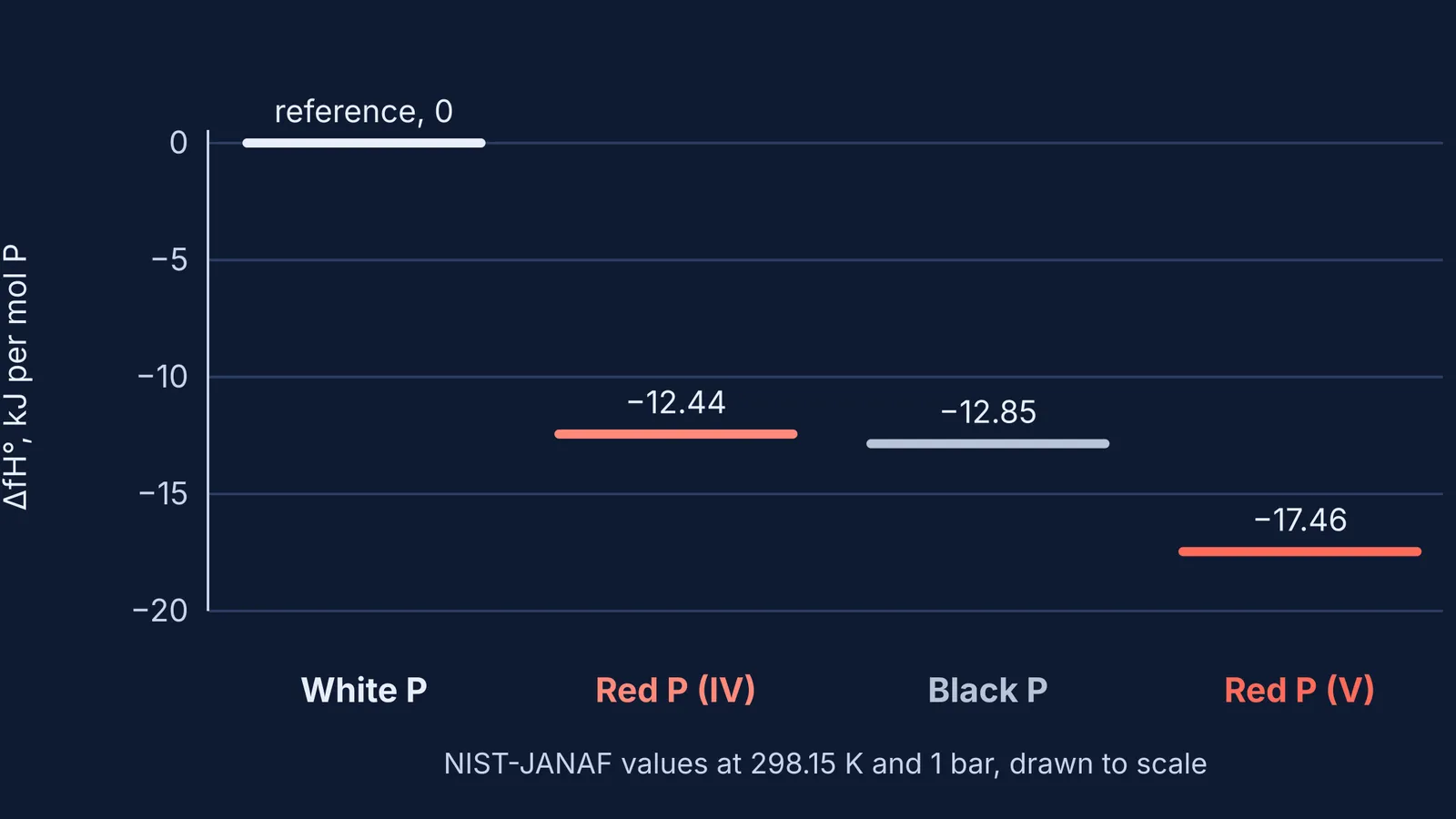
Red phosphorus has a negative ΔfH°, because forming it from white phosphorus releases heat. "Red phosphorus" is not one well-defined solid, and JANAF has separate tables for two crystalline red forms. At 298.15 K, per mole of P:
Red phosphorus V: ΔfH° = −17.460 kJ/mol, ΔfG° = −12.026 kJ/mol, S° = 22.853 J K⁻¹ mol⁻¹.
Red phosphorus IV: ΔfH° = −12.439 kJ/mol, ΔfG° = −7.108 kJ/mol.
Black phosphorus: ΔfH° = −12.851 kJ/mol, ΔfG° = −7.338 kJ/mol.
Other sources give different numbers. The site's post on white, red and black phosphorus quotes −17.6 kJ/mol for red and −39.3 kJ/mol for black from Wikipedia, which also calls black phosphorus the stable form. JANAF instead puts red V lowest. Which of red and black is most stable depends on the table and the exact form, so do not memorise one ordering. What every source agrees on is the point that matters here: white phosphorus is the least stable of these forms, and it is still the zero.
Worked example: white to red phosphorus
Find ΔH°, ΔG° and ΔS° at 298.15 K for P₄(s, white) → 4P(s, red V), using the JANAF values.
Check the balance. 4 P atoms on each side. Balanced.
ΔH°. ΔH° = 4 × ΔfH°(red V) − 1 × ΔfH°(white, per P₄) = 4 × (−17.460) − 0 = −69.84 kJ per mol P₄. The reaction is exothermic.
ΔG°. ΔG° = 4 × (−12.026) − 0 = −48.10 kJ per mol P₄. Negative, so the conversion is thermodynamically spontaneous at 298 K.
ΔS°. Per mol P, ΔS° = 22.853 − 41.077 = −18.224 J K⁻¹ mol⁻¹, so −72.90 J K⁻¹ per mol P₄. Check it with ΔG = ΔH − TΔS per mol P: −17.460 − 298.15 × (−0.018224) = −12.027 kJ/mol, which matches JANAF's −12.026.
Interpret. The change is downhill, yet white phosphorus does not turn red on its own at room temperature; red phosphorus is made by heating white phosphorus. Spontaneous does not mean fast. See thermodynamic vs kinetic stability for the general idea.
A Hess's-law consequence: burning one mole of red phosphorus (form V) to the same oxide releases 17.46 kJ less heat than burning one mole of white phosphorus, because red starts 17.46 kJ/mol lower.
Why was white phosphorus chosen as the reference?
Neither the CODATA page nor the JANAF tables give a reason. The explanation you will often see (Wikipedia's white phosphorus article gives it, without a source) is that white phosphorus is easier to purify and handle as a well-defined substance for collecting reference data. That fits the facts above: white phosphorus is made of identical P₄ molecules, while "red phosphorus" covers several forms with different values. Treat the reason as plausible, not as something to quote as a rule.
The key idea for you is simpler. A reference state is a convention. Usually the convention picks the most stable form; for phosphorus, the tables pick white.
What should you write in the exam?
"ΔfH° = 0 for white phosphorus, P₄(s), not for red phosphorus."
In a definition: "the reference state is usually the most stable form of the element at 1 bar and the given temperature; phosphorus is an exception, where white phosphorus is taken as the reference."
For red phosphorus, ΔfH° is negative (about −17 kJ/mol per mol P; tables differ slightly).
An option claiming ΔfH°(red P) = 0 is wrong.
Gaseous P₄ and P atoms have positive ΔfH°.
To practise reference-state traps alongside other thermodynamics questions, Fermi Test Prep is built for JEE Main and Advanced preparation, and its Concept Library gives each chemistry concept, including standard states, its own lesson.
Quick checklist
NCERT: reference state = most stable form at 25 °C and 1 bar; ΔfH° = 0 for it.
Phosphorus is the exception: CODATA and JANAF both set white P = 0.
Red P (JANAF, form V): ΔfH° = −17.46, ΔfG° = −12.03 kJ/mol at 298.15 K.
P₄(white) → 4P(red V): ΔH° = −69.8 kJ, ΔG° = −48.1 kJ, spontaneous but slow.
Only solid white P is zero; P₄(g) and P(g) are positive.
The reason for choosing white P is not stated in the tables; don't present one as fact.