

On this page
"Diamonds are forever" is a great marketing slogan, but in chemistry, it is only half true. Under normal conditions, every diamond on Earth is naturally trying to turn into pencil lead (graphite).
Why doesn't it happen? The answer lies in the difference between thermodynamic stability (what the universe wants to happen) and kinetic stability (how fast it actually happens). Understanding this difference is essential for physical chemistry, where mixing up these two concepts is a common source of lost marks.
What is thermodynamic stability?
Thermodynamic stability is about the start and end points of a reaction, ignoring how you get between them. It asks: which state has lower overall energy?
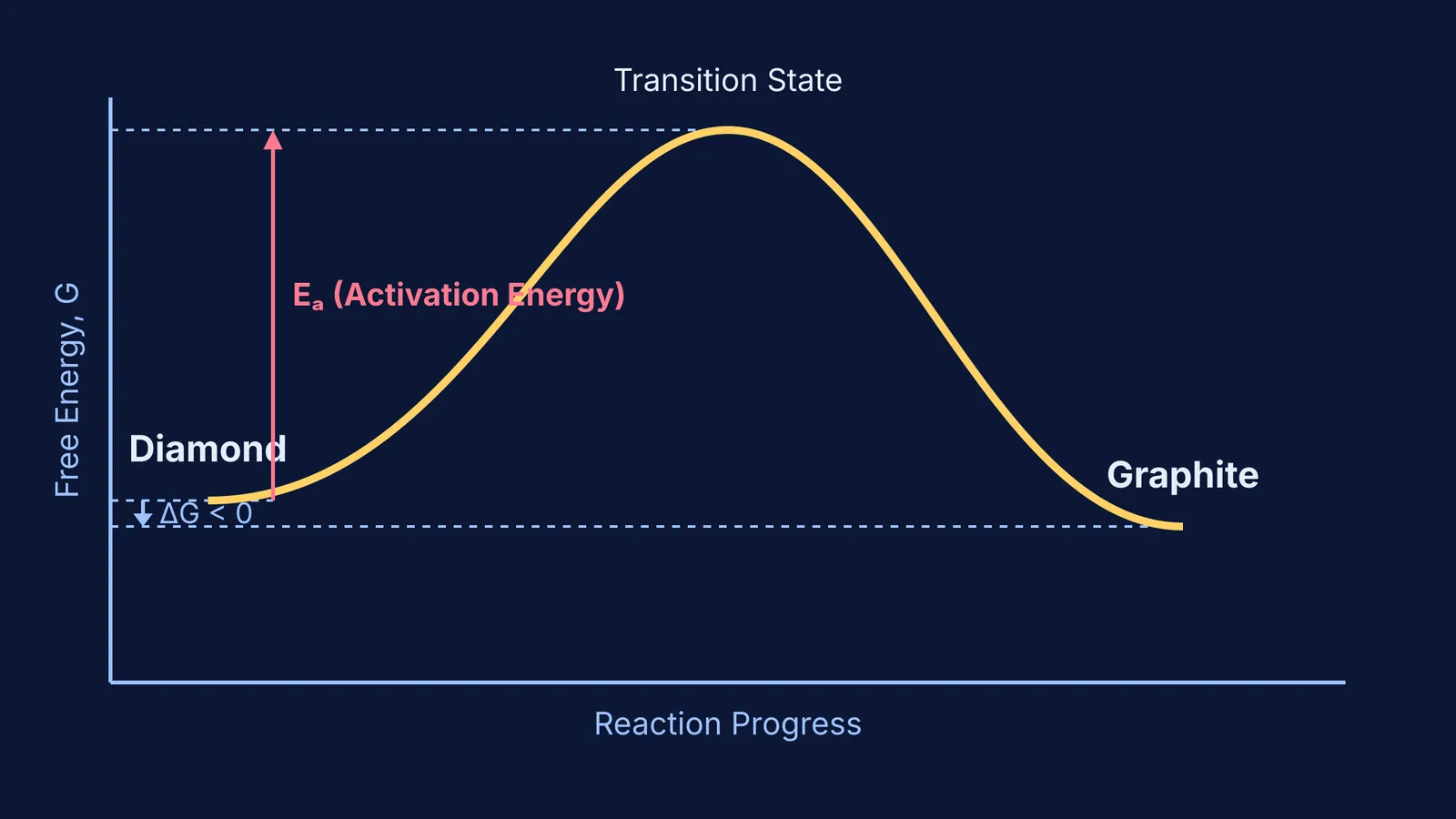
Systems naturally move toward their lowest energy state. At standard room temperature and pressure, graphite is the standard, lowest-energy state of carbon (Wikipedia). The Gibbs free energy of formation (ΔG_f°) for graphite is lower than for diamond. Because the conversion of diamond to graphite releases energy (ΔG < 0), it is a spontaneous process.
In thermodynamic terms, graphite is the stable form of carbon. Diamond is less stable. It is often called "metastable" because it is trapped in a higher-energy state, unable to reach the lower-energy graphite state under its own power.
What is kinetic stability?
Kinetic stability is about the journey between the start and end points. It asks: how fast does the reaction go?
For a diamond to become graphite, it cannot just instantly change its shape. The carbon atoms must physically rearrange. They have to break the strong sp³ covalent bonds that lock every atom into a rigid three-dimensional lattice, and then reform those bonds into the flat, hexagonal sp² sheets that make up graphite.
The activation energy barrier
Breaking those initial sp³ bonds requires a massive input of energy, called the activation energy (Eₐ). For the diamond-to-graphite transition, this barrier requires a massive amount of energy to start breaking strong carbon-carbon bonds.
This is where the two types of stability split:
Thermodynamics says the ball is on a hill and wants to roll down into the valley (graphite) because it is a lower energy state.
Kinetics says the ball is sitting in a very deep crater at the top of that hill. It needs a huge push (activation energy) to get out of the crater before it can roll down into the valley.
At room temperature, the carbon atoms simply do not have enough thermal energy to climb that wall. The reaction rate is so unimaginably slow that it would take millions to billions of years to measure even a microscopic change (Wikipedia). Therefore, diamond is highly kinetically stable.
The difference between "spontaneous" and "instant"
In everyday language, spontaneous means something happens suddenly and without warning. In thermodynamics, spontaneous simply means ΔG is negative—the reaction can happen without a continuous input of external energy. It says absolutely nothing about how fast it will happen.
The rusting of an old car, the radioactive decay of uranium, and the conversion of diamond to graphite are all spontaneous processes. But because of their different kinetic stabilities and activation energies, rusting takes years, uranium takes billions of years, and diamond takes even longer.
Next time you see a question asking why a spontaneous reaction isn't happening in the beaker in front of you, the answer is almost always kinetic stability. The reaction has the thermodynamic green light, but it lacks the activation energy to get over the kinetic speed bump.
How to spot them in exam questions
When solving problems in physical chemistry, use this simple checklist to look at the language the question uses to know which rules to apply.
Testing thermodynamics: The question mentions equilibrium, ΔG, ΔH, ΔS, or asks if a reaction is "spontaneous" or "feasible". You should look strictly at the start and end energies. Activation energy does not matter here.
Testing kinetics: The question mentions rate, activation energy (Eₐ), catalysts, or asks "how fast" something happens. You should look at the size of the energy barrier. A catalyst will lower the activation energy and change the rate, but it will never change the thermodynamics or the equilibrium position.
The Fermi Concept Library maps out thermodynamics and kinetics as separate but connected ideas, showing you how changes in temperature affect both the equilibrium position and the rate of reaction. When you attempt a numerical problem and apply the wrong set of rules, the Fermi Problem Library will step in. Instead of just printing the answer, the AI tutor will spot the error in your reasoning, draw the energy profile, and help you see whether you need to calculate the reaction quotient or the rate constant.
Read more about how these ideas apply to other systems in Reaction quotient Q vs K: predicting which way a reaction moves, or see how temperature drives kinetics in Temperature coefficient of rate: why rates double every 10 °C.


