On this page
Plant Kingdom is Chapter 3 of the NCERT Class 11 Biology textbook (Reprint 2026-27). The CBSE 2026-27 Biology curriculum asks for the major plant groups, their distinguishing features and a few examples of each. For the group comparison and practice questions, see our Plant Kingdom Class 11 chapter guide.
How do biologists classify plants?
Artificial system: grouping plants by a few easy-to-see features such as habit, leaf shape or stamens. Example: Linnaeus's system, based largely on stamens. Don't confuse with: natural system.
Natural system: grouping by natural affinities, using internal features (anatomy, embryology, phytochemistry) as well as external ones. Example: Bentham and Hooker's system for flowering plants.
Phylogenetic system: grouping by evolutionary relationships, assuming members of a taxon share a common ancestor; accepted today.
Numerical taxonomy: computer-based classification that codes every observable character and weighs them all equally.
Cytotaxonomy and chemotaxonomy: classification helped by chromosome data (number, structure, behaviour) and by the plant's chemical make-up.
What are the key terms for algae?
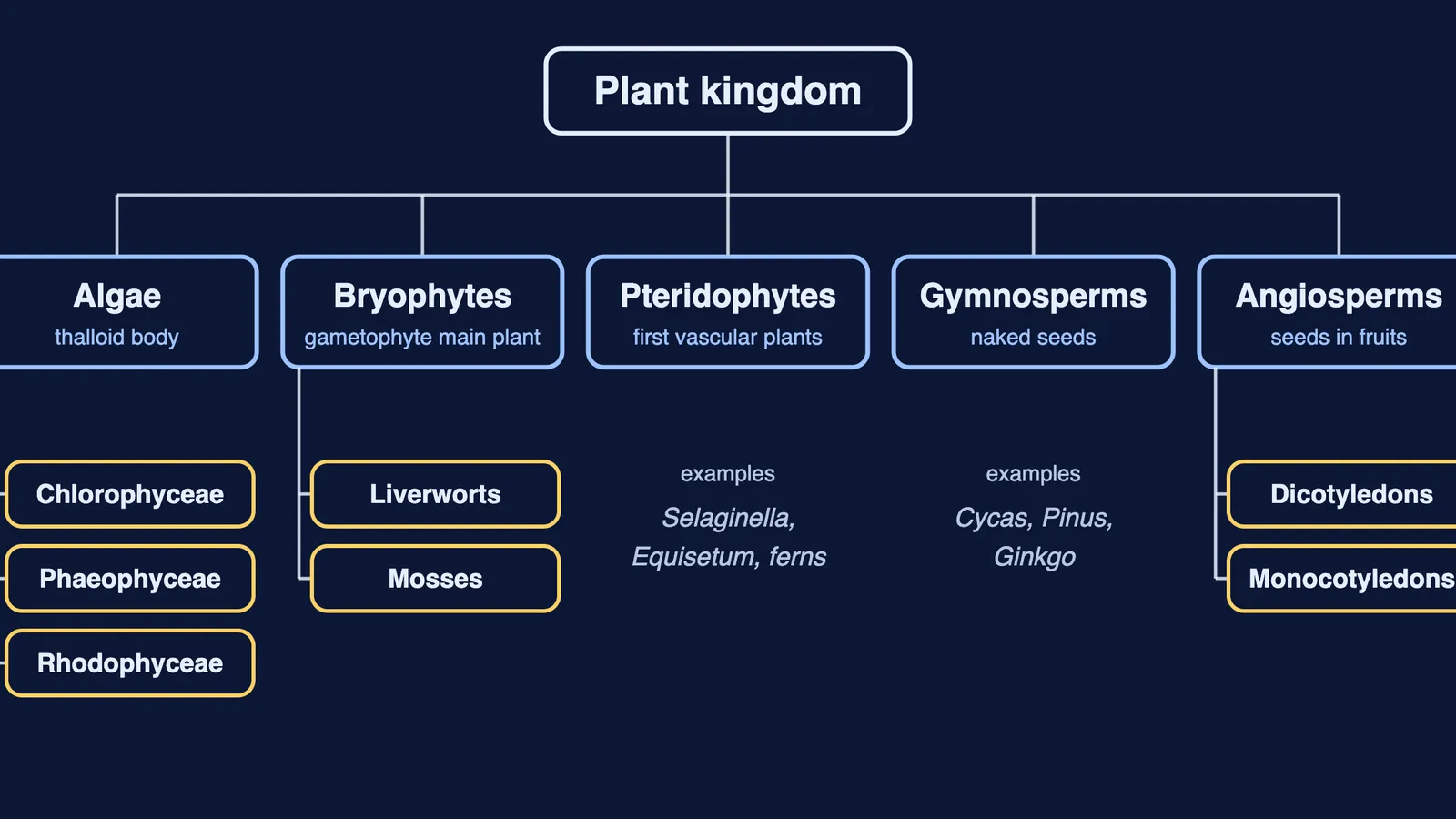
Algae: simple, thalloid, chlorophyll-bearing autotrophs, mostly aquatic. Example: Volvox (colonial), Ulothrix and Spirogyra (filamentous). The NCERT chapter no longer counts cyanobacteria (blue-green algae) as algae.
Thallus: a plant body not divided into true root, stem and leaves.
Fragmentation: vegetative reproduction where each broken piece grows into a new thallus.
Zoospore: a flagellated, swimming asexual spore.
Isogamy: fusion of two gametes of the same size, motile (Ulothrix) or non-motile (Spirogyra).
Anisogamy: fusion of two gametes of different sizes. Example: Eudorina.
Oogamy: fusion of a large, non-motile female gamete with a smaller, motile male gamete. Example: Volvox, Fucus. Don't confuse with: anisogamy, where a size difference alone is enough.
Chlorophyceae (green algae): chlorophyll a and b, food stored as starch, cell wall with inner cellulose and outer pectose. Example: Chlamydomonas, Chara.
Pyrenoid: a storage body in the chloroplast of green algae holding protein as well as starch.
Phaeophyceae (brown algae): mostly marine, with chlorophyll a and c plus the brown pigment fucoxanthin; food stored as laminarin or mannitol. Example: Laminaria, Sargassum. The body has a holdfast (anchor), a stipe (stalk) and a frond (leaf-like photosynthetic part).
Rhodophyceae (red algae): red from the pigment r-phycoerythrin, food stored as floridean starch, spores and gametes without flagella. Example: Polysiphonia, Gelidium. Don't confuse with: brown algae, whose zoospores carry two unequal flagella on the side.
Hydrocolloids: water-holding substances from seaweeds, such as algin (brown algae) and carrageen (red algae).
What do gametophyte and sporophyte mean in bryophytes?
Bryophytes: liverworts and mosses, called the amphibians of the plant kingdom because they grow on land but need water for sexual reproduction.
Rhizoids: single-celled or many-celled threads that fix a bryophyte to the soil, not true roots.
Gametophyte: the haploid plant body that makes gametes; in bryophytes it is the main plant. Don't confuse with: sporophyte.
Antheridium: the male sex organ; it releases biflagellate antherozoids (male gametes) that swim to the egg.
Archegonium: the flask-shaped female sex organ, holding a single egg.
Sporophyte: the diploid body that grows from the zygote and makes haploid spores by meiosis. In bryophytes it stays attached to the gametophyte and draws food from it; it has a foot, seta and capsule.
Gemmae: green, multicellular asexual buds formed in gemma cups on a liverwort thallus; each grows into a new plant. Example: Marchantia.
Protonema: the first stage of a moss gametophyte: a green, branched, mostly thread-like growth that comes straight from a spore and later buds into leafy shoots. Example: Funaria.
What are the key terms for pteridophytes?
Pteridophytes: horsetails and ferns, the first land plants with vascular tissue (xylem and phloem). The main plant is a sporophyte with true roots, stems and leaves.
Microphylls and macrophylls: small leaves (Selaginella) and large leaves (ferns).
Sporophyll: a leaf-like appendage that bears sporangia.
Strobilus (cone): a compact cluster of sporophylls. Example: Selaginella, Equisetum.
Prothallus: the gametophyte of a pteridophyte, a small, multicellular, thalloid body that lives independently and usually photosynthesises; it grows only in cool, damp, shady spots.
Homosporous: producing one kind of spore, as most pteridophytes do.
Heterosporous: producing small microspores (which form male gametophytes) and large megaspores (which form female gametophytes). Example: Selaginella, Salvinia. Keeping the female gametophyte, and the embryo inside it, on the parent is a precursor to the seed habit.
What separates gymnosperms from angiosperms?
Gymnosperms: plants whose ovules are not enclosed by an ovary wall, so the seeds are naked. Example: Cycas, Pinus, Ginkgo.
Mycorrhiza: an association between roots and a fungus. Example: Pinus.
Coralloid roots: small specialised roots of Cycas associated with nitrogen-fixing cyanobacteria. Don't confuse with: mycorrhiza, which involves a fungus.
Microsporophyll and megasporophyll: sporophylls carrying microsporangia and megasporangia (ovules), arranged on an axis as cones. Pinus carries both cone types on one tree; Cycas carries male cones and megasporophylls on separate trees.
Ovule: the nucellus (megasporangium) with its protective envelopes. Inside, meiosis gives four megaspores; one grows into the female gametophyte with two or more archegonia.
Pollen grain: the much-reduced male gametophyte, formed in the microsporangium; its pollen tube carries male gametes to the archegonia.
Angiosperms: flowering plants, which form pollen and ovules inside flowers and enclose seeds in fruits. Example: from tiny Wolffia to Eucalyptus trees that the NCERT chapter puts at over 100 metres. Don't confuse with: gymnosperms, which also bear seeds, but naked ones.
Dicotyledons and monocotyledons: the two classes of angiosperms.
The 2026-27 chapter has no section on life-cycle patterns, so haplontic, diplontic and haplo-diplontic are not defined here, though exercise 8 still lists "diplontic".
How to learn these terms
Learn in pairs: gametophyte vs sporophyte, isogamy vs anisogamy vs oogamy, homosporous vs heterosporous, mycorrhiza vs coralloid roots, gymnosperm vs angiosperm.
Draw a moss with its sporophyte on top; label foot, seta, capsule, leaves and rhizoids, and mark each part n or 2n.
Make one card per algal class with four rows: pigment, stored food, flagella, example.
Tie each term to one organism: gemmae to Marchantia, protonema to Funaria, heterospory to Selaginella, coralloid roots to Cycas.
If a term stays vague, the Fermi Concept Library gives each biology concept its own lesson and its place in the map.
For NEET, see plant kingdom for NEET and commonly confused plant biology terms.